he World Cup is usually sold through trophies, superstars and rivalries. Yet the details that supporters repeat to their friends are often much stranger.
A famous surname has returned in an unexpected goal. A message ignored for nine months eventually led to the biggest stage in football. Players from rival countries and competing sportswear brands have somehow arrived wearing the same colour boots. One squad contains a teenager and a goalkeeper separated by more than a quarter of a century.
With 48 countries and 1,248 players, World Cup 2026 is not one story. It is a collection of thousands, and some of the best have little to do with the final score.
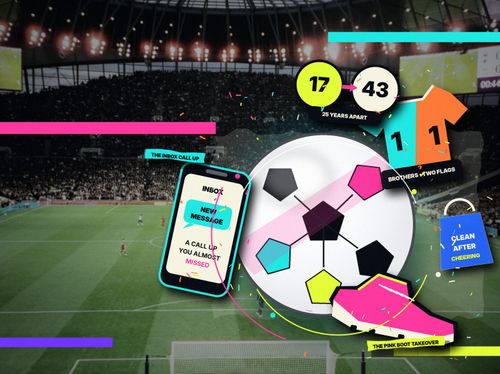
1. Four sets of brothers arrived wearing different national shirts
For four families, supporting the World Cup means following two flags.
Désiré Doué represents France, while his older brother Guéla plays for Côte d’Ivoire. Nico Williams wears Spain’s colours, while Iñaki Williams represents Ghana. Brian Brobbey plays for the Netherlands, while his half brother Derrick Luckassen joined Ghana as an injury replacement. John Souttar represents Scotland, while his younger brother Harry plays for Australia.
None of the four pairs were scheduled to meet during the group stage, but the knockout rounds could still create an extraordinary family reunion.
There is a rare precedent. Jérôme Boateng played for Germany against his half brother Kevin Prince Boateng of Ghana at both the 2010 and 2014 World Cups. Until now, they were the only brothers to face one another at the tournament.
The question is irresistible. What happens when one brother’s greatest football memory becomes the other brother’s worst?
2. A message that looked like spam led Roberto Lopes to the World Cup
Roberto “Pico” Lopes did not discover his international future through an agent, a scout or a dramatic telephone call.
He found it on LinkedIn.
The Dublin born defender received a message in Portuguese from the Cape Verde football setup. He did not understand it, assumed it was spam and ignored it. Nine months later, another message arrived in English. Lopes finally translated the original note and learned that Cape Verde wanted him to represent the country of his father’s birth.
He made his international debut in 2019 and became an important part of the side that eventually qualified for its first World Cup.
One of the most improbable journeys to football’s largest stage began with an unread message sitting in a professional networking inbox.
3. The oldest and youngest players are separated by more than 25 years
Scotland goalkeeper Craig Gordon was 43 years and 162 days old when the tournament opened. Mexico midfielder Gilberto Mora was 17 years and 240 days old.
That gap is large enough for one player to have completed an entire professional career before the other was born.
Mora then added another piece of history when he came on against South Africa. He became Mexico’s youngest World Cup player and the youngest footballer ever to appear for a host nation at the tournament. He had already become the youngest player to make an official senior appearance for Mexico at the age of 16.
Gordon represents extraordinary survival at the highest level. Mora represents a future arriving much earlier than expected. World Cup 2026 has both stories in the same competition.
4. Lionel Messi’s record equalling hat trick arrived on a perfect date
On June 16, 2006, an 18 year old Lionel Messi came off the bench against Serbia and Montenegro and scored his first World Cup goal.
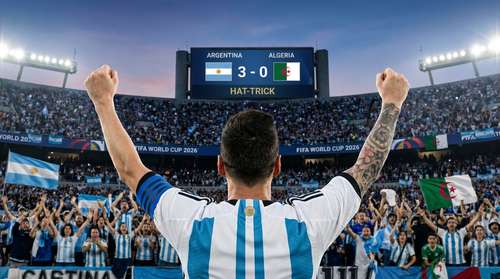
Exactly 20 years later, on June 16, 2026, he scored three times against Algeria.
The hat trick moved Messi level with Miroslav Klose on 16 World Cup goals and made him the oldest player to score three in a match at the tournament. It also came during his 200th appearance for Argentina and his first match at a sixth World Cup.
Football produces coincidences every season. Very few feel as carefully written as this one.
A teenager announced himself to the world on one June evening. Two decades later, on the same date, the veteran version of that player reached the top of the World Cup scoring list.
5. Zidane returned to the World Cup in Algeria’s goal
The name is familiar, but the position and national shirt are not.
Luca Zidane is the son of Zinedine Zidane, the French legend who inspired his country to the 1998 World Cup title. Luca is a goalkeeper, not an attacking midfielder, and he represents Algeria.
After playing for France at youth level, he changed his international allegiance in 2025. He qualified for Algeria through his paternal grandparents, who came from the Kabylie region.
His first World Cup match brought an almost cinematic opponent. Algeria opened against Argentina, Zinedine watched from the crowd and Messi scored a hat trick past Luca.
The Zidane surname had returned to the World Cup, but in a story no one from 1998 could have predicted.

6. Messi, Ronaldo and Ochoa all reached a sixth World Cup in different ways
Lionel Messi, Cristiano Ronaldo and Guillermo Ochoa were all named to a sixth World Cup squad, a tournament record.
The detail becomes more interesting when the appearances are separated from the selections.
Messi and Ronaldo had played at every World Cup since 2006. Ochoa was also selected in 2006 and 2010, but he did not appear in either tournament. He later became one of Mexico’s defining World Cup players through memorable performances in 2014, 2018 and 2022.
Ronaldo entered the 2026 tournament as the only man to have scored in five different editions. Messi arrived with the men’s record for World Cup appearances, then became the first man to take the field at six tournaments.
The phrase “six World Cups” sounds simple. In reality, it contains three very different careers.
7. More than 70% of the players were new to a World Cup squad
The familiar stars attract the cameras, but most of the tournament is experiencing this stage for the first time.
Of the 1,248 players named in the original squads, 357 had previously been included in a World Cup squad. The other 891 had not.
That does not mean they were inexperienced footballers. Many had played in major leagues, continental tournaments and intense international matches. It means they had never previously entered this particular environment, where one mistake can follow a player for years and one goal can transform an unknown name into a national hero.
World Cup 2026 may contain some of the oldest icons in football, but numerically it belongs to the newcomers.

8. Manchester City supplied 19 players to the tournament
The original squad lists contained players from 449 clubs in 71 countries.
England based clubs supplied 200 players, more than any other country. Manchester City led every individual club with 19 representatives. Bayern Munich followed with 18, while Arsenal and Paris Saint Germain supplied 16 each.
This creates one of the World Cup’s most fascinating reversals. Players who train together for most of the year suddenly spend a month studying one another as opponents.
A defender knows which way his club teammate prefers to turn. A goalkeeper has faced his teammate’s penalties hundreds of times in training. A midfielder recognises the run before it begins.
At club level, that knowledge creates chemistry. At the World Cup, it can become intelligence.
9. Pink became the tournament’s unofficial colour
Look down during almost any match and the same colour appears again and again.
Dozens of players have worn bright pink boots, including Kylian Mbappé, Vinícius Júnior, Cristiano Ronaldo, Erling Haaland, Jude Bellingham, Lamine Yamal and Giovanni Reyna.
This is not the work of one company. Nike, Adidas, Puma, Skechers and New Balance all produced pink designs for the tournament. The colour was chosen partly because it stands out clearly against the green pitch and remains highly visible in photographs, television coverage and social media clips.
The teams represent 48 countries. The boot brands compete fiercely. Yet many of the tournament’s biggest stars look as though they followed the same dress code.
10. Japanese supporters use the same bags to cheer and clean
Japanese fans have turned an ordinary plastic bag into one of the World Cup’s most recognisable symbols.
Before and during matches, supporters wave blue rubbish bags in the air to add colour to the stands. After the final whistle, those same bags are used to collect cups, wrappers and other waste left around the seats.
The tradition continued after Japan’s 4 to 0 victory over Tunisia in Monterrey. Local authorities had arranged for 20,000 bags to be distributed after requests from Japanese supporters.
For the fans taking part, the practice is not a performance for the cameras. It reflects the idea that a shared space should be left ready for the next person.
Most supporters leave a stadium carrying memories. Japan’s supporters often leave carrying the rubbish as well.
11. Brazil brought 23 tournaments of history, while four countries brought none
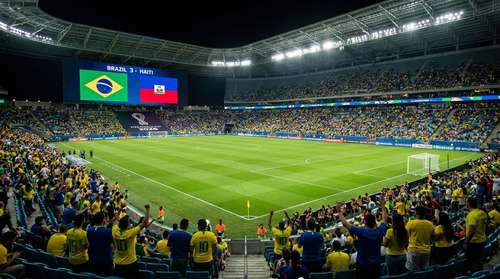
Brazil are the only nation to have appeared at every men’s World Cup. The 2026 tournament is their 23rd.
At the other end of the historical scale, Cape Verde, Curaçao, Jordan and Uzbekistan arrived as first time participants. Their inclusion raised the total number of countries that have played at a men’s World Cup to 84.
The contrast captures the competition perfectly.
One country arrived carrying almost a century of World Cup memories. Four others arrived without a previous match, goal, victory or point at the tournament.
Once the whistle blew, all that history had to prove itself again.
The strange details are what make the World Cup addictive
Results determine who advances, but details determine which stories survive.
Supporters will remember the brothers wearing different colours, the LinkedIn message that almost went unanswered, the teenager sharing a tournament with a 43 year old goalkeeper, the Zidane name appearing for Algeria and the wave of pink boots moving across green pitches.
That is the real advantage of a World Cup containing 48 teams and 1,248 players. It creates more than additional matches. It creates more routes into the story.
And somewhere in the remaining games, the strangest detail of World Cup 2026 may still be waiting to happen.