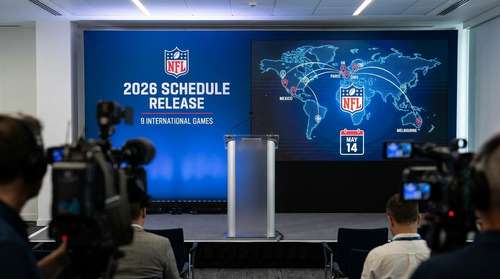
The wait is almost over for football fans. The National Football League officially announced on Friday that the highly anticipated 2026 NFL schedule release is set for Thursday, May 14, at 8 p.m. ET. Broadcast live across NFL Network, ESPN2, and the NFL+ app, the reveal event has evolved into a major offseason spectacle. However, the most compelling storyline for the upcoming campaign is already clear: the league is taking its global footprint to unprecedented heights. With a record-breaking slate of nine overseas matchups spanning four continents, seven countries, and eight different stadiums, the upcoming season will redefine American football's international presence.
A Historic Global Footprint: NFL International Games 2026
The sheer scale of the NFL international games 2026 lineup is a logistical marvel. Utilizing sophisticated scheduling algorithms powered by Amazon Web Services (AWS), the league had to account for time zone differences, travel fatigue, and competitive fairness for all 32 franchises. Before the complete 272-game schedule is broadcast on Thursday, the NFL will formally announce the remaining details of its international slate on Wednesday, May 13, during Good Morning Football. This year's global series requires unparalleled coordination between the league, international broadcasters, and local municipalities. While several massive overseas matchups have already been confirmed, creating a wave of excitement across new fanbases, the final dates and kickoff times remain the missing pieces to the puzzle.
Groundbreaking Debuts: Down Under and The City of Light
For the very first time, regular-season football is heading to the Southern Hemisphere. The highly anticipated NFL Melbourne Australia game will feature an NFC West rivalry clash between the Los Angeles Rams and the San Francisco 49ers. Taking place at the iconic Melbourne Cricket Ground, which boasts a massive seating capacity, this matchup is expected to be a historic milestone for the sport. The game is scheduled for Thursday, September 10 (Pacific Time), introducing complex logistical challenges that the league's schedule makers have carefully navigated. The Rams, acting as the designated home team, will have their travel carefully managed to ensure adequate recovery time after returning stateside.
Equally significant is the inaugural NFL Paris game 2026. The New Orleans Saints have been designated as the home team for this historic contest at the Stade de France. Expanding into the French market is a strategic move that capitalizes on a rapidly growing European fanbase, adding Paris to an already robust rotation that includes London's Wembley and Tottenham Hotspur stadiums, Madrid's Bernabéu Stadium, and Munich's FC Bayern Munich Stadium.
Other confirmed international clashes include the Baltimore Ravens taking on the Dallas Cowboys at the legendary Maracanã Stadium in Rio de Janeiro, Brazil. Additional stops at Mexico City's Estadio Banorte guarantee that the NFL shield will be visible worldwide.
Defending Champions Take the Stage: The 2026 NFL Season Opener
While international expansion dominates the headlines, domestic fans are eagerly awaiting the league's Thursday and Sunday night pillars. The 2026 NFL season opener will feature a unique scheduling twist this year. The defending Super Bowl champion Seattle Seahawks will host the first game of the regular season on Wednesday, September 9, delivering a raucous Seattle Seahawks 2026 kickoff under the lights at Lumen Field.
Moving the traditional kickoff game to Wednesday night sets the stage for the massive Melbourne game, which will follow on Thursday, September 10. This staggering back-to-back showcase ensures the opening week will command global attention for two consecutive prime-time broadcasts before the standard Sunday slate even begins.
Navigating the Flurry of NFL Schedule Leaks
As May 14 approaches, the traditional cottage industry of NFL schedule leaks has shifted into high gear. Dedicated fans, local journalists, and analytics experts are frantically piecing together flight manifests, hotel block bookings, and stadium availability—such as competing concerts or college football games—to predict the week-by-week matrix.
Every team already knows its home and away opponents, but the sequencing is what dictates the rhythm of a season. When do the grueling three-game road trips happen? Who lands the coveted prime-time slots? Who gets short-changed by a late-season Thursday night game? These questions fuel the intense leak culture. For instance, the league has already confirmed a full Thanksgiving week slate and a highly coveted Christmas Day tripleheader. These marquee holiday dates are prime targets for schedule sleuths hoping to break the news before the major insiders do.
Select broadcast partners will formally announce a handful of premium games early next week to build momentum, but unverified rumors will undoubtedly dominate social media channels right up until the 8 p.m. ET broadcast on Thursday.
The intricacies of this year's schedule reveal demonstrate just how complex the league's operations have become. Balancing the demands of nine international games across four continents, maintaining updated flex scheduling procedures that allow a 21-day notice for Sunday-to-Thursday shifts, and ensuring competitive equity requires millions of computational runs. When the final 18-week grid is unveiled on May 14, fans can finally stop tracking the rumor mill and start booking their flights—whether they are traveling to a divisional road game, the City of Light, or all the way to Melbourne.