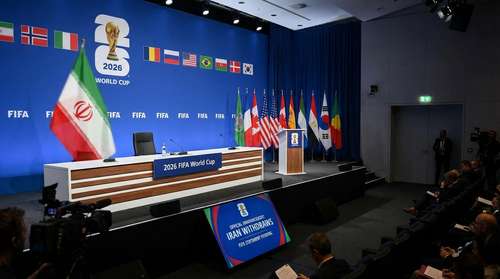
The global sports community was dealt an unprecedented shockwave this week. On Wednesday, March 11, 2026, Iran officially announced its complete departure from the upcoming men's tournament in North America. This historic Iran World Cup withdrawal comes a mere three months before the opening ceremonies, throwing international football into administrative and logistical chaos. Rooted in severe geopolitical escalation and recent military strikes in the Middle East, the decision intertwines sports and international warfare in a way rarely seen on the modern global stage.
As fans and analysts frantically search for the most accurate FIFA news today, the focus has shifted entirely to the sudden vacuum in the 2026 World Cup schedule and the desperate search for a viable FIFA replacement team. The monumental fallout stems from escalating hostilities, culminating in a series of late-February military strikes by the United States and Israel that reportedly claimed the life of Iran's Supreme Leader, Ayatollah Ali Khamenei.
Ahmad Donyamali Cites Extreme Safety Concerns
In a highly publicized televised address to the nation on Wednesday, Iran's Minister of Sport and Youth, Ahmad Donyamali, delivered the definitive verdict on Team Melli's status. Holding nothing back, the minister cited the profound human toll of the recent military engagements as the absolute barrier to their participation on American soil.
"Considering that this corrupt regime has assassinated our leader, under no circumstances can we participate in the World Cup," Donyamali firmly stated during his broadcast, directly pointing the finger at the host nation.
The minister underscored that the US Iran soccer conflict is no longer just a matter of diplomatic friction or historical rivalries, but an issue of profound national security and mourning. "Our children are not safe and, fundamentally, such conditions for participation do not exist," he added. Pointing to the recent barrage of attacks, Donyamali argued that Iran has been forced into devastating regional wars over the last several months. Sending a national sporting delegation to compete in cities across the United States, he argued, is an impossible ask when thousands of Iranian citizens have already lost their lives.
A Chaotic Shift in the 2026 World Cup Schedule
Prior to this explosive announcement, the Iranian national team, led by head coach Amir Ghalenoei, had successfully dominated their Asian qualifying group. They were slated to compete in Group G, drawn alongside formidable opponents including Belgium, Egypt, and New Zealand.
The 2026 World Cup schedule originally featured Iran playing their critical group-stage matches heavily on the West Coast of the United States. Two fixtures were booked for the massive stadium complex in Inglewood, California, with a third set for Seattle, Washington. Now, the sudden vacancy leaves ticket holders, international broadcasters, and rival teams in a state of deep uncertainty. New Zealand's All Whites, who were eagerly anticipating their opening match against Team Melli, now face an entirely unknown opponent. With host cities already preparing for the massive influx of international fans, local organizers are scrambling to adjust their security and marketing logistics.
Infantino, Trump, and the Hunt for a FIFA Replacement Team
The timing of Donyamali's announcement presents a jarring contrast to the optimistic reassurances provided by football's governing body just hours prior. Early on Wednesday morning, FIFA President Gianni Infantino took to social media to claim that U.S. President Donald Trump was completely open to hosting the Iranian squad. According to Infantino, private discussions yielded a promise that Iranian athletes would be "welcome to compete" despite the broader military crisis, pushing the narrative that "Football Unites the World".
Clearly, that diplomatic olive branch was firmly rejected by Tehran. Consequently, FIFA officials are currently locked in emergency deliberations at their Swiss headquarters to determine the fairest path forward. According to tournament regulations, any federation withdrawing within 30 days of the kickoff faces severe financial penalties. However, with three months to go, the immediate crisis is purely logistical: officially identifying and integrating a FIFA replacement team.
Speculation within the Asian Football Confederation (AFC) points heavily toward Iraq or the United Arab Emirates. Iraq, as the next highest-ranked team in the region following their strong performance in the fifth round of qualifiers, is widely considered the frontrunner to inherit the Group G vacancy. Originally, Iraq was scheduled to participate in the Inter-confederation play-offs against the winner of a Bolivia versus Suriname match on March 31. If Iraq is automatically promoted to the main tournament, the UAE could potentially take their spot in the play-off brackets.
What This Means for International Football
This dramatic Iran World Cup withdrawal represents one of the most significant geopolitical disruptions in the history of the sport. While boycotts and bans have occurred in the past, a voluntary, late-stage withdrawal by a fully qualified nation due to an active war with the tournament's host country is completely unprecedented.
Furthermore, the Iranian Football Federation president, Mehdi Taj, had previously hinted at boycotts following domestic controversies, but the sheer scale of this military conflict has cemented the final decision.
As the June kickoff rapidly approaches, the world watches closely. The coming days will demand swift, decisive action from FIFA to finalize their emergency protocols, stabilize the tournament brackets, and ensure the safety of all remaining participating nations. For now, the beautiful game finds itself tragically sidelined by the harsh realities of global conflict, leaving fans to wonder how the 2026 tournament will ultimately be remembered.