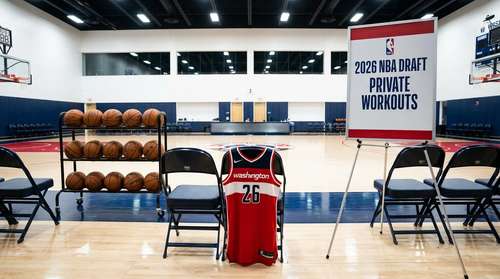
The countdown to the 2026 NBA Draft is officially in its final hours, and the basketball world has just been dealt a massive curveball. With the event set to kick off on June 23, projected top pick AJ Dybantsa has pulled back the curtain on his highly unorthodox pre-draft process. In a move that is virtually unheard of for top-tier prospects, the 19-year-old phenom confirmed that he did not participate in a single private physical workout for any NBA franchise. This shocking revelation has sent ripples through front offices and completely upended the latest NBA Mock Draft 2026 projections.
Treating the Draft Process Like Free Agency
Traditionally, the weeks leading up to draft night are an exhausting gauntlet of intense physical evaluations, one-on-one drills, and grueling conditioning tests. Prospects are expected to prove their worth on the hardwood for general managers and scouts. Dybantsa, however, decided to completely flip the script and rewrite the rules of prospect engagement.
During a recent appearance on the "Baseline Banter" podcast, the superstar forward broke down his mentality. "I didn't work out for none, I just visited the cities," he explained. "Take me to the facility, take me to dinner, talk. I don't gotta workout. They know what I can do".
This bold, unprecedented strategy treats the draft cycle more like a veteran's free agency tour than a rookie evaluation. Rather than sweating through agility drills, Dybantsa opted to use his time interviewing front offices, assessing team culture, and letting his elite college tape do the talking. It is a massive flex that only a player with immense confidence in his professional resume could realistically pull off.
A Historic BYU Basketball Draft Prospect
To understand why Dybantsa feels so secure in his standing, you only have to look at his historic 2025-26 campaign. The 6-foot-9 jumbo wing delivered one of the most dominant seasons in recent BYU basketball draft history. He led the entire nation in Division I scoring, pouring in an incredible 25.5 points per game while pulling down 6.8 rebounds and dishing out 3.7 assists.
His efficiency was equally staggering. Shooting 51.0 percent from the field and demonstrating tremendous growth from beyond the arc (33.1 percent), he rightfully captured the Julius Erving Award as the country's top small forward. Dybantsa clearly believes that dominating the collegiate landscape over a 35-game sample size provides far more actionable intel for scouts than a 45-minute empty-gym workout.
The Battle for No. 1: AJ Dybantsa vs. Darryn Peterson
While Dybantsa remains the consensus favorite, skipping workouts does introduce a sliver of risk. The Washington Wizards draft pick at No. 1 overall is arguably the most valuable asset in the league right now, and the front office is finalizing its board under intense media scrutiny.
Dybantsa isn't running unopposed. He is locked in a fiercely competitive battle with Kansas guard Darryn Peterson and Duke forward Cameron Boozer for the top overall spot. Peterson is widely regarded as a dynamic, three-level scorer who projects as a franchise-altering point guard at the next level. He took the traditional route, participating in standard interviews and reportedly showcasing his skills to solidify his standing. If Washington's brass felt slighted by Dybantsa's refusal to lace up his sneakers in their practice facility, they could easily pivot to Peterson's highly polished offensive package.
However, reports indicate that Washington, along with the Utah Jazz who hold the No. 2 overall selection, have happily hosted Dybantsa for meetings and dinners. The Wizards' front office knows exactly what the BYU standout brings to the table: an NBA-ready frame, elite shot-creation, and superstar upside.
Igniting NBA Draft Trade Rumors
Dybantsa's unique approach has inevitably sparked a flurry of last-minute NBA Draft trade rumors. With the draft order completely locked in, teams are frantically trying to read the tea leaves. If a team in the top three—whether it is Washington, Utah, or the Memphis Grizzlies at No. 3—gets nervous about drafting a player who refused to work out, it could open the door for aggressive maneuvering.
Could a blockbuster deal reshape the top of the board? Rival executives are undoubtedly monitoring the situation, wondering if they can package future first-round assets to trade up and snatch a generational talent if he slips even a single spot. The lack of private workout agility times, shooting drill percentages, and physical exertion data creates a shroud of mystery that only amplifies the tension as the clock ticks down to June 23.
What This Means for the Future of Pre-Draft Evaluations
Regardless of whose name is called first by Commissioner Adam Silver, Dybantsa's decision may permanently alter how elite prospects approach the pre-draft process. If he successfully lands at No. 1 or No. 2 overall without breaking a single sweat in a private gym, other surefire lottery picks in future classes will undoubtedly follow his blueprint.
The traditional power dynamic between teams and prospects is shifting rapidly. The modern athlete recognizes the value of their own tape and the unnecessary risk of pre-draft injuries. For Dybantsa, the message is remarkably clear: the game is played on the court during the season, not in an empty facility in June.
As the basketball world holds its breath, all eyes are fixed squarely on the nation's capital. Will the front office embrace Dybantsa's supreme confidence, or will his lack of private workouts push them toward Darryn Peterson? We will find out in a matter of days.