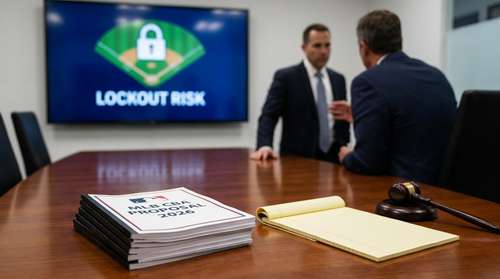
In a move that fundamentally threatens the financial architecture of America's pastime, Major League Baseball owners have officially pitched a hard salary cap of $245.3 million for the 2027 season. Delivered during the opening salvos of the MLB CBA negotiations 2026, the league's economic outline pairs that restrictive ceiling with a strict baseball salary cap floor of $171.2 million. This dramatic request has immediately drawn the ire of the union, sharply escalating the probability of an MLB labor dispute lockout before the current collective bargaining agreement expires on December 1, 2026.
Inside the Groundbreaking MLB Salary Cap Proposal 2026
The league's comprehensive offer, submitted on Thursday, May 28, represents the most aggressive shift in baseball economics in three decades. Under the proposed framework, no team would be permitted to spend above the $245.3 million limit, and every franchise would be legally bound to meet the $171.2 million minimum. Both figures calculate total payroll, which includes standard salaries, player benefits, and pre-arbitration bonus pools.
Beyond the raw payroll thresholds, the owners' pitch includes an even 50-50 revenue split between the league and the players. To sweeten the deal, MLB is also offering to centralize all local media and television rights. This centralization strategy aims to mimic the highly successful national media models utilized by the NFL and NBA. By pulling local broadcast rights under a single league-wide umbrella, owners argue they can distribute broadcasting cash equally among all 30 teams and eliminate frustrating local TV blackouts for fans.
How the Baseball Salary Cap Floor Reshapes the League
If adopted, this economic realignment would mandate seismic roster adjustments across the sport. Based on 2026 Opening Day numbers, the baseball salary cap floor would require 12 historically thrifty franchises—including the Marlins, Athletics, and Pirates—to increase their combined spending by a staggering $617 million.
Conversely, the top of the market would face extreme payroll shedding. Eight big-spending clubs would need to slash a combined $578 million from their books. Specifically, the Dodgers Yankees Mets payroll figures would take massive hits. The Los Angeles Dodgers carried an estimated $415 million luxury tax payroll into the 2026 campaign—putting them roughly $170 million over the newly proposed ceiling. The New York Mets and New York Yankees also routinely breeze past the $245 million mark.
Managing the Transition
To prevent immediate chaos, owners indicated a willingness to negotiate a phase-in schedule. They also floated the concept of "Bird rights"—a mechanism borrowed from basketball that would allow teams to exceed the cap specifically to re-sign their own homegrown talent. Importantly, the league assured the union that all existing guaranteed contracts would remain fully guaranteed, regardless of whether they push a franchise over the limit in 2027.
MLB Players Association Strike Fears Resurface
Unsurprisingly, the players' union vehemently rejected the offer. Generations of athletes have viewed a hard cap as a non-starter, and this proposal immediately resurrected the ghost of 1994, the last time owners demanded a salary ceiling. That standoff resulted in a 7.5-month MLB players association strike that wiped out the World Series and permanently scarred the sport's reputation.
Interim MLBPA Executive Director Bruce Meyer wasted no time dismissing the framework, releasing a statement that categorized the system as a mechanism that "suffocates competition" and acts as "an all-purpose excuse for inaction and mediocrity". The union's opening pitch earlier in the week focused on an entirely different economic vision. Instead of a hard cap, players demanded a "competitive-integrity tax" for teams refusing to spend up to $150 million. They also requested an increase in the league minimum salary to $1.5 million and the ability for players to hit free agency at age 30, provided they have five years of service time.
The Timeline for the MLB CBA Negotiations 2026
As the calendar inches toward the December 1 deadline, the gap between the two sides appears ideological rather than just financial. Baseball Commissioner Rob Manfred has publicly argued that a $446 million gap between the highest and lowest spending teams creates an unfair fight, limiting postseason access for small-market clubs. The union views the same system as a free-market engine that correctly rewards the athletes driving the sport's record revenues.
Unless one side concedes significant ground, an MLB labor dispute lockout seems increasingly probable this winter. While a December freeze would stall free agency and trades rather than immediately cancel regular-season games, a protracted battle could easily bleed into spring training. The stakes are remarkably high. Baseball is currently enjoying a surge in national television ratings and attendance. A work stoppage could halt that momentum instantly, right as the league prepares to negotiate a new national streaming rights deal after the 2028 season.
Both sides are gearing up for a brutal public relations war. Owners will pitch the cap and floor as the ultimate tool for competitive balance and fan fairness. The union will spotlight billionaire franchise valuations and warn against artificial wage suppression. With the battle lines officially drawn, the baseball world braces for an agonizingly turbulent offseason.