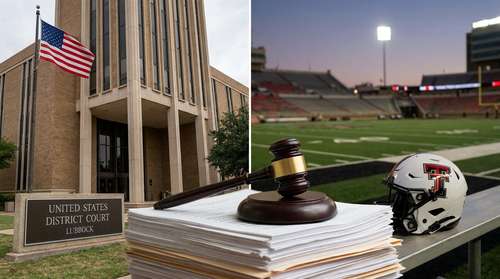
Texas Tech quarterback Brendan Sorsby is locked in a high-stakes legal battle that could redefine NCAA sports betting rules. On June 1, 2026, attorneys for the 22-year-old standout and the NCAA squared off in a Lubbock County District Court, fighting over an emergency temporary injunction that will determine whether Sorsby can take the field for the Red Raiders this fall. The quarterback faces a permanent eligibility ban after court documents revealed he placed thousands of wagers totaling at least $90,000, including bets on his own team during his tenure at Indiana University.
The outcome of this hearing will not only decide the fate of a multi-million dollar NIL investment but could also set a massive precedent for how collegiate sports govern player conduct in an era dominated by ubiquitous gambling apps.
Inside the $90,000 College Football Betting Scandal
The details surrounding the Brendan Sorsby gambling investigation paint a startling picture of modern athletic vulnerabilities. According to stipulated facts agreed upon by both the defense and the NCAA, Sorsby placed an estimated 2,900 bets between June 2022 and December 2023. Law enforcement first flagged the anomalous activity to an online sportsbook in early March, which subsequently tipped off the NCAA. By mid-April, Texas Tech was formally notified of the looming investigation.
The most damning revelation involves at least 40 specific wagers placed on Indiana Hoosiers football games and players while Sorsby was a member of the active roster. Though records indicate he never bet on games in which he personally played, crossing the line into betting on his own locker room triggered the NCAA's strictest penalties. He also placed roughly 40 bets on Indiana men's basketball and hundreds of wagers on unrelated college football matchups.
Even after leaving Bloomington, the compulsion persisted. Following his transfer to Cincinnati, Sorsby began utilizing accounts that were not in his own name to bypass institutional scrutiny. Court filings illustrate a complex web where Sorsby funneled over $60,000 to a friend, who then deposited the funds into a shared FanDuel account registered under his brother-in-law’s name. Since arriving in Lubbock—a state where online sports betting remains illegal—he continued sending thousands of dollars via payment apps like Venmo and Zelle to facilitate out-of-state wagers.
Defense Strategy: Mental Health and the Jeffrey Kessler Sorsby Lawsuit
Faced with a career-ending ban, Sorsby enlisted heavy-hitting legal representation. Antitrust heavyweight Jeffrey Kessler, fresh off negotiating the historic House v. NCAA settlement, is leading the charge. Kessler, alongside Texas representative Dustin Burrows, argues that the Texas Tech Brendan Sorsby case should be viewed through a clinical lens rather than a purely disciplinary one.
During the two-hour hearing before Senior Judge Ken Curry, Kessler positioned his client not as a rogue rulebreaker trying to cheat the system, but as a young man struggling with a severe, clinically diagnosed gambling disorder and anxiety-driven compulsion. The Jeffrey Kessler Sorsby lawsuit accuses the NCAA of weaponizing a legitimate mental health crisis. The defense emphasized that Sorsby never attempted to manipulate game outcomes or wager for financial profit; rather, the action was driven entirely by psychological dependency.
To demonstrate his commitment to recovery, the quarterback recently completed a 35-day residential rehabilitation program. Texas Tech leadership, including head coach Joey McGuire, has fiercely backed him, publicly expressing pride in Sorsby for seeking professional help for his addiction.
The NCAA’s Unyielding Stance on Locker Room Bets
The NCAA pushed back firmly in court, requesting the judge deny the injunction due to the "destabilizing ramifications" it would cause across collegiate athletics. Association lawyers highlighted that allowing a player back on the field after betting on his own team would make them the only major sports league in America to forgive such a direct violation of competitive integrity.
While the NCAA has recently relaxed some guidelines regarding athletes wagering on professional sports, they view this college football betting scandal as a non-negotiable offense. According to their arguments, granting the injunction would irreparably damage the credibility of the sport and open the floodgates for similar appeals.
Looming Deadlines and the NFL Supplemental Draft 2026
The clock is ticking aggressively for everyone involved. Judge Curry opted not to issue an immediate ruling on Monday, leaving Texas Tech's quarterback room in complete limbo just months before the season opener. Kessler specifically requested a decision by June 15.
The urgency is tied to alternative professional avenues. If the injunction fails and the permanent ban is upheld, Sorsby’s collegiate career is officially over. His only immediate path to continue playing football would be entering the NFL supplemental draft 2026, which carries a strict entry deadline of June 22.
For the Red Raiders, losing their prized transfer portal acquisition would deal a severe blow to their Big 12 championship aspirations. However, the broader implications of the Brendan Sorsby saga will stretch far beyond Lubbock. As college athletics becomes increasingly intertwined with legalized sports gambling, how the Texas court rules on this intersection of NCAA bylaws and mental health could reshape the very fabric of eligibility enforcement for years to come.