
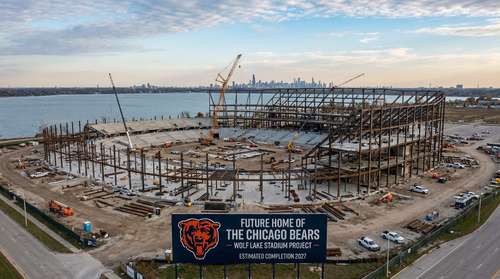
In a stunning development that could reshape the future of the NFL's founding franchise, Chicago Bears stadium news reached a fever pitch this week as team officials officially pivoted toward a massive development in Northwest Indiana. Following a breakdown in negotiations with Illinois lawmakers, the franchise has committed $2 billion toward a new stadium project near Wolf Lake in Hammond, Indiana. This historic shift marks a potential end to the team's century-long residence in Illinois, signaling that the Bears move to Indiana is no longer just a rumor—it is a rapidly developing reality.
Bears Commit $2 Billion to Wolf Lake Stadium Project
The landscape of Chicago sports shifted seismically on Thursday when Indiana House Speaker Todd Huston announced that the Chicago Bears are willing to commit $2 billion of private funding to a new stadium development. The proposed site is located near Wolf Lake in Hammond, sitting directly on the Illinois-Indiana border. This commitment accompanies the advancement of Indiana Senate Bill 27, legislation designed to create a Northwest Indiana Stadium Authority that would oversee the construction and financing of the venue.
In a statement read to the Indiana Ways and Means Committee, the Bears organization called the bill's passage "the most meaningful step forward in our stadium planning efforts to date." The team explicitly confirmed their intent to finalize "site-specific necessary due diligence" to bring a world-class facility to the region. Unlike previous NFL relocation rumors, this announcement involves concrete financial figures and legislative action, moving the project from speculation to a structured framework.
The Financial Framework
The proposed deal mirrors the successful public-private partnership used to build Lucas Oil Stadium in Indianapolis. While the Bears would contribute the lion's share of $2 billion, the remaining funding would likely come from the newly established stadium authority through bond issuances paid back by stadium-related revenues. This model offers the Bears stadium funding certainty that has eluded them in Illinois, where disputes over property tax assessments and public subsidies have stalled progress for years.
Illinois Stalemate: Negotiations Collapse in Springfield
The pivot to Indiana comes directly on the heels of a collapsed legislative effort in Springfield. A scheduled hearing regarding tax incentives for the team's property in Arlington Heights was abruptly canceled at the Bears' request just hours before the Indiana announcement. This sudden halt underscores the severity of the Bears Illinois exit threat, leaving Illinois Governor J.B. Pritzker and other state officials scrambling.
Governor Pritzker expressed visible disappointment, noting that his administration had been engaged in "productive" talks with the team. However, the Bears' decision to pause Illinois discussions while simultaneously endorsing the Indiana bill suggests a strategic calculation: the path of least resistance—and greatest financial benefit—now lies across the state line. The Chicago Bears stadium update from Illinois is now one of uncertainty, as the team essentially froze their home state out of the conversation to pursue the Indiana opportunity.
Why Wolf Lake? Location and Logistics
For fans worried about travel, the Wolf Lake stadium project offers a unique geographic compromise. Located roughly 20 miles from downtown Chicago, the Hammond site is actually closer to Soldier Field than the previously proposed Arlington Heights location. The site straddles the state line, potentially allowing the team to retain its strong Chicago identity while benefiting from Indiana's more favorable business climate.
Hammond Mayor Thomas McDermott called the proposal a "once-in-a-generation opportunity," emphasizing that Northwest Indiana is ready to welcome the team with open arms. The location boasts access to the Indiana Toll Road and proximity to the Chicago Skyway, addressing some logistical concerns, though significant infrastructure upgrades would still be required to handle NFL game-day traffic.
What This Means for Bears Fans
While the deal is not yet signed in ink, the momentum is undeniable. The creation of a dedicated stadium authority and the public commitment of $2 billion from the team indicates that this is far more than leverage. If the Bears move to Indiana, it would end a tenure at Soldier Field that dates back to 1971 and a history in Illinois starting in 1920.
For now, the "Chicago" Bears seem poised to become the NFL's newest cross-border franchise, playing home games in Indiana while representing the Windy City—a reality that is sinking in fast for fans on both sides of the border.