
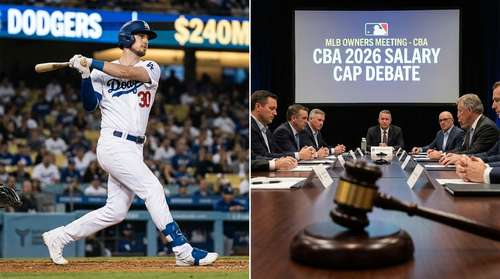
The Los Angeles Dodgers have once again shattered the ceiling of Major League Baseball’s financial landscape, finalizing a four-year, $240 million contract with superstar outfielder Kyle Tucker. The deal, officially announced this week, carries a staggering $60 million average annual value (AAV)—the second-highest in MLB history—and has pushed the Dodgers’ projected 2026 luxury tax payroll well past the $400 million mark. As Los Angeles gears up for a historic World Series three-peat, rival owners are reportedly “raging” behind closed doors, fueling an aggressive push for a hard salary cap in the upcoming Collective Bargaining Agreement negotiations.
The $240 Million Gamble: Inside the Historic Contract
Kyle Tucker’s arrival in Los Angeles is not just a roster move; it is a financial earthquake. The 29-year-old outfielder’s contract is structured to maximize immediate earnings while offering flexibility. Sources confirm the deal includes a massive $64 million signing bonus, with $54 million payable immediately—a lump sum that eclipses the total annual payroll of several small-market teams. Tucker will earn a base salary of just $1 million in 2026, a structure designed to navigate cash-flow management while hitting the competitive balance tax (CBT) ledger with a record-setting $60 million AAV.
Crucially, the contract offers Tucker opt-outs after the 2027 and 2028 seasons, allowing him to re-enter free agency at age 31 or 32 if the market resets. “This is a player betting on himself and a team betting on a dynasty,” said one National League executive. “The Dodgers aren’t just trying to win; they’re trying to bury the competition under a mountain of cash.” The deal also includes $30 million in deferred money, payable between 2036 and 2045, further cementing the Dodgers' strategy of leveraging future debt for present-day dominance.
“System is Broken”: Owners Demand Salary Cap in 2026 CBA
The reaction from across the league has been swift and vitriolic. The MLB salary cap debate 2026 has shifted from a theoretical discussion to an immediate battle cry. According to multiple reports, a coalition of small-to-mid-market owners held an emergency conference call shortly after news of the Tucker signing broke, describing the Dodgers' spending as “existential threat” to competitive balance.
With the current Collective Bargaining Agreement (CBA) set to expire on December 1, 2026, the timing could not be more volatile. Hardline owners are reportedly preparing to demand a fixed salary cap—similar to the NFL or NBA models—as a non-negotiable term in the next labor deal. “You can’t have one team operating with a GDP larger than some island nations while others are cutting scouting departments,” an anonymous AL owner told reporters. “If this doesn’t trigger a cap, nothing will. We are heading for a lockout, and the Dodgers just lit the fuse.”
The Dodgers Superteam: $400M Payroll Chasing History
Ignoring the noise, the Los Angeles Dodgers superteam is now assembled to chase a rare “three-peat,” a feat not accomplished since the New York Yankees of 1998-2000. Tucker joins a lineup that already features Shohei Ohtani, Mookie Betts, and Freddie Freeman, creating a top four that rivals any in the history of the sport. The addition pushes the Dodgers' estimated 2026 luxury tax payroll to approximately $429 million, placing them in a tax bracket of their own.
Projected 2026 Dodgers Lineup
- 1. Shohei Ohtani (DH)
- 2. Mookie Betts (SS)
- 3. Kyle Tucker (RF)
- 4. Freddie Freeman (1B)
- 5. Will Smith (C)
This financial muscle allows the Dodgers to absorb the massive tax penalties—projected to be over $160 million alone this season—without blinking. For the MLB free agency tracker, the Tucker signing marks the culmination of an offseason where the rich got significantly richer, leaving the rest of the league scrambling for alternatives.
The Looming Labor War
As the 2026 season approaches, the focus is rapidly shifting from the field to the boardroom. The MLB Players Association (MLBPA) has historically resisted any form of a salary cap, viewing it as a mechanism to suppress wages. However, the disparity created by the Dodgers luxury tax payroll may force a confrontation that threatens the 2027 season. The Tucker contract is no longer just about baseball; it is the opening salvo in a labor war that will define the sport's economic future for the next decade.