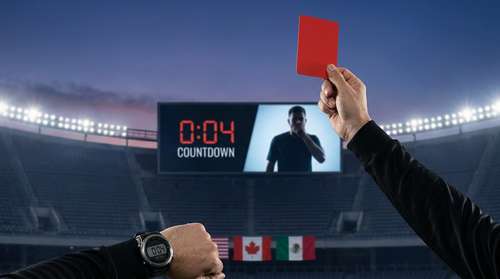
With the highly anticipated tournament kicking off on June 11 across the United States, Mexico, and Canada, the sport of soccer is bracing for a monumental shift. Over the past 48 hours, the International Football Association Board (IFAB) has officially ratified sweeping FIFA 2026 rule changes designed to eliminate cynical tactics and aggressively protect match tempo.
Addressing reporters yesterday, FIFA's Chief Refereeing Officer Pierluigi Collina detailed how these World Cup 2026 rule changes target two major blights on the modern game: unchecked time-wasting and discriminatory behavior. By enforcing these strict frameworks on the sport's biggest stage, FIFA guarantees that the expanded 48-team tournament will feature a dramatically different rhythm than any previous iteration. Fans can expect fewer stoppages and more continuous action.
The Groundbreaking Red Card Mouth Covering Rule
Perhaps the most discussed regulation heading into the summer is the strict new red card mouth covering rule. For decades, players have routinely shielded their lips with a hand or jersey while speaking to opponents or referees. Historically, this was framed as a way to hide tactical adjustments. However, it frequently serves as a shield to conceal unsportsmanlike conduct, insults, or bigotry from lip-readers and broadcast cameras.
Starting this June, any player who deliberately covers their mouth during a confrontational situation will be shown an automatic red card. The catalyst for this dramatic shift stems from a high-profile club incident involving Benfica's Gianluca Prestianni, who faced serious accusations of aiming discriminatory slurs at Vinicius Jr. while hiding his mouth. Following that event, which resulted in a worldwide six-game suspension for Prestianni, IFAB prioritized this immediate crackdown.
Referees will still apply common sense to the new mandate. Players covering their mouths to share tactical secrets on free kicks or to have friendly, non-confrontational conversations with teammates will not face disciplinary action. The focus remains entirely on eradicating hidden abuse and improving player respect.
Strict Penalties to Eliminate World Cup 2026 Time Wasting
If you have ever felt frustrated watching a team protect a narrow lead by taking an absolute eternity to restart play, the IFAB soccer rule changes 2026 bring welcome, long-overdue relief. Referees are now empowered with hard countdown clocks to physically force a faster pace of play.
The 5-Second Restart Countdown
To combat deliberate delays, match officials will now initiate a highly visible, five-second hand countdown for both throw-ins and goal kicks. If a team fails to put the ball back in play before the referee's hand drops, the punishment is an immediate turnover.
- Throw-ins: Taking longer than five seconds results in a foul throw, and possession is awarded directly to the opposing team.
- Goal Kicks: Delaying a goal kick carries an even heavier penalty. The defending team will forfeit the kick, and a corner kick will be awarded to the opposition—instantly turning a defensive restart into a high-danger scoring opportunity.
The 10-Second Exit Limit for Substitutions
The days of substituted players slowly strolling across the pitch to kill the clock are officially over. Under the Pierluigi Collina new rules framework, any player being subbed off has exactly 10 seconds to step off the field of play once their number is raised.
If the departing player fails to exit within that strict window, their replacement must wait on the touchline until after one full minute of running match time has elapsed. This forces the offending team to play with only 10 men for a full 60 seconds, creating a severe tactical disadvantage that completely neutralizes the incentive for late-game dawdling.
Cracking Down on Protests and Tactical Pauses
The FIFA World Cup 2026 rules also take direct aim at team-wide protests and orchestrated medical timeouts. In a bid to protect match officials, leaving the field of play to protest a referee's decision will now trigger a straight red card. This zero-tolerance policy applies to both players on the pitch and any team officials found inciting a walk-off. IFAB accelerated this specific law after a controversial Africa Cup of Nations final where the Senegalese squad stormed off the pitch over a penalty dispute, before eventually returning to finish the game.
Furthermore, FIFA is effectively banning the tactical pause disguised as an injury. In recent years, when a goalkeeper went down requiring medical attention, outfield players would sprint to the sidelines for impromptu coaching sessions and water breaks. Moving forward, all players must remain in their tactical positions or gather in the center circle during goalkeeper treatments. As Collina emphatically pointed out, while goalkeepers have the right to receive treatment for genuine injuries, teams do not have the right to hijack that necessary stoppage for a free timeout. Any player attempting to run to the bench will be proactively stopped by officials.
A Faster, Fairer Tournament Awaits
By implementing these aggressive, tempo-focused measures, FIFA is sending a clear, unavoidable message to the 48 participating nations: play the game, respect the opponent, and keep the ball moving. As the world prepares for the opening matches, these World Cup 2026 time wasting and anti-discrimination regulations promise to deliver a historic tournament. Fans can finally look forward to matches defined by relentless action and uncompromising sportsmanship, rather than gamesmanship and delay.