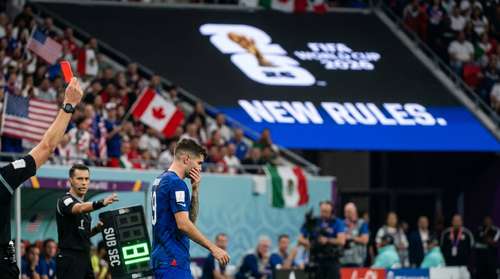
The landscape of international football is undergoing a massive shift. The International Football Association Board (IFAB) has officially approved a groundbreaking package of FIFA World Cup 2026 rule changes that will completely redefine how the game is played and officiated across North America. Designed to eradicate time-wasting, severely punish discriminatory behavior, and bring unprecedented transparency to officiating, these sensational updates leave zero room for error. If you thought previous tournaments were strict, the World Cup 2026 new rules are about to shock players, coaches, and fans alike.
The Controversial Mouth-Covering Red Card Rule
One of the most drastic updates targets player conduct during heated moments on the pitch. Under the newly approved mouth-covering red card rule, match officials now have the immediate authority to issue straight red cards to players who cover their mouths while engaging in confrontations with opponents or referees.
For years, athletes have reflexively pulled their jerseys over their faces or raised their hands to shield trash talk from broadcast cameras and amateur lip-readers. IFAB and FIFA are actively dismantling this habit to curb hidden discriminatory insults and abusive language. By implementing this rule, governing bodies establish a strict presumption of guilt for intentionally concealing speech during altercations. You will no longer see players successfully hiding behind their hands during a heated clash without facing an early shower.
Strict 10 Second Substitution Rule FIFA Enforces
Time-wasting tactics have plagued the sport for decades, but the 10 second substitution rule FIFA is rolling out aims to kill the tactical "slow walk" entirely. Players whose numbers are raised on the electronic board must now exit the pitch via the nearest boundary line within exactly ten seconds.
The penalty for stalling is severe. If a substituted player fails to leave the field within the allotted timeframe, the incoming substitute is barred from entering the game for one full minute of running match time. The offending team will be forced to play a man down during that penalty period. This aggressive mandate was already tested in a recent pre-tournament friendly between Japan and Iceland, where Icelandic midfielder Kristian Hlynsson took too long to depart, leaving his squad temporarily with ten men and entirely vulnerable to an opposing attack.
Five-Second Countdowns for Restarts
Adding to the anti-stalling measures, referees will physically count down a five-second allowance for throw-ins and goal kicks. Surpassing this strict limit results in an immediate loss of possession; delayed throw-ins will be turned over to the opposition, while delayed goal kicks will result in an attacking corner kick.
Banning the Tactical Injury Timeout
Another subtle but massive shift involves medical stoppages. Teams have increasingly exploited goalkeeper injuries to host impromptu tactical huddles near the technical area. Going forward, officials are mandated to proactively break up these gatherings. Furthermore, if an outfield player goes down and requires medical assessment on the pitch, that player must stay off the field for a mandatory 60-second cool-down period after play restarts, effectively penalizing squads who fake cramps to kill an opponent's momentum.
Unprecedented Transparency: Referee View Body Cameras
Officiating tech is taking a monumental leap forward. FIFA has officially partnered with technology giants to implement Referee View body cameras. Building on successful trials at the 2025 FIFA Club World Cup, match officials will wear advanced, lightweight cameras attached to their communication headsets.
Powered by sophisticated stabilization software, the live footage will smooth out the chaotic motion of a running official and feed a first-person perspective directly to global television broadcasts and stadium screens. Fans will literally see exactly what the referee sees in real-time, pulling the curtain back on the most debated penalty box incidents and creating an incredible immersive viewing experience.
Major IFAB New Football Rules 2026: Expanded VAR Powers
Alongside on-pitch behavioral shifts, the FIFA 2026 VAR changes grant the Video Assistant Referee expanded jurisdiction to fix obvious, game-altering blunders. Previously, VAR intervention was strictly reserved for straight red cards, penalty decisions, offsides, and mistaken identity.
The updated protocol allows the booth to intervene on incorrect second yellow cards. A player wrongly sent off due to an unjust second booking can now have the decision overturned live. Furthermore, VAR can correct corner-kick errors and spot fouls committed before a set-piece restart is even taken, provided the review is swift and does not hold up play.
These IFAB new football rules 2026 fundamentally shift the power dynamic of international soccer. By equipping referees with body cameras, expanding video review, and implementing harsh new penalties for time-wasting and misconduct, FIFA is ensuring the upcoming North American World Cup will be the most heavily regulated tournament in sporting history.