The buildup to North America's biggest sporting spectacle has hit an unprecedented legal roadblock. On Wednesday, the Attorneys General of New York and New Jersey officially issued subpoenas to FIFA regarding the contentious rollout of FIFA World Cup 2026 tickets. State regulators are actively investigating the global soccer governing body over allegations of blatantly deceptive practices, zeroing in on a World Cup ticket pricing scandal that has left devoted fans dealing with manipulated seat allocations, hidden costs, and severe sticker shock.
The Dynamic Pricing and "Fake Scarcity" Dilemma
New Jersey Attorney General Jennifer Davenport and New York Attorney General Letitia James launched the joint probe following a deluge of consumer complaints. Central to the inquiry is FIFA's aggressive implementation of a dynamic pricing World Cup strategy. Taking a page from the live concert industry, this algorithm-driven model allows ticket costs to fluctuate in real-time based on surging market demand.
State officials argue that FIFA weaponized this system to maximize profits at the public's expense. Davenport publicly accused the organization of deploying deliberate market manipulation tactics. By allegedly withholding massive blocks of inventory during initial sales windows, organizers created an artificial buying frenzy that drove standard match tickets well past the $1,000 threshold. During recent limited ticket drops, premium listings for the July 19 final were spotted approaching an astonishing $33,000 on the official portal.
"FIFA has turned buying a ticket to the World Cup into a gauntlet of confusion, fake scarcity, and impossibly high prices," Davenport stated, emphasizing that hosting the international tournament is not a license to exploit hardworking residents. These FIFA ticket false scarcity allegations mark a major escalation, representing the first time a U.S. law enforcement authority has legally challenged the organization's inventory distribution tactics on such a massive scale.
Seat Manipulation at MetLife Stadium
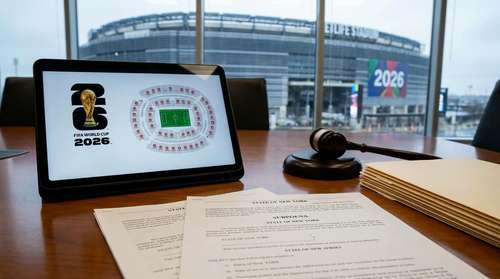
The joint FIFA subpoena New York New Jersey inquiry heavily scrutinizes logistical operations at East Rutherford's MetLife Stadium, which is slated to host eight pivotal matches, including the highly anticipated final. According to the subpoenas, early purchasers were led to believe they were securing top-tier seats within a standard four-tier ticketing system.
Yet, after millions of fans confidently secured their spots, many discovered that FIFA had abruptly altered the venue's seating maps. Regulators noted that the governing body introduced unexpected "premium front categories" into existing zones post-sale. This controversial adjustment effectively downgraded initial buyers, bumping them from prime Category 1 vantage points into less desirable Category 2 seating located behind the goals or far from the pitch.
New York Attorney General Letitia James forcefully condemned these alleged bait-and-switch tactics. "No one should be manipulated into paying sky-high prices for seats, and fans should be able to trust that the tickets they purchase will be the ones they receive," James asserted, demanding immediate operational transparency regarding the MetLife Stadium ticket investigation. The sentiment is widely shared by consumers; as soccer fan Jordan Likover told local news outlets, the process has been "shrouded in secrecy" and deliberately confusing for buyers.
Broader Consumer Protection Implications
This aggressive legal maneuver from the Northeast is not happening in a vacuum. The state officials are working closely with the New York City Department of Consumer and Worker Protection (DCWP). DCWP Commissioner Samuel A.A. Levine has openly warned that the reported seat manipulation and opaque pricing structures likely violate local consumer protection laws.
A Nationwide Regulatory Ripple Effect
The legal pressure on FIFA is mounting across the country. The staggering 2026 World Cup ticket prices have also caught the attention of politicians and regulators nationwide. California Attorney General Rob Bonta recently requested formal records from FIFA regarding potentially misleading ticketing practices for matches hosted on the West Coast, signaling a coordinated coastal pushback.
As the tournament draws nearer across the United States, Canada, and Mexico, this escalating probe could force a drastic overhaul of how international sporting bodies manage consumer relations in North America. Both Attorney General offices are actively encouraging affected ticket holders to file formal complaints. While it remains to be seen if the subpoenas will force a direct reduction in current market costs, the legal intervention draws a definitive line in the sand: global sporting monopolies cannot bypass regional consumer rights when operating on American soil.