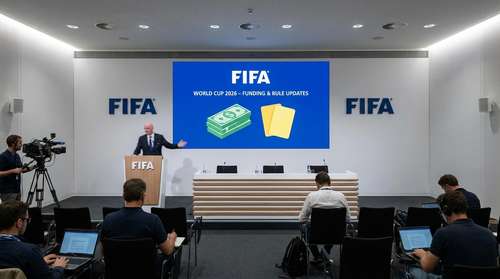
The road to the largest sporting event in history just received a massive financial and regulatory overhaul. Meeting in Vancouver this week ahead of the 76th FIFA Congress, the governing body's ruling council announced sweeping updates for the upcoming 48-team tournament spanning the United States, Canada, and Mexico. Headlining the soccer news today is a historic FIFA 871 million funding boost designed to offset soaring logistical costs for competing nations. Alongside the financial relief, crucial World Cup rule changes 2026 will completely alter how player suspensions are managed, ensuring the sport's biggest stars remain on the pitch for the most crucial matches.
Breaking Down the 2026 FIFA World Cup Prize Money
Hosting a tournament across three massive North American nations creates unprecedented travel and accommodation hurdles. With 104 matches scheduled across multiple climate zones and time zones, participating federations raised serious concerns about the sheer cost of competing. In response, the FIFA Council officially agreed to increase the resources distributed to all participating teams by 15 percent, raising the total pool to a staggering $871 million.
This massive injection of cash fundamentally shifts the landscape of World Cup 2026 preparations. Every single one of the 48 participating nations is now guaranteed $10 million in qualification money, up from the $9 million awarded during previous cycles. Furthermore, the base preparation allowance—the upfront capital used to book training facilities, schedule friendly matches, and coordinate complex travel itineraries—has jumped from $1.5 million to $2.5 million per team.
These financial interventions provide a necessary lifeline, particularly for smaller footballing economies. The extra preparation money makes assembling stable squads and organizing international travel far more viable, leveling the competitive playing field. For the elite squad that ultimately lifts the trophy in New York on July 19, the 2026 FIFA World Cup prize money payout will be an eye-watering $50 million.
Major World Cup Rule Changes 2026: The "Double Amnesty"
The financial package wasn't the only revelation out of Vancouver. The expansion from 32 to 48 teams inherently creates a longer tournament, introducing an additional knockout round via the Round of 32. Under previous regulations, a player could accumulate two yellow cards across five matches and face a crushing suspension right before the semifinals.
To prevent this scenario, the updated FIFA yellow card policy introduces a "double amnesty" system. Disciplinary records will now be wiped clean at two separate intervals. The first reset occurs immediately following the three-game group stage, allowing players to start the knockout phase completely afresh. The knockout rounds from the Round of 32 through the quarterfinals form the second block. Any single yellow cards accumulated during this stretch are entirely erased once the quarterfinals conclude.
This dual-reset guarantees that no player will miss the World Cup final simply because they received a tactical booking in the semifinal. It is a calculated move to preserve the entertainment value of the tournament's climax, ensuring global audiences see the best talent available rather than severely depleted rosters.
A Stricter Code for Player Protests
While the amnesty rule protects players from cumulative suspensions, match officials are being handed unprecedented authority to punish direct dissent. The council approved a strict new protocol aimed at curbing aggressive behavior toward referees. Players who intentionally leave the pitch to challenge an officiating decision can now be shown a direct red card.
Additionally, the controversial practice of players covering their mouths to hide abusive or insulting language directed at officials will now be treated as a severe offense, also carrying the threat of immediate ejection. These disciplinary adjustments reflect a broader institutional effort to clean up the game's optics and maintain authority on the pitch.
What This Means for the USMNT and Host Nations
For the host nations, these regulatory and financial shifts offer both clarity and competitive structure. Fans tracking USMNT World Cup news know that playing on home soil eliminates the transatlantic travel burden, but the expanded geography still demands rigorous internal logistics. The additional $1 million in preparation funds allows U.S. Soccer to finalize top-tier base camps without tapping into emergency federation reserves.
Moreover, the updated suspension rules play perfectly into the hands of teams heavily reliant on a core group of elite starters. In a grueling 48-team format, squad depth will be tested like never before. The group stage card wipe allows aggressive midfielders and defenders to reset their physical approach heading into the Round of 32, mitigating the risk of walking a disciplinary tightrope for weeks on end.
As the clock ticks down to the summer of 2026, the combination of enhanced funding and progressive rule modifications paints a clear picture. By mitigating financial disaster for smaller nations and protecting elite talent from bureaucratic suspensions, FIFA is actively clearing the runway for what promises to be a spectacular month of uninterrupted football.