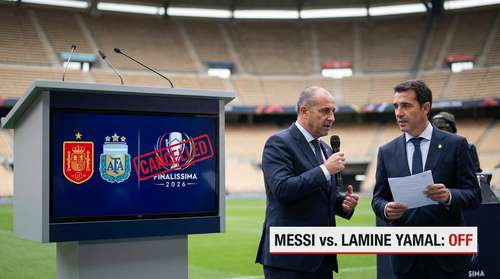
The highly anticipated clash between two footballing eras will have to wait. Following escalating geopolitical tensions in the Middle East, UEFA and CONMEBOL have officially confirmed the Finalissima 2026 cancellation. The showpiece event, originally scheduled for March 27 at the Lusail Stadium in Doha, was set to feature a historic Messi vs Lamine Yamal encounter. Instead, the highly touted Argentina vs Spain 2026 showdown has collapsed entirely after organizers and national federations failed to agree on a viable alternative venue or date.
Why the Spain vs Argentina Qatar Match Was Called Off
The breakdown of the fixture began in late February when rising security concerns across the Middle East prompted a sudden halt to sporting events in the region. The Spain vs Argentina Qatar match had been booked for the 89,000-capacity Lusail Stadium—the exact pitch where Lionel Messi lifted the 2022 FIFA World Cup. The event was supposed to be the crown jewel of the Qatar Football Festival.
However, UEFA issued a statement confirming that the safety of players, coaching staff, and traveling supporters had to take precedence. The governing body emphasized that the current political climate made hosting a global sporting event of this magnitude an impossible logistical and security risk. Broader sporting impacts were also felt globally, with Formula One calling off both the Bahrain and Saudi Arabian Grand Prix events in the same regional context. This rapid escalation abruptly stripped the March international window of its marquee fixture, sending organizers scrambling to salvage the intercontinental trophy.
A Diplomatic Deadlock Over Relocation
Once Doha was officially ruled out, frantic negotiations unfolded behind closed doors between UEFA, CONMEBOL, the Royal Spanish Football Federation, and the Argentine Football Association. Relocating a massive international event with just weeks to spare proved to be an insurmountable hurdle.
UEFA first proposed shifting the match to Real Madrid's Santiago Bernabéu on the original March 27 date. Organizers offered a strict 50-50 ticket allocation to maintain a neutral atmosphere, but Argentina rejected the plan, citing concerns over playing essentially an away game in the Spanish capital. A subsequent pitch for a two-legged format—featuring one game in Madrid and another at the Estadio Monumental in Buenos Aires later in the cycle—also fell flat due to logistical constraints.
Scheduling Conflicts Seal the Deal
The core issue ultimately came down to the congested international soccer schedule 2026. The AFA countered with a proposal to push the match to March 31, a date UEFA deemed completely unworkable for European clubs expecting their star players back for domestic league duties. A final proposal from Argentina to delay the fixture until after the 2026 World Cup was dismissed outright because Spain lacked available open dates in their upcoming calendar.
The Dream Matchup: Messi vs Lamine Yamal Deferred
For millions of football fans, the heaviest blow of the Finalissima 2026 cancellation is missing out on the first-ever competitive meeting between the sport's greatest living legend and his most promising heir. Recent Lionel Messi Inter Miami news leading up to this window indicated the 38-year-old captain was specifically gearing up for this transatlantic test as a measuring stick ahead of his final World Cup campaign.
On the opposite side, the fixture was meant to be a crowning international stage for the Spanish teenager. Following sensational Lamine Yamal Barcelona updates that highlight the 18-year-old's meteoric rise, many viewed this match as a symbolic passing of the torch. Yamal, who led La Roja to UEFA Euro 2024 glory, will now have to hope for a potential World Cup pairing to share the pitch with his idol.
Fallout for the International Soccer Schedule 2026
The sudden collapse of this fixture leaves a noticeable void in the final stretch of World Cup preparations. Both national team managers had planned to use the high-pressure environment of the Finalissima to stress-test their tactical setups against elite opposition. Now, Spain and Argentina must pivot to standard training camps or hastily arranged friendlies that lack the intensity of a major trophy-awarding match.
While the 2022 edition at Wembley Stadium—where Argentina dismantled Italy 3-0—successfully revived the Artemio Franchi Cup lineage, this year's logistical nightmare raises questions about the tournament's long-term sustainability. Without a dedicated, protected window immune to the shifting complexities of global politics and domestic league demands, the intercontinental clash remains vulnerable. Fans who had hoped to witness history must now look ahead to the summer, wondering if this generational clash will ever materialize.