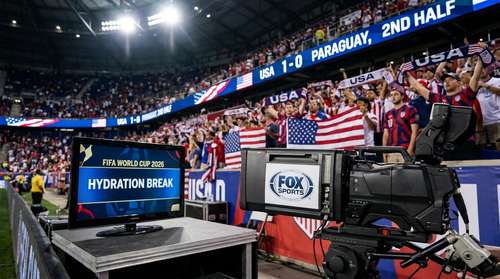
The FIFA World Cup 2026 has arrived on American soil with a bang, delivering both historic television audiences and immediate broadcast drama. The United States Men’s National Team (USMNT) secured a thrilling 4-1 victory over Paraguay in their opening match at SoFi Stadium, drawing an unprecedented 25 million combined viewers. However, the record-breaking USMNT World Cup opener viewership was quickly overshadowed by immense fan backlash regarding commercial interruptions. Viewers were furious when live match action was cut off for full-screen advertisements during the newly introduced mandatory hydration pauses. Despite the public outcry over the Fox Sports World Cup controversy, FIFA has officially decided not to punish the U.S. broadcaster, accepting the network's explanation that production simply missed the referee's whistle.
Record-Breaking USMNT vs Paraguay TV Ratings
There is no denying the monumental success of the tournament's opening weekend. The USMNT vs Paraguay TV ratings shattered previous benchmarks, confirming that the American appetite for soccer has reached an all-time high. Official broadcast figures reveal a staggering combined audience of nearly 25 million viewers tuning in to witness the host nation's dominant performance.
Fox Sports, handling the English-language broadcast across its main network and streaming platforms like Tubi, pulled in an average of 15.98 million viewers, peaking at roughly 18.86 million late in the second half. This establishes a new all-time high for an English-language USMNT match. Meanwhile, Telemundo and Peacock added another 8.9 million viewers for the Spanish-language broadcast. For context, the combined audience dwarfed the early games of this year's NBA Finals and the Stanley Cup Final. It highlights how hosting the tournament on home soil with favorable time zones has turbocharged domestic interest, cementing the FIFA World Cup 2026 as a top-tier broadcast commodity in the United States.
The World Cup Hydration Breaks Ads Controversy Explained
While the ratings were a massive win for executives, the viewer experience left traditional football fans seething. The backlash centers around the implementation of World Cup hydration breaks ads. For this tournament, organizers mandated three-minute hydration pauses midway through each half—approximately at the 22nd and 67th minutes—regardless of the local temperature.
Fox Sports opted to use these mandated pauses to run lucrative full-screen commercial blocks. During the first half alone, viewers were subjected to extended blocks featuring promotions for major brands and in-house programming. This heavy monetization essentially divided the seamless 45-minute halves into American-style quarters. The boiling point for fans arrived during the second half. Fox's commercial break ran long, and the broadcast returned to the live feed several seconds after the referee had already restarted play. Soccer purists flooded social media, branding the interruption as "anti-football" and questioning whether the integrity of the FIFA World Cup 2026 was being compromised for advertising revenue. Unlike Fox, Telemundo opted against full-screen commercial cutaways during these breaks, instead utilizing on-screen graphic ads to keep the live feed visible.
Navigating FIFA Broadcast Rules Fox Missed
When the second-half commercial block overran, fans missed the opening sequences of the restart. The late return to live action wasn't just a nuisance for viewers; it was a direct violation of international broadcasting guidelines. According to standard tournament protocols, rightsholders are required to return from any permitted break at least 30 seconds before the referee restarts play. The failure to meet this window put the network squarely in the crosshairs of the FIFA broadcast rules Fox was contractually obligated to uphold. The incident sparked debates over whether American sports broadcasting culture is fundamentally at odds with the continuous nature of global soccer.
Why FIFA Chose Not to Penalize the Broadcaster
In the immediate aftermath of the broadcast blunder, speculation mounted over whether the network would face fines or lose commercial privileges for future matches. However, governing officials have chosen leniency. FIFA accepted Fox's internal explanation that their production truck simply missed the referee's whistle signaling the end of the hydration break, resulting in the delayed return to the live feed.
The decision not to penalize the broadcaster likely stems from a combination of the network's massive financial investment in the tournament and the undeniable success of the opening weekend's viewership. Punishing a primary broadcast partner just days into a multi-billion dollar domestic event might have strained a highly profitable relationship. Moving forward, the network has reportedly assured organizers that timing protocols will be strictly enforced during future hydration breaks to ensure viewers never miss another second of live play. It remains to be seen if Fox will adopt a hybrid, picture-in-picture approach to avoid similar blunders in upcoming high-stakes group matches.
As the FIFA World Cup 2026 progresses, all eyes will be on how American broadcasters balance immense commercial opportunities with the uninterrupted flow that global soccer fans rightfully expect.