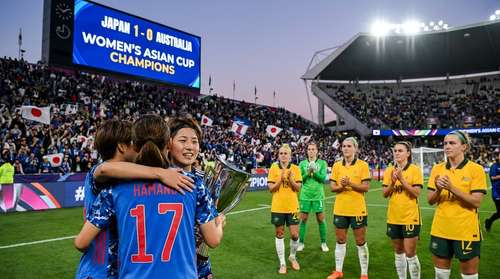
Saturday night delivered another chapter of heartbreak for Australia and unbridled joy for Japan, as the highly anticipated Japan vs Australia Women's Asian Cup final concluded with a familiar scoreline. On March 21, 2026, a solitary strike was all it took for the visitors to silence the host nation, securing a tense 1-0 victory to claim their third continental crown in the last four editions. The matchup was a bitter case of déjà vu for the Matildas, who previously suffered 1-0 defeats to Japan in both the 2014 and 2018 finals. For the newly crowned Japan women's soccer champions, the flawless campaign cements their status as an undisputed powerhouse on the global football stage.
The Maika Hamano Goal 2026: A Strike That Stunned Sydney
Heading into the match, Australia's game plan was clear: apply immense physical pressure early. The hosts dominated the opening exchanges, with Sam Kerr and Caitlin Foord finding pockets of space and forcing early saves from Japanese goalkeeper Ayaka Yamashita. But football is often decided in a split second, and the turning point came entirely against the run of play.
In the 17th minute, the defining Maika Hamano goal 2026 completely altered the tactical landscape. The 21-year-old Tottenham Hotspur forward, currently on loan from Chelsea, received the ball with her back to the net right on the edge of the penalty area. With a lightning-fast turn, Hamano curled a spectacular, dipping shot from 16 feet out, sending the ball soaring past the outstretched fingertips of Mackenzie Arnold. It was a moment of sheer individual brilliance that naturally dominated the post-match Nadeshiko Japan news cycle.
Setting a New Stadium Australia Attendance Record
Even with the ultimate result favoring the visitors, the evening marked a monumental milestone for women's sports. An official crowd of 74,397 fans poured into the venue, shattering previous benchmarks to set a brand new Stadium Australia attendance record for the tournament. To put this explosive growth into perspective, this figure was roughly six times the attendance of the tournament's previous high-water mark set in China back in 2010.
Japanese head coach Nils Nielsen acknowledged the sheer magnitude of the atmosphere. "It's very difficult to play with an enthusiastic audience like this," Nielsen told reporters following the final whistle. "But the girls fought with everything they had, and I'm actually very proud of them when it comes to that part". The roaring sea of green and gold kept the pressure cooker environment boiling, driving the Matildas forward as they hunted for a second-half equalizer.
A Tactical Masterclass and Frustration for the Hosts
Trailing by a goal, Australian head coach Joe Montemurro tweaked his fluid 4-4-2 diamond formation, pushing fullbacks higher up the pitch to stretch Japan's disciplined defensive block. The Matildas threw caution to the wind in the final half-hour. Substitutes like Hayley Raso and Emily van Egmond were injected into the match to add fresh attacking dynamics, yet they continually crashed into a blue wall anchored by veteran Saki Kumagai.
The tension reached a fever pitch in the dying moments. In the 89th minute, Ellie Carpenter whipped a precision cross into the box, connecting perfectly with the head of Alanna Kennedy. What looked like a guaranteed equalizer was somehow kept out by a sensational diving save from Ayaka Yamashita. This late-game heroics highlighted a staggering tournament statistic for the Women's Asian Cup 2026 results: Japan scored 29 goals across their six matches while conceding only once.
Looking Ahead: The 2027 Women's World Cup Qualifiers
As analysts continue to break down the comprehensive tournament statistics, both federations are already pivoting their focus toward the global stage. The stakes in Sydney extended far beyond regional supremacy, as the tournament doubled as the official pathway for the 2027 Women's World Cup qualifiers.
By advancing deep into the knockout rounds, both Japan and Australia successfully booked their tickets to next year's marquee tournament in Brazil. They will be joined by fellow qualifiers South Korea, China, North Korea, and the Philippines. For the Matildas, the coming months will be about refining their finishing in front of goal and overcoming their historical hurdle against top-tier Asian opposition. For Japan, lifting the trophy in enemy territory sends an ominous warning to European and American rivals: the Queens of Asia are coming for the world title.