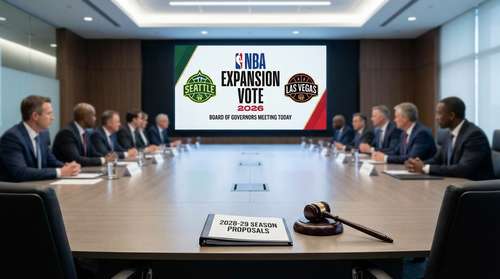
The professional basketball landscape is on the brink of a seismic geographical shift. Decades of speculation, arena negotiations, and careful league planning have culminated in the highly anticipated NBA expansion vote 2026. As the league continues to experience record-breaking revenue and international viewership, extending the footprint into two of America's most lucrative, basketball-hungry markets has transformed from a distant possibility into an imminent reality.
Inside the NBA Board of Governors Meeting Today
All eyes are on New York for the NBA Board of Governors meeting today, where team owners are casting a pivotal vote that will likely redefine the association's future. Commissioner Adam Silver has consistently targeted this year for a definitive resolution on league growth, following the stabilization of long-term national and local media rights agreements.
For the process to officially advance, a three-fourths majority—meaning 23 of the 30 current franchise owners—must vote in favor of initiating formal expansion proceedings. Approving this measure will not instantly create two new franchises by tomorrow morning. Instead, it authorizes the league office to begin the rigorous, months-long financial vetting of prospective ownership groups for Seattle and Las Vegas NBA expansion.
League insiders and financial analysts anticipate overwhelming support from the current ownership. Diluting the revenue-sharing pie from 30 slices to 32 requires substantial financial incentive, and the proposed entry costs are more than enough to justify the temporary dilution.
The Staggering NBA Expansion Fee 10 Billion Projection
Money talks, especially in the upper echelons of professional sports ownership. Initial estimates for the buy-in cost were substantial, but current forensic financial projections have pushed the expected NBA expansion fee 10 billion dollars per team. Even conservative estimates place the minimum bid between $7 billion and $8 billion.
Because these massive franchise fees are not treated as basketball-related income (BRI), they are not split with the players under the current Collective Bargaining Agreement. Instead, the entire sum is divided equally among the 30 existing ownership groups. If the Las Vegas and Seattle expansion fees reach the projected $15 billion to $20 billion total, each existing owner would receive a staggering windfall ranging from $500 million to over $600 million.
Who is Footing the Bill?
To meet these astronomical figures, billionaires are rapidly forming specialized syndicates. League rules stipulate that a controlling owner must possess at least a 15% stake in the franchise, requiring a minimum upfront liquid commitment exceeding $1 billion. Institutional investment and private equity firms are expected to play major roles as minority partners to help bridge the financial gap.
Seattle SuperSonics Return News: A City Awaits
No storyline carries as much emotional weight as the Seattle SuperSonics return news. Since the franchise controversially relocated to Oklahoma City in 2008, the Pacific Northwest has been the largest American metropolitan market without an NBA presence. Generations of fans who grew up idolizing Gary Payton and Shawn Kemp have aggressively lobbied for basketball's return.
The primary hurdle historically blocking Seattle's bid—the lack of a modern, NBA-compliant arena—was resolved with the construction of Climate Pledge Arena. The venue has already proven its viability by hosting the WNBA's Storm, the NHL's Kraken, and multiple sold-out NBA preseason showcases.
Recently, Kraken ownership executive Samantha Holloway launched One Roof Sports and Entertainment, an umbrella organization heavily rumored to be the foundation for the city's primary NBA bid. If successful, the revived franchise would legally reclaim the SuperSonics' historic branding, colors, and pre-2008 records, righting a historical wrong that has lingered over the league for nearly two decades.
Las Vegas NBA Team Update: The Desert's Next Crown Jewel
While Seattle offers legacy and nostalgia, Nevada offers unmatched modern momentum. The latest Las Vegas NBA team update highlights a city that has rapidly transformed into the undisputed sports and entertainment capital of the world. Having successfully integrated the NHL's Golden Knights, the NFL's Raiders, MLB's impending Athletics relocation, and the WNBA's back-to-back champion Aces, adding a men's professional basketball team completes the market's total sports domination.
The NBA already treats Las Vegas as a second home. The city hosts the annual Summer League, an event that draws all 30 front offices, and serves as the destination for the NBA Cup semifinals and championship. Prospective ownership groups feature heavy hitters, including basketball icon Magic Johnson's MAGI group and Golden Knights owner Bill Foley. Current players have even expressed a strong desire to transition into Las Vegas ownership post-retirement, further elevating the market's prestige.
Targeting the NBA New Teams 2028 Season
Assuming the Board of Governors approves the exploratory phase today, the aggressive timeline aims for the NBA new teams 2028 season tip-off. This multi-year runway is entirely necessary for the winning bids to finalize their front offices, build out scouting departments, and construct state-of-the-art practice facilities.
Integrating two Western markets will also force a highly anticipated geographic realignment. To maintain a balanced 16-team structure in both the Eastern and Western Conferences, one existing Western team will be pushed East. The Minnesota Timberwolves, Memphis Grizzlies, and New Orleans Pelicans are the frontrunners for this transition, with Minnesota making the most logistical sense given their proximity to Eastern Conference rivals in Milwaukee and Chicago.
As the owners cast their ballots in New York, the basketball world holds its collective breath. The sport is ready to usher in a new era, fundamentally reshaping the competitive landscape while solidifying its place as a global economic powerhouse.