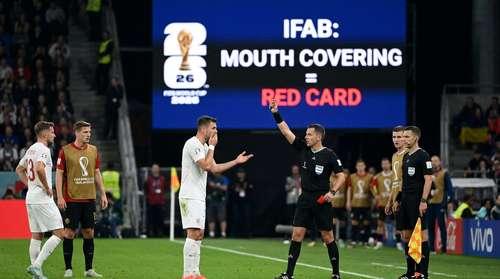
In a groundbreaking development that will reshape the landscape of international soccer, the International Football Association Board (IFAB) has officially approved a radical new set of 2026 World Cup rules. Ratified during a special meeting in Vancouver on Tuesday, April 28, this unprecedented regulation gives match officials the authority to issue an immediate red card to players who cover their mouths while engaging in confrontational exchanges with opponents or referees. As the global soccer community digests this major World Cup 2026 news, players and managers are scrambling to adapt to a reality where the deeply ingrained habit of hiding one's lips during arguments will be strictly penalized.
The Mechanics of the New Soccer Verbal Abuse Rule
For decades, footballers have reflexively pulled their jerseys over their faces or raised their hands to shield their words from broadcast cameras and amateur lip-readers. However, as part of sweeping FIFA disciplinary changes, this action is no longer just frowned upon—it is a sending-off offense. The IFAB red card mouth covering mandate dictates that, at the discretion of the competition organizer, any player deliberately obscuring their speech during a heated altercation will be sanctioned with a straight red card. By removing the physical barrier used to conceal potentially offensive language, governing bodies are eliminating the 'cloak of invisibility' that has allowed toxic on-pitch behavior to go unchecked. This soccer verbal abuse rule establishes a strict presumption of guilt; the act of hiding your words during an argument is now treated as an explicit attempt to conceal discriminatory or abusive language.
The Catalyst: The Controversial Vinicius Junior Incident
To understand the urgency behind these sweeping FIFA disciplinary changes, one must look back to the high-profile Vinicius Junior incident that sent shockwaves through the sport earlier this year. During a volatile UEFA Champions League knockout match in February 2026, Benfica forward Gianluca Prestianni became entangled in a bitter dispute with Real Madrid winger Vinícius Júnior. While launching verbal attacks at the Brazilian star, Prestianni deliberately pulled his shirt over his mouth to hide his words from the cameras. Vinícius subsequently accused the Argentine of making racist remarks. Because the visual evidence of Prestianni's lips was obscured, disciplinary committees faced significant hurdles in proving racial abuse. UEFA eventually banned Prestianni for six matches after he admitted to using a homophobic slur, but the lack of conclusive visual proof highlighted a massive loophole in the sport's disciplinary framework. FIFA President Gianni Infantino immediately championed the need to eradicate this hidden abuse, ensuring that players could no longer weaponize their hands or jerseys to escape punishment.
Elevating FIFA Refereeing Standards and Punishing Walk-Offs
While the IFAB red card mouth covering provision has dominated headlines, the Vancouver summit also addressed another critical issue threatening the integrity of the game. In a bid to elevate FIFA refereeing standards and maintain absolute control over the pitch, IFAB passed a secondary amendment that permits referees to issue straight red cards to any player or team official who leaves the field of play in protest of a refereeing decision. This strict zero-tolerance policy directly stems from the chaotic scenes witnessed at the 2026 Africa Cup of Nations (AFCON) final in January. During that contentious match, several Senegalese players walked off the pitch in stoppage time after Morocco was awarded a late penalty. Under the newly ratified 2026 World Cup rules, such theatrical protests will result in automatic dismissals. Furthermore, if a team's walk-off causes the match to be abandoned, they will automatically forfeit the game. This dual-pronged approach ensures that officials command absolute authority and respect, safeguarding the flow and fairness of the sport.
Reactions and Potential Challenges for Competition Organizers
While the introduction of the soccer verbal abuse rule has been widely praised by anti-discrimination groups, it has also sparked debate among domestic leagues and players' unions. Because IFAB has not mandated these changes globally, their implementation remains at the discretion of individual competition organizers. European domestic leagues, for instance, have raised concerns about the automatic red card for players leaving the pitch in protest. They argue there could be complex situations where players walk off because they are actively suffering racist abuse, as has happened in several high-profile league matches over the last few years. Punishing a victim of abuse for leaving an unsafe environment would be entirely counterproductive. Consequently, organizers must carefully balance strict enforcement of FIFA disciplinary changes with the need to protect vulnerable athletes. On the matter of the IFAB red card mouth covering rule, however, there is broader consensus. Anti-racism advocates have long argued that players who are simply discussing tactics do not need to aggressively hide their mouths when confronting opponents. By shifting the burden of proof, the new regulation ensures that instigators cannot hide behind a lack of audio evidence.
What This Means for World Cup 2026 News and Tactics
With the 2026 FIFA World Cup kicking off on June 11 across the United States, Canada, and Mexico, the 48 participating nations have precious little time to adjust their on-field behavior. IFAB has confirmed that these amendments will be communicated to all competing teams in the coming weeks. For coaches and sports psychologists, the immediate challenge lies in retraining players to break a long-standing, unconscious habit in the heat of battle. Failure to do so could leave teams severely handicapped on soccer's biggest stage. As we track the latest World Cup 2026 news, the consensus among analysts is that these rules will dramatically alter how players interact. The era of hidden trash talk is officially over. By closing the loopholes that allowed discriminatory behavior to thrive in the shadows, IFAB and FIFA are making a definitive statement: transparency, accountability, and respect are paramount. Any player unwilling to abide by these updated FIFA refereeing standards will quickly find themselves watching the remainder of the tournament from the locker room.