
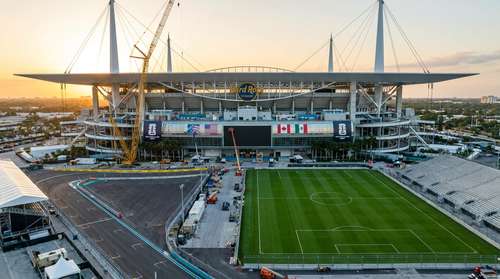
The checkered flag has barely settled on the May 3 conclusion of the Miami Grand Prix, but the engines of change are already roaring. Inside the venue soon to be known globally as 'Miami Stadium,' a frantic 25-day countdown is underway. Crews are now working around the clock to execute an unprecedented Hard Rock Stadium transformation, stripping away massive Formula 1 infrastructure to prepare the grounds for the Miami World Cup 2026.
The 25-Day Countdown to a Clean Site
With the tournament opener rapidly approaching on June 11, and Miami's first localized match slated for June 15, there is absolutely no margin for error. This rapid pivot from elite motorsport to the world’s biggest soccer tournament represents a masterclass in modern soccer stadium logistics, seamlessly merging two massive global audiences in an astonishingly tight window. For local organizers, the race didn't end on Sunday; it simply shifted from the asphalt track to the venue's operations command center. Organizers face a monumental task: dismantling an entire racing circuit’s hospitality and operational footprint in less than a month. Typically, taking down the sprawling Miami Grand Prix infrastructure, which features massive multi-story hospitality units, temporary grandstands, and miles of reinforced barriers, requires roughly four weeks of steady labor. However, the impending arrival of FIFA officials demands a dramatically accelerated timeline.
According to Natalie Clark, the senior director of event operations, crews have "about 25 days to remove everything off of our site that has been built up for the last three-and-a-half months". Once the remnants of the paddock and concert flooring are fully cleared out, FIFA takes definitive control of what must be a perfectly "clean and clear site" to begin their own specialized tournament build-out. The stark contrast between the two events was evident over the race weekend. Just days ago, Argentine legend Lionel Messi was walking across the static-charged green carpets of the F1 paddock, visiting compatriot Franco Colapinto ahead of Sunday's sprint and main event. Within hours of the race ending, those very same carpets were being ripped up to make way for the real thing—a playing surface fit for the 48-team tournament.
Navigating Strict FIFA Pitch Requirements
Transforming an NFL stadium and F1 epicenter into a world-class soccer venue requires far more than just removing temporary walls. The most critical, and heavily scrutinized, element of the Miami Grand Prix World Cup handover is the playing surface itself. To satisfy rigorous FIFA pitch requirements, organizers aren't just laying down standard commercial sod. The specialized natural grass has been meticulously cultivated for months at a 96-acre sod farm in Loxahatchee Groves, located roughly 61 miles north of the stadium. Capable of growing enough premium turf for 20 separate fields at any given time, this dedicated Dolphins-owned facility will transport the finalized grass to Miami Gardens in mid-May.
Todd Boyan, Senior Vice President of Stadium Operations for the Miami Dolphins, detailed the extreme precision required for the handover. Once the heavy F1 concert flooring is extracted, crews will execute a rapid three-day installation of the natural grass. Following the initial laydown, FIFA technicians will move in to perform a highly specialized pitch stitching process. This technique involves weaving synthetic fibers directly into the natural grass roots, ensuring the surface holds up to the intense wear and tear of a month-long international tournament without degrading.
A Premier Destination Among 2026 World Cup Host Cities
As one of the marquee 2026 World Cup host cities, Miami is aggressively preparing to welcome a massive influx of international fans. The 65,000-capacity stadium will host seven highly anticipated matches during the tournament, navigating a dense schedule of high-profile global fixtures. The action kicks off in South Florida on June 15 with an exciting Group Stage clash between Saudi Arabia and Uruguay. Throughout the ensuing weeks, fans will witness heavyweights like Brazil, Colombia, Portugal, and Scotland testing the newly stitched pitch. The venue's significant responsibilities culminate late in the tournament, hosting a crucial quarter-final matchup on July 11 and the high-stakes Bronze Final on July 18.
The Ultimate Test in Sports Venue Versatility
This unprecedented turnaround is completely dominating local Miami soccer news, highlighting the incredible versatility of a stadium that already routinely juggles NFL games, top-tier college football, and the Miami Open tennis tournament. Operating on a demanding calendar of nearly 60 ticketed events annually, the venue has truly evolved into a 365-day global entertainment destination. While the pressure is immense and the timeline is unforgiving, the blueprint for this dual-mega-event summer was drawn up months in advance. Planners have carefully coordinated every truck delivery and dismantle phase to ensure seamless continuity. If successful, this rapid shift from high-speed racing to the beautiful game will set a new global standard for multipurpose arena management. As the 25-day timer relentlessly ticks down, all eyes are squarely on Miami to deliver a flawless stage for the world's most watched sporting spectacle.