Major League Baseball has officially changed the game forever. In a historic vote concluded this Thursday at the owners' meetings in Florida, the league's Joint Competition Committee approved the implementation of the Automated Ball-Strike (ABS) challenge system for the 2026 regular season. This groundbreaking shift, often referred to as "robot umpires," will allow players to challenge calls at the plate in real-time. Alongside this technological leap, MLB owners also voted to enforce strict new regulations requiring base coaches to remain inside their boxes, a move designed to eliminate modern sign-stealing tactics once and for all.
The ABS Challenge System: How It Works
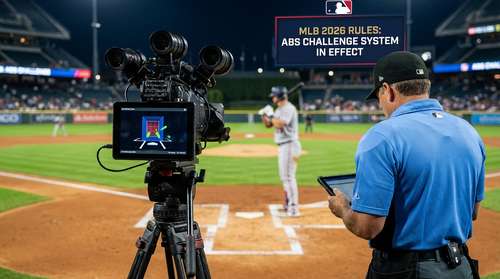
The days of arguing over a strike three call that was clearly off the plate are numbered. Beginning Opening Day 2026, the "challenge system" will be in full effect. Unlike a fully automated zone where every pitch is called by a computer, this hybrid model keeps human umpires behind the plate but gives teams a safety net against egregious errors.
Under the new guidelines, each team will be allotted two challenges per game. Crucially, if a challenge is successful—meaning the Hawk-Eye tracking technology overturns the human umpire's call—the team retains that challenge. This creates a strategic layer where teams could theoretically challenge an unlimited number of pitches if they keep getting them right.
Only the specific individuals involved in the play—the pitcher, catcher, or batter—can initiate a challenge. They must do so immediately, typically by tapping their helmet or cap to signal the umpire. The review is nearly instantaneous, with the result displayed on the stadium scoreboard within seconds via a 5G-enabled system. The strike zone itself will be standardized as a two-dimensional rectangle over the plate, with the top and bottom limits adjusted to 53.5% and 27% of the batter's height, respectively.
The 'Bonus Challenge' for Extra Innings
To ensure fairness in the most critical moments, the committee introduced a specific "bonus" provision for overtime baseball. If a game goes into extra innings and a team has exhausted its two challenges, they will be granted one additional challenge per extra inning. This ensures that a game-deciding call in the 10th or 11th inning isn't left entirely to human error simply because a team used their challenges earlier in the contest.
Cracking Down on Pitch Tipping and Sign-Stealing
While the robot umpires grabbed the headlines, a secondary vote by the owners may have an equally profound impact on game strategy. The league has authorized a strict crackdown on the positioning of base coaches. Starting in 2026, first and third base coaches must remain strictly within their designated coach's boxes until the pitch is delivered.
This decision targets the growing issue of "pitch tipping." In recent seasons, teams have grown increasingly suspicious that base coaches were wandering out of position to get better angles on the pitcher's grip or mechanics, then relaying that information to the batter or runner. By enforcing the boundaries of the coach's box, MLB aims to cut off this avenue of information warfare.
Umpires have been instructed to issue a warning for a first violation, with subsequent infractions resulting in an immediate ejection. This move signals that the league is prioritizing the integrity of the battery (pitcher and catcher) over the "gamesmanship" that has evolved in the post-PitchCom era.
Why the Shift? Owners and Players Weigh In
The vote to approve the ABS system was not unanimous, passing 9-2 within the Joint Competition Committee, which includes owners, players, and an umpire representative. However, the move to a challenge system rather than a fully automated zone reflects a compromise that players heavily favored.
"The strong preference from players for the challenge format over using the technology to call every pitch was a key factor in determining the system we are announcing today," Commissioner Rob Manfred stated following the meetings. Players argued that a fully automated zone removed the art of pitch framing and the human element entirely, whereas the challenge system corrects clear mistakes while keeping the game's traditional rhythm intact.
With these changes, the 2026 season promises to be one of the most distinct in baseball history. The fusion of high-tech officiating with stricter enforcement of traditional rules aims to create a fairer, faster, and more action-packed product for fans.