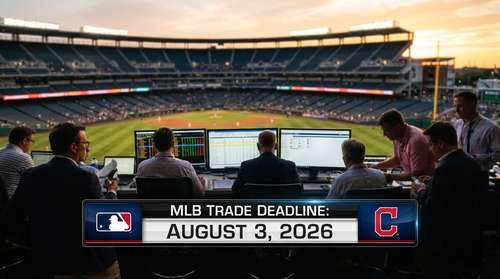
Major League Baseball has officially confirmed a significant shift to the summer calendar, setting the 2026 MLB trade deadline for Monday, August 3, at 6:00 p.m. ET. This decision, announced earlier this week, marks the latest date the deadline has ever fallen in a season under the current Collective Bargaining Agreement (CBA). While a few days might seem like a minor administrative tweak, the move to an August 3 trade deadline carries substantial strategic and logistical implications for front offices, players, and fans alike.
A Historic Shift: Why August 3?
For decades, baseball fans were conditioned to circle July 31 on their calendars. It was the immutable pivot point of the season—the day contenders went all-in and rebuilders folded their hands. However, the current MLB CBA trade rules, ratified in 2022, introduced new flexibility, allowing the Commissioner's Office to schedule the deadline on any date between July 28 and August 3.
In 2026, MLB is utilizing the full extent of this window. The decision to push the date to the absolute limit is primarily driven by the calendar. July 31, 2026, falls on a Friday, kicking off a weekend slate packed with afternoon baseball. By moving the deadline to Monday, August 3, the league avoids the logistical nightmare of processing complex transactions while games are actively being played.
Rob Manfred and league officials have increasingly prioritized a "clean" deadline. The goal is to ensure the 6:00 p.m. ET cutoff occurs when the field is quiet. On August 3, 2026, all scheduled games are set to begin at 6:40 p.m. ET or later. This creates a dedicated window for MLB trade rumors 2026 to reach their fever pitch without interrupting the on-field product.
Avoiding the "Hug Watch" Chaos
One of the primary drivers for this scheduling shift is the desire to eliminate the awkward, sometimes chaotic scenes of players being traded mid-game. MLB news today is instantaneous, and in the social media age, fans often know a player has been dealt before the manager can even get to the mound to remove him. A deadline set during active play—like a Friday afternoon—invites this kind of disruption.
History is littered with bizarre moments that MLB is keen to avoid repeating:
The Austin Jackson Moment (2014)
Perhaps the most famous modern example of a mid-game trade involved Austin Jackson. On deadline day in 2014, playing center field for the Detroit Tigers, Jackson was pulled in the middle of an inning. As he jogged off the field at Comerica Park, news rippled through the stands that he had been dealt to the Seattle Mariners in a three-team blockbuster involving David Price. Jackson received a confusing, emotional standing ovation as he left, a surreal moment that underscored the human element of the business.
The Yasiel Puig Brawl (2019)
In an even more chaotic scene, Yasiel Puig was effectively traded from the Cincinnati Reds to Cleveland during a bench-clearing brawl against the Pittsburgh Pirates. While front offices were finalizing the paperwork, Puig was on the field fighting for a team he technically no longer played for. The image of Puig furiously charging opponents moments before swapping uniforms remains one of the wildest deadline visuals in history.
The Joel Youngblood Anomaly (1982)
While rare, the "two-city double" is the ultimate quirk of a flexible deadline. In 1982, Joel Youngblood recorded a hit for the New York Mets in a day game at Wrigley Field, was traded mid-game to the Montreal Expos, hopped a flight to Philadelphia, and recorded a hit for the Expos that same night. It remains the only time in history a player has recorded hits for two different teams in two different cities on the same day.
By pushing the 2026 MLB trade deadline to a Monday evening with no day games, the league effectively ensures that players won't have to be pulled from the field or say goodbye to teammates in the dugout during a game. It dignifies the process and saves managers from the uncomfortable task of in-game personnel management based on front-office phone calls.
Strategic Implications for Front Offices
Beyond the logistics, the extra three days provided by an August 3 trade deadline offer a massive tactical advantage for General Managers. In the high-stakes environment of pennant races, 72 hours can provide critical clarity.
Consider the "bubble" teams—clubs hovering around .500 that aren't sure if they should buy or sell. An extra weekend of games allows these teams to see one more turn through the rotation and play one more crucial series before committing to a direction. A team might sweep a weekend series and decide to buy, or get swept and decide to pivot to a sale. Those three extra days could be the difference between acquiring a rental ace or trading one away.
Furthermore, the later date gives teams more time to assess player health. Injuries in late July often dictate deadline strategies. A star player suffering a minor strain on July 29 might have a clearer prognosis by August 3, allowing his team to make a more informed decision on whether they need to acquire an expensive replacement.
What to Expect in 2026
As we look toward the baseball trade deadline date in 2026, fans should prepare for a frenzied Monday. With the deadline falling on a weekday evening, the final hours will likely dominate the sports news cycle, completely unimpeded by actual gameplay.
The MLB trade deadline time of 6:00 p.m. ET is perfectly positioned to capture the news cycle before the night's games begin. We can expect a flurry of activity in the late afternoon, with finalized rosters taking the field immediately after the dust settles. For players, it means a tense weekend of waiting, but at least they will likely be in the clubhouse, not on the diamond, when their phones finally ring.
This shift to August 3 is a win for order and logic in a sport that often thrives on chaos. By aligning the deadline with a gap in the schedule, MLB has ensured that the 2026 deadline will be remembered for the trades made, not the awkward moments created.