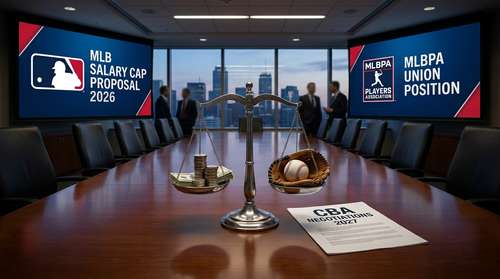
In a move that promises to drastically shift the financial landscape of professional baseball, a monumental MLB salary cap proposal 2026 has officially hit the negotiating table. Major League Baseball has submitted a sweeping collective bargaining agreement (CBA) counterproposal to the players' union, aimed directly at addressing severe payroll disparities and competitive balance issues. However, the ambitious plan has drawn immediate and fierce condemnation from players, setting the stage for what could become the most contentious labor battle the sport has seen in three decades.
As the clock ticks toward the December 1, 2026 expiration of the current labor pact, the early stages of the MLB CBA negotiations 2027 are already flashing warning signs. With billion-dollar stakes on the line, both owners and the players' union find themselves miles apart on the fundamental economic structure of the game, leaving fans anxious about a potential lockout.
Understanding the $245.3 Million Hard Cap and Salary Floor
For the first time since the ill-fated negotiations of 1994, team owners have formally requested a hard limit on player payrolls. At the center of the dispute is a proposed baseball salary cap 245 million—specifically, $245.3 million—that would take effect starting in the 2027 season. Unlike the current competitive balance tax (luxury tax), which only penalizes overspending through escalating fines, this new framework would act as an absolute ceiling that no franchise could legally exceed under any circumstances.
To incentivize spending among historically frugal small-market teams and ensure a baseline of competitiveness, the league's counterproposal simultaneously introduces a Major League Baseball salary floor set at $171.2 million. While players have generally supported minimum spending mandates to prevent tanking, the details reveal a crucial mathematical catch. This $171.2 million floor actually includes roughly $23 million in player benefits (such as insurance and transportation) per team, meaning the actual cash payroll floor would sit closer to a modest $148 million.
According to the league's internal projections based on 2026 payroll data, this new economic model would fundamentally alter team building. It would force 12 teams to substantially increase their spending to hit the floor, while eight of the league's biggest spenders—including heavyweights like the Dodgers, Mets, and Yankees—would have to aggressively shed payroll to comply with the restrictive ceiling.
Inside the MLB 50-50 Revenue Split and Blackout Reforms
Beyond the raw payroll parameters, the owners' pitch outlines an MLB 50-50 revenue split between the league and the players. This structure heavily mirrors the economic models currently utilized by the NBA and NHL, tying player compensation directly to the overall financial performance of the sport. By linking the cap and floor directly to league revenues, the financial limits would theoretically fluctuate year-over-year based on the sport's economic health.
Perhaps the most consumer-friendly element of the presentation targets the widely despised MLB local media blackout rule. The league is proposing a complete centralization of all local media revenue, which would then be shared equally among all 30 franchises. This centralization aims to eliminate frustrating regional broadcasting blackouts entirely and paves the way for a unified, national streaming rights deal—potentially arriving as early as the 2028 season. For everyday fans tired of being unable to watch their local teams, this concession could be a game-changer.
The Union's Response: A Looming MLB Players Union Labor Dispute
If history is any indicator, the mere mention of a salary cap is an absolute non-starter for the Major League Baseball Players Association (MLBPA). The union's response was swift, uncompromising, and highly critical, instantly raising the threat level of an ugly MLB players union labor dispute.
The union firmly argues that such artificial limits naturally erode contractual guarantees, pit players against one another in free agency, and provide front offices with built-in, league-sanctioned excuses for mediocrity. Furthermore, player advocates highlighted a perceived hypocrisy: while billionaire owners are eager to artificially cap player compensation, they are notably absent in seeking to limit their own soaring franchise values or record corporate profits.
The historical context here cannot be ignored. The last time team owners pushed for a hard salary limit was in 1994, resulting in a devastating impasse that triggered the longest work stoppage in baseball history and forced the unprecedented cancellation of the World Series.
What the MLB Salary Cap Proposal 2026 Means for the Future
As stakeholders navigate these crucial MLB CBA negotiations 2027, the stark contrast between the two sides is glaringly obvious. Just one day before the owners presented their cap-and-floor system, the players submitted their own comprehensive package. The union's plan focused heavily on enhancing compensation for early-career players and replacing the existing luxury tax with a $150 million competitive-integrity tax aimed specifically at punishing teams that refuse to invest in their rosters.
The massive gulf between the two sides underscores a deep, philosophical divide regarding competitive balance. The payroll gap from top to bottom stands at a staggering $446 million—referencing the massive divide between the highest and lowest spending clubs. League officials insist that a strict cap and floor, combined with an MLB 50-50 revenue split, is the only sustainable way to ensure smaller markets can consistently compete for championships.
Moving forward, the baseball world will be watching these developments with bated breath. With the current collective bargaining agreement expiring in December 2026, both parties have ample time to negotiate. However, early indications suggest a grueling marathon of legal maneuvering rather than a quick sprint to a resolution. Whether the league will eventually compromise on its demand for a baseball salary cap 245 million or the union will reconsider its historic opposition remains the defining question of this pivotal labor cycle.