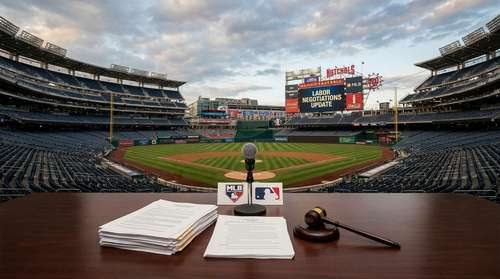
The battle lines for the sport's impending winter war have been firmly drawn. Following the highly contentious MLB salary cap proposal 2026, the Major League Baseball Players Association has made it abundantly clear that they will not entertain a hard ceiling on player earnings. Interim Executive Director Bruce Meyer delivered a blistering rebuke of the league's initial economic terms, setting the stage for what could be the sport's most bitter financial clash since 1994.
With the current MLB collective bargaining agreement set to expire on December 1, 2026, the opening salvos of these negotiations leave almost no middle ground. The looming MLB lockout threat 2026 is no longer just a hypothetical scenario whispered by insiders; it is rapidly becoming the expected reality for fans, players, and front offices alike.
MLBPA Bruce Meyer Salary Cap Stance: "Institutionalized Collusion"
During a fiery recent media session, the union's leadership rejected the league's economic framework outright. The core of the MLBPA Bruce Meyer salary cap response was a fierce defense of the sport's free-market system. Meyer characterized the league's push for a hard spending limit as "a form of institutionalized collusion," arguing that ownership is simply attempting to suppress wages under the guise of competitive balance.
According to Meyer's calculations, the league's initial proposal would be financially devastating for the clubhouse. If the proposed economic structure had been active for the current season, Meyer estimates that major leaguers would have lost over $500 million in total compensation.
"Our union has never been broken and never will be," Meyer declared to reporters, emphasizing that baseball remains the only major North American professional sport without this "ultimate restriction" on earning potential. He pointedly noted that unions in the NFL, NBA, and NHL did not accept salary caps because they benefited players. Instead, they simply failed to fight them off the way the MLBPA has successfully done for generations. For the baseball union, maintaining a market where players are paid their true value is a non-negotiable pillar of their solidarity.
Breaking Down the Baseball Salary Cap 2027 Framework
The underlying mechanics of the league's proposal represent a radical departure from baseball's traditional economic model. To understand why the union is threatening prolonged labor peace disruptions, you have to look at the exact figures ownership brought to the table.
The league pitched a baseball salary cap 2027 model featuring a hard ceiling of $245.3 million and a mandatory spending floor of $171.2 million. Currently, baseball utilizes a Competitive Balance Tax (CBT) that penalizes spending over a certain threshold, but teams are technically free to spend whatever they want. Transforming that soft threshold into an absolute $245.3 million wall would force big-spending franchises like the Los Angeles Dodgers and New York Mets to drastically slash payrolls.
While the introduction of a $171.2 million floor might appear beneficial on the surface—forcing notoriously frugal owners to finally invest in their major league rosters—the union views the accompanying ceiling as an absolute non-starter. The MLBPA believes that caps do not eliminate tanking or lower ticket prices; they merely provide owners with an excuse for financial inaction.
The Escrow Problem and Revenue Splits
Another massive friction point is the inclusion of an MLB players union revenue sharing system. Ownership's proposal included a 50-50 revenue split between the league and the players.
However, Meyer argued that based on the league's own definition of revenues, the players' share would actually decrease from its current trajectory. For the 2026 season, the union projects players will take home well over 50% of the revenue. Furthermore, a strict 50-50 split would likely require player salaries to be held in escrow to ensure the financial balance is maintained at the end of the fiscal year if league revenues underperform. Meyer argued this effectively eliminates truly guaranteed money, something the union has fought decades to protect.
Escalating the MLB Labor Negotiations 2026
The severity of the MLB labor negotiations 2026 cannot be overstated. We are witnessing two fundamentally opposed economic philosophies colliding head-on. The owners believe a strict salary band will curb runaway spending by top-tier franchises and level the playing field across the league. The players see a cap as an artificial mechanism to increase billionaire owners' profitability at the direct expense of the athletes generating the revenue.
Historically, salary cap proposals have been radioactive for baseball's labor peace. The last time ownership pushed this aggressively for a cap, it resulted in the catastrophic 1994-1995 strike that wiped out the World Series and alienated millions of fans. Even the 99-day lockout prior to the 2022 season feels mild compared to the rhetoric currently being exchanged.
What Happens Next for Fans and Free Agency?
As the calendar pushes toward the December 1 expiration date, the pressure will mount exponentially. The union's initial counter-proposal—which reportedly sought expanded free agency, an increased major league minimum salary, and bolstered arbitration rights—was instantly dismissed by ownership.
Without significant compromises from either the commissioner's office or the union's executive board, the sport is hurtling toward a deep freeze. Free agency and winter trades will likely be completely halted. The $245 million question isn't whether there will be a labor stoppage, but rather how much damage will be done to the sport's momentum before one side finally blinks.