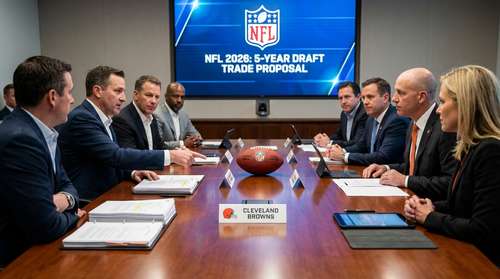
As front offices gear up for the start of the new league year, a monumental shift in how teams build their rosters is officially on the table. Among the highly anticipated NFL rule changes 2026, the league is reviewing a landmark resolution that would allow franchises to trade draft picks up to five seasons in advance. Spearheaded by the Cleveland Browns, this aggressive push to expand the current three-year limit comes at a fascinating time, colliding perfectly with the freshly established record $301.2 million salary cap.
Breaking Down the Cleveland Browns proposal
The current collective bargaining agreement restricts teams to dealing picks a maximum of three drafts out. However, under this new Cleveland Browns proposal, general managers could mortgage or stockpile assets half a decade down the line. Only two team-submitted resolutions are up for debate this cycle—the other being a Pittsburgh Steelers adjustment to make free agency communication rules permanent. This lack of on-field submissions makes Cleveland's push the definitive focal point of the offseason.
If approved, allowing NFL draft trades 5 years into the future would drastically alter front office dynamics, bringing the league slightly closer to the NBA's seven-year trading window. In their official submission, the Browns argued that this longer trade window would increase the liquidity of draft capital, support league-wide parity, and create structures that better mirror the massive valuations of both premium draft selections and superstar players.
The Immediate Impact on NFL roster strategy
Why make this push now? A new crop of aggressive general managers has led to an explosion of high-stakes trades in recent years. In fact, six first-round picks from the upcoming draft have already been traded, highlighted by Denver recently sending its top selection to Miami in exchange for receiver Jaylen Waddle.
This level of market activity completely redefines NFL roster strategy. Front offices willing to stomach long-term risk can spread their compensation packages across multiple seasons. Instead of crippling their immediate future to acquire a missing piece, a contender could structure a blockbuster deal using a blend of current assets and NFL future draft picks stretching into 2030 or 2031.
The Quarterback and Megastar Motivations
NFL insiders are already connecting the dots on why Cleveland specifically authored this document. Some analysts point to the franchise's ongoing quarterback dilemma after a rocky 2025 campaign. The expanded window could provide the ammunition needed to make an unprecedented leap for a highly touted prospect—like Texas standout Arch Manning—in 2027 by parting with selections stretching deep into the decade.
Others speculate it could be a mechanism to eventually yield a massive return for their own aging superstars, such as pass rusher Myles Garrett. Moving a player with an enormous cap hit is incredibly difficult when asking for three consecutive first-round picks. However, if that return can be spread over five years, the price tag becomes significantly easier for acquiring teams to swallow.
Adapting to the Record NFL salary cap 2026
You cannot separate this legislative push from the league's current economic boom. Late last month, the league informed clubs that the NFL salary cap 2026 is set at a staggering $301.2 million per team. Surpassing the $300 million threshold for the very first time, this $22 million jump from last season represents a 40% cap increase since the pandemic-altered 2020 season.
With total projected player costs now sitting at $378.8 million per club when including benefits, teams are actively searching for complementary avenues to build their squads. Massive cap space means clubs can absorb gigantic contracts, but without the draft capital to match, deals often stall. A five-year trade window perfectly aligns contract cycles with long-term roster construction, giving cap-rich teams the draft assets necessary to pull off massive, franchise-altering trades.
The Decisive Vote at the NFL owners meeting
To become reality, the resolution requires a supermajority. When executives and league brass gather at the annual NFL owners meeting from March 29 to April 1, at least 24 of the 32 clubs must vote "yes" to pass the measure.
Whether traditional, risk-averse owners will be willing to grant their front offices the power to leverage assets five years out remains the biggest hurdle. A poorly evaluated trade under these new rules could cripple a franchise for half a decade, leaving a team without a first-round pick long after the general manager who made the deal has been fired.
Yet, the appetite for modernized NFL rule changes 2026 has never been higher. The business of football is moving faster than ever, and if this proposal crosses the 24-vote threshold, the trade market will fundamentally change overnight.