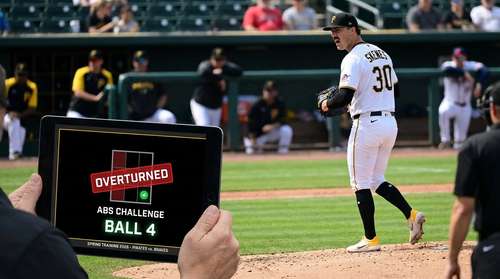
In a glimpse of Major League Baseball’s high-tech future, Pittsburgh Pirates ace Paul Skenes found himself battling more than just the Atlanta Braves lineup in his 2026 Spring Training debut. The reigning National League Cy Young Award winner saw four of his called strikes overturned by the Automated Ball-Strike (ABS) challenge system on Wednesday, transforming a potentially dominant outing into a showcase of the sport's evolving digital landscape.
The Machine 4, Paul Skenes 0
Taking the mound at CoolToday Park in North Port, Florida, Skenes displayed the electric stuff that took the league by storm in 2024 and 2025. His fastball sat consistently in the upper 90s, touching 99 mph, and his slider had its signature bite. However, the story of the day wasn't his velocity—it was the precision of the Hawk-Eye tracking technology.
The Braves were perfect in their usage of the challenge system, going 4-for-4 in overturning called strikes. The impact was immediate and tactical. In the first inning alone, Atlanta batters successfully challenged three calls. Matt Olson initiated the trend, challenging an 82.3 mph curveball that home plate umpire Chris Segal had originally rung up as a strike. The ABS system revealed the pitch to be just off the plate, extending the at-bat which eventually ended in a walk.
"When the season gets rolling, that's probably not the pitch that you're going to be challenging, but you've got to feel it out a bit," Olson said after the game, admitting the spring environment encourages testing the system's boundaries.
Momentum Shift in the First Inning
The overturns didn't stop with Olson. Jurickson Profar successfully challenged a 98.3 mph fastball on the very first pitch he saw, flipping the count to 1-0. He, too, would go on to walk. Later, Austin Riley used a challenge to erase a strike call on a 99 mph heater that was ruled above the zone. While Skenes managed to strike out Riley on the next pitch—a 98.5 mph fastball at the knees—the rhythm of the inning had been undeniably disrupted by the stoppages and reversals.
Skenes Reacts: 'Ask Me Again in June'
Despite the frustration of losing four strike calls, Skenes maintained his composure both on the mound and in the clubhouse. His final line—2.1 innings pitched, one hit, one earned run, four walks, and four strikeouts—was a statistical anomaly created largely by the new rules. Without the ABS overturns, his walk total would likely have been halved.
"Today, that's how it is. I've just got to adjust," Skenes told reporters post-game. "I think it will even out over the course of the season, but ask me in June."
The right-hander, who is using this start as his final tune-up before joining Team USA for the World Baseball Classic, threw 53 pitches in total. While the walks were uncharacteristic, the raw capability was evident. He struck out Ronald Acuña Jr. to open the game and showed no signs of physical rust, focusing instead on the mental adjustment required by the razor-thin margins of the automated zone.
How the ABS Challenge System Works in 2026
The 2026 season marks the full integration of the ABS challenge system at the Major League level, a "middle ground" between traditional umpiring and a fully robotic zone. Under these rules:
- Challenges: Each team receives two challenges per game.
- Retention: If a challenge is successful (e.g., a called strike is overturned to a ball), the team retains that challenge.
- The Zone: The strike zone is defined as a two-dimensional rectangle over home plate, with the top set at 53.5% of the batter's height and the bottom at 27%.
The system puts a premium on catcher framing—or rather, the lack thereof. Pitches that catch the edge of the "black" are no longer subject to an umpire's interpretation if a player chooses to challenge. As Skenes experienced, a pitch just millimeters off the plate is now definitively a ball, regardless of how beautifully it was received by the catcher.
Braves Capitalize on the Overturns
While Skenes escaped the first two innings relatively unscathed, the pitch count accumulation caught up to him in the third. Drake Baldwin led off the inning with a triple, marking the only hit Skenes allowed. Skenes was lifted shortly after, and reliever Jarod Bayless surrendered an RBI double to Profar that was charged to Skenes, followed by a two-run homer by Riley.
The 3-1 Braves victory was a footnote compared to the data harvested by both clubs. For Pittsburgh, it was a stark lesson in the efficiency of the challenge system against their ace. For Atlanta, it was a successful stress test of their strategy to contest borderline pitches early in the count.
As Skenes departs for the World Baseball Classic to chase gold for Team USA, his "battle vs. the machine" serves as a headline-grabbing preview of the 2026 MLB season. The days of getting the benefit of the doubt on the corner are over; for even the game's most dominant arms, the strike zone is now an exact science.