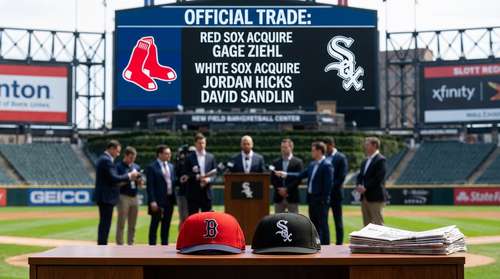
In a significant pre-Spring Training shakeup, the Boston Red Sox have traded veteran right-hander Jordan Hicks and pitching prospect David Sandlin to the Chicago White Sox. The deal, finalized late Sunday, sends pitching prospect Gage Ziehl to Boston in a move primarily driven by the Red Sox's desire to dip under the MLB luxury tax threshold. With pitchers and catchers set to report in just days, this trade reshapes the financial and roster landscape for both clubs heading into the 2026 season.
Breaking Down the Red Sox-White Sox Deal
The trade, first reported by ESPN and confirmed by multiple outlets, involves significant financial maneuvering. The Red Sox are sending $8 million in cash considerations to Chicago to offset part of the $24 million remaining on Hicks' contract through 2027. This effectively clears approximately $16 million from Boston's books over the next two seasons, a critical amount for a front office navigating the competitive balance tax (CBT).
For the White Sox, the acquisition is a classic leverage play. General Manager Chris Getz is effectively using the team's payroll flexibility to purchase a high-upside arm in Sandlin by eating the majority of Hicks' salary. "We see an opportunity to help Jordan reset while adding a starter in David who we believe has mid-rotation potential," a White Sox source indicated shortly after the deal broke.
The Financial Motive: Boston's Salary Dump
The primary driver for Boston Chief Baseball Officer Craig Breslow is undeniably financial. By shedding the bulk of Hicks' contract, the Red Sox have reportedly lowered their projected luxury tax payroll to approximately $258 million, dipping just below the crucial $264 million second surcharge threshold. This Boston Red Sox salary dump gives the front office breathing room to potentially make one final roster addition—possibly an infielder or bullpen depth—without incurring steeper penalties.
Hicks, 29, arrived in Boston last year as part of the blockbuster trade that sent Rafael Devers to the San Francisco Giants. However, his tenure at Fenway Park was rocky. Used primarily out of the bullpen after failing to stick in the Giants' rotation, Hicks posted a disappointing 8.20 ERA in 21 appearances for Boston. His high-velocity sinker remains elite, averaging over 97 mph, but control issues (career-worst walk rates in 2025) made his $12 million annual salary an anchor on Boston's payroll.
Prospect Spotlight: David Sandlin and Gage Ziehl
David Sandlin: The Prize for Chicago
While Jordan Hicks is the headline name, David Sandlin is the true prize for the White Sox. The 24-year-old right-hander, previously ranked as Boston's No. 8 prospect, features a wipeout slider and a fastball that touches 98 mph. Although he struggled in his first taste of Triple-A Worcester last season (7.61 ERA), his Double-A numbers were stellar, posting a 3.61 ERA with over 11 strikeouts per nine innings. Chicago views him as a near-MLB-ready starter who could join their rotation as early as June 2026.
Gage Ziehl: Boston's Return
Coming back to Boston is Gage Ziehl, a 22-year-old right-hander selected by the White Sox in the fourth round of the 2024 draft out of the University of Miami. Ziehl is known for his durability and a high-spin slider that misses bats. In his first full professional season, he posted a respectable 4.12 ERA across 22 starts in High-A. While he doesn't possess Sandlin's raw ceiling, Ziehl adds depth to a Boston farm system that prioritizes strike-throwers with advanced pitchability.
What This Means for MLB Trade News 2026
This move signals that the Red Sox offseason rumors aren't finished. With the savings from Hicks' contract, Boston is now positioned to pivot toward the free-agent market for a short-term fix at second base or a right-handed bat. For the White Sox, the trade continues their strategy of accumulating talent by taking on bad contracts, a method that has rebuilt their farm system rapidly over the last 18 months.
As MLB trade news 2026 heats up just before camp opens, the pressure is now on Hicks to revitalize his career in Chicago. Whether he slots into the White Sox rotation or returns to a high-leverage relief role, he offers Chicago a low-risk, high-reward veteran presence. Meanwhile, Boston fans will be watching closely to see how Breslow reinvests the $16 million savings—and if Gage Ziehl can develop into a future rotation piece.