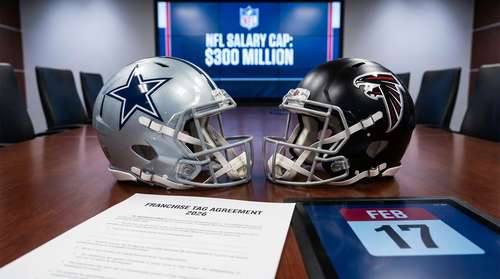
With the confetti from Super Bowl LX still being swept from the streets, the NFL offseason has arrived with a thunderous start. On Tuesday, February 17, the two-week window for teams to designate franchise and transition players officially opens, forcing front offices into high-stakes decisions that will shape the 2026 campaign. While the projected salary cap explosion to over $300 million gives general managers more breathing room than ever, the looming contract battles for stars like Dallas Cowboys wide receiver George Pickens and Atlanta Falcons tight end Kyle Pitts threaten to dominate the headlines.
George Pickens: The $28 Million Dilemma in Dallas
No situation is more volatile than the one brewing in Frisco. After acquiring George Pickens in a blockbuster trade with the Pittsburgh Steelers last offseason, the Cowboys watched their gamble pay off spectacularly on the field. Pickens erupted for a career-best season in 2025, hauling in 93 receptions for 1,429 yards and nine touchdowns, earning his first Pro Bowl nod and providing Dak Prescott with the elite perimeter weapon the offense had desperately needed opposite CeeDee Lamb.
However, that production comes with a massive price tag. With Pickens’ rookie contract now expired, the Cowboys are widely expected to place the non-exclusive franchise tag on him to prevent him from hitting the open market on March 11. The projected cost for a wide receiver tag in 2026 sits at approximately $28.8 million—a figure that complicates Dallas’s already precarious financial situation. Reports indicate the Cowboys are currently roughly $30 million over the cap, meaning a simple tag-and-play scenario is unlikely without significant roster maneuvering.
"The tag undoubtedly is coming, if for no other reason than to serve as a placeholder," ESPN's Adam Schefter reported Saturday. But league sources suggest a "tag-and-trade" scenario remains a distinct possibility if long-term negotiations stall. For a franchise that has historically fought tooth and nail to retain its stars, Pickens represents both an essential offensive piece and a luxury they might struggle to afford.
Kyle Pitts and the Falcons: A $16 Million No-Brainer?
In Atlanta, the decision surrounding Kyle Pitts seems far more straightforward, though no less critical. After playing out his fifth-year option in 2025, the former No. 4 overall pick finally silenced his critics with a resurgence that reminded the league of his unicorn potential. Pitts tallied 88 catches for 928 yards and five scores, serving as the engine of the Falcons' passing attack and earning second-team All-Pro honors.
The projected franchise tag for tight ends in 2026 is $16.319 million—a relative bargain compared to the exploding receiver market. For Atlanta, tagging Pitts ensures they retain a premier playmaker entering his prime without committing to a market-resetting long-term deal immediately. Unlike the Cowboys, the Falcons have a healthier cap sheet (approx. $27 million in space), giving them the flexibility to carry the tag number while working toward a multi-year extension. Losing Pitts now would strip the Falcons' offense of its most unique mismatch nightmare, a risk the front office is unlikely to take.
The $300 Million Salary Cap Reality
The backdrop for these negotiations is a historic financial landscape. The NFL informed clubs last week that the 2026 salary cap is projected to land between $301.2 million and $305.7 million. This $20 million-plus increase from 2025 is fueled by booming media revenue and international growth. While this influx of cash helps teams like the Titans and Raiders (who lead the league in cap space), it merely keeps the lights on for heavy spenders like the Cowboys, Chiefs, and Saints.
This inflation also drives up tag values across the board. Quarterbacks are now commanding a staggering $47.3 million on the tag, while even the devalued running back position has seen its tag number creep up to $14.5 million. This rising tide lifts all boats, but it also raises the stakes for teams unsure about committing fully to their pending free agents.
Breece Hall and the Running Back Market
Beyond the pass catchers, the running back market faces a fascinating test case in New York Jets star Breece Hall. Coming off a career-high 1,065 rushing yards in 2025, Hall is arguably the top back available. The Jets, currently in a retooling phase, must decide if a $14.5 million tag is a wise allocation of resources for a non-playoff team. Rumors have already linked Hall to contenders like the Cowboys (should they find space) and the Chiefs, making him a prime candidate for a transition tag ($11.7 million) or a tag-and-trade if New York decides to rebuild its assets.
The Clock is Ticking
The franchise tag window closes on March 3 at 4:00 p.m. ET. For Pickens, Pitts, and Hall, the next two weeks will determine whether they lock in massive one-year guarantees or find themselves as the crown jewels of the wildest free agency period in recent memory. As the legal tampering period approaches on March 9, the decisions made in these war rooms will echo throughout the 2026 season.