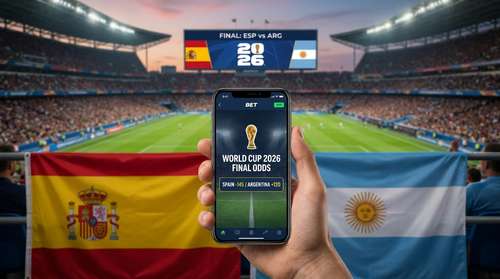
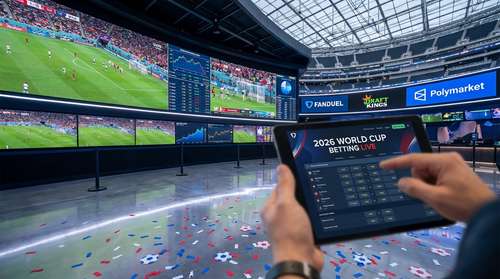
The 2026 FIFA World Cup is fundamentally rewriting the economics of global sports entertainment before the knockout stages have even kicked off. With an expanded field of 48 teams competing in 104 matches spread across the United States, Mexico, and Canada, the tournament has rapidly become the most heavily wagered event in history. According to the latest sports betting news 2026 updates, global betting handles are projected to shatter previous benchmarks, soaring past the $50 billion threshold. This unprecedented figure represents a colossal leap from the estimated $35 billion wagered during the 2022 tournament in Qatar. As fans and sharps alike scour the latest 2026 World Cup betting odds, they are engaging with a market vastly transformed by widespread regulatory approval and cutting-edge financial platforms.
The Math Behind the World Cup Sports Betting Records
Market-favorable kickoff times across North American time zones and a dramatically expanded schedule serve as the primary catalysts for this historic surge. Analysts at the investment bank Macquarie forecast total global wagers to cross $50 billion, essentially turning a month-long soccer tournament into a financial behemoth. This staggering FIFA World Cup wagering volume is not merely a byproduct of 40 additional matches; it is driven heavily by the maturation of legal betting infrastructures worldwide.
The United States landscape is drastically different today compared to four years ago. Currently, roughly 65% of the U.S. population resides in a jurisdiction with legal sports betting, a sharp increase from the 40% access rate during the 2022 event. Eilers & Krejcik Gaming estimates that U.S. online sportsbooks alone could handle upward of $4.33 billion in wagers. These World Cup sports betting records highlight a massive cultural shift, as domestic fans transition out of informal office pools and into regulated, highly tracked commercial markets. Furthermore, Brazil's newly regulated framework has unleashed millions of legal bettors into the ecosystem, significantly thickening global liquidity.
FanDuel and DraftKings Soccer Handle Reaches Historic Highs
The domestic U.S. market has operated as the main engine for this explosive commercial growth. Opening matches featuring the United States and Brazil became the most heavily wagered soccer games in history for major American operators. Consequently, the FanDuel DraftKings soccer handle has reached unprecedented levels, matching metrics typically reserved for the NFL's Super Bowl.
Flutter Entertainment, the parent company of FanDuel, reported active customer numbers scaling past previous global highs. The operator prepared its infrastructure to process up to 100,000 bets per minute during peak moments of the tournament. DraftKings mirrored these extraordinary figures, citing all-time records for active users placing soccer wagers. Rather than strictly betting on match winners, gamblers are gravitating toward complex bet builders and individual player performance props. Operators are maximizing this trend through localized payment structures and dynamic live-betting algorithms that keep engagement elevated long after the opening whistle.
Tracking the Shifting 2026 World Cup Betting Odds
As group stage results disrupt pre-tournament narratives, the futures market has become remarkably volatile. Bettors monitoring traditional lines have witnessed dramatic movements reacting to tactical adjustments and late-game equalizers. Defending Euro champions Spain and a deeply talented French squad currently command the tightest odds at major books. Meanwhile, traditional powerhouse Argentina relies on its veteran core to draw significant public money. For casual fans and professional sharps, tracking these fluctuations provides real-time insight into how global oddsmakers evaluate true squad depth across a grueling summer schedule.
The Explosion of Polymarket World Cup Bets
While traditional sportsbooks dominate the mainstream narrative, decentralized prediction markets have seized a massive portion of the tournament's action. Platforms like Polymarket and the U.S.-regulated Kalshi have facilitated over $5 billion in tournament-related trades combined. This alternative ecosystem allows users to buy and sell event contracts much like financial assets, constantly reacting to on-pitch developments in real-time.
The sheer scale of Polymarket World Cup bets has introduced extreme volatility—and staggering financial consequences—to the space. Just days ago, the market witnessed a jarring display of this high-risk environment when an anonymous trader lost a jaw-dropping $13 million on a single contract backing Belgium to defeat Egypt. The massive upset sent shockwaves through the prediction market community. Yet, the volume continues to pour in. The outright winner market on Polymarket alone recently approached $2 billion in trading volume, with nations like Spain, France, and Argentina emerging as heavily traded favorites among digital investors.
A Transformative Era for Global Wagering
The financial mechanics surrounding the 2026 tournament represent a definitive turning point for the industry. Bookmakers and prediction exchanges are no longer merely capturing pre-match enthusiasm; they are sustaining live, minute-by-minute trading environments that resemble Wall Street trading floors more than traditional casino sportsbooks. The sheer density of the 104-match schedule guarantees virtually uninterrupted action for weeks on end.
As the group stage gives way to the high-stakes knockout rounds, overall market liquidity will inevitably thicken. The blend of prime North American geography, matured domestic legalization, and the explosive rise of prediction platforms has engineered a perfect storm. This expanded World Cup is not just crowning a global soccer champion; it is permanently restructuring the boundaries of sports wagering.