
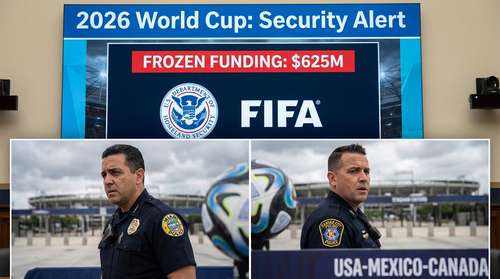
With the 2026 FIFA World Cup kickoff just over 100 days away, a partial Department of Homeland Security (DHS) shutdown has plunged tournament preparations into chaos. Major U.S. host cities, including Miami and Kansas City, warned congressional lawmakers this week that critical security measures are paralyzed due to the freezing of $625 million in federal aid. As political gridlock in Washington halts the flow of essential resources, local officials say they are rapidly approaching a "point of no return" that could force the cancellation of major fan events and compromise public safety during the largest sporting event in history.
Federal Funding Freeze Threatens Tournament Safety
The security crisis stems from a stalemate on Capitol Hill over immigration policy reforms, which triggered a partial government shutdown at midnight on Saturday. In response, DHS Secretary Kristi Noem implemented emergency protocols on Sunday, directing the Federal Emergency Management Agency (FEMA) to cease all "non-disaster-related response efforts." This directive immediately froze the FIFA World Cup Grant Program, a dedicated funding stream appropriated by Congress to help host cities fortify stadiums, train officers, and deploy anti-terrorism technology.
During a tense hearing before the House Committee on Homeland Security on Tuesday, city officials testified that the timing could not be worse. The frozen funds—totaling $625 million for initial security operations, with an additional $250 million earmarked for counter-drone systems—are meant to cover overtime for police, interoperable communication systems, and cyber defense infrastructure. Without this liquidity, departments report they cannot finalize contracts with vendors or commit to mutual aid agreements with neighboring jurisdictions.
Host Cities Issue Stark Warnings
The testimony from host city representatives painted a grim picture of the situation on the ground. Ray Martinez, Chief Operating Officer of the Miami World Cup Host Committee, delivered one of the most sobering assessments, telling lawmakers that the city’s preparations are effectively stalled. Miami, which is set to host seven matches including a quarterfinal and the bronze medal game, relies heavily on federal reimbursement to manage the millions of visitors expected to flood South Florida.
"We are 107 days out from the tournament, but more importantly, we are about 70 days out from starting to build the Fan Fest," Martinez testified. He issued a strict 30-day deadline, warning that if the funding dispute is not resolved by late March, organizers will be forced to begin canceling complementary events, starting with the massive Fan Fest planned for the city. "These decisions have to be made. Without receiving this money, it could be catastrophic for our planning and coordination."
Kansas City Prepares for Personnel Shortages
In the Midwest, the situation is equally precarious. Joseph Mabin, Deputy Chief of the Kansas City Police Department, told the committee that his agency does not have the manpower to secure the event alone. Kansas City is scheduled to host six matches at Arrowhead Stadium, along with four team base camps and an 18-day fan festival. The security footprint spans two states and ten counties, requiring a level of coordination that Mabin called "the largest mutual aid deployment in the city's history."
"We just don't have enough officers within my own department to cover all the threats," Mabin said. He emphasized that the federal grant money is the linchpin for bringing in outside officers. Without guaranteed funding to pay for travel, lodging, and overtime, partner agencies are hesitant to commit their personnel, leaving a dangerous gap in the security perimeter.
Drone Threats and Cyber Risks Loom Large
Beyond the staffing shortages, the funding freeze is creating vulnerabilities in high-tech defense. Security experts at the hearing highlighted that the DHS shutdown has paused the rollout of critical counter-drone technology. With the proliferation of unmanned aircraft systems posing a significant risk to open-air stadiums, the inability to procure and test detection equipment is a major concern. Mike Sena, president of the National Fusion Center Association, warned that the lapse in funding is blinding intelligence agencies to potential threats.
"If we'd been having this conversation two years ago, we'd be in better shape," Sena said. "But today, as we're approaching these games, we're nowhere near the capability we need." The shutdown has also reportedly paused training at the National Computer Forensics Institute, potentially hampering the ability of local law enforcement to respond to cyberattacks targeting critical infrastructure like power grids and transportation networks during the matches.
A Race Against the Clock
The impasse in Washington shows few signs of breaking, with the White House and congressional Democrats remaining at odds over ICE operational reforms. However, the pressure to carve out an exception for 2026 World Cup security funding is mounting. Representative Nellie Pou (D-NJ), the ranking member of the House Homeland Security Task Force, demanded immediate action from the administration, calling the delay "unacceptable" this close to kickoff.
For the host cities, the clock is ticking louder every day. The security plans for the 2026 World Cup were designed to be a model of interagency cooperation, but without the fuel of federal funding, that engine has sputtered to a halt. As Martinez noted in his testimony, the window to save the full fan experience—and ensure the safety of millions of global visitors—is rapidly closing.