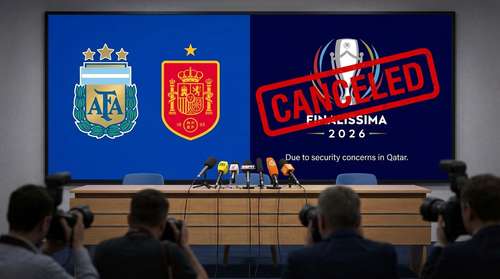
In a devastating update for global football fans dominating soccer news today March 17, the highly anticipated showdown between the reigning South American and European champions will not take place. UEFA officially confirmed over the weekend that the Argentina vs Spain Finalissima canceled status is final. Originally slated for March 27 at the iconic Lusail Stadium in Doha, the fixture's collapse deprives the sports world of a historic intercontinental clash just months ahead of the upcoming summer tournament in North America.
Why the Argentina Spain Match Qatar Cancellation Happened
The Argentina Spain match Qatar cancellation stems directly from the deteriorating geopolitical climate and escalating conflicts in the Middle East. According to a joint statement released by UEFA on Sunday, March 15, organizing authorities reached a mutual conclusion that the match could not proceed safely under the current regional circumstances.
Recent military strikes and widespread airspace disruptions have severely impacted travel protocols across major Gulf transit hubs. The Spain vs Argentina fixture was supposed to be the crown jewel of the five-day Qatar Football Festival, an event designed to celebrate global soccer. While other participating nations like Serbia have pivoted to play Spain on away turf instead, the logistical mountain of relocating a marquee trophy match featuring two global superpowers ultimately proved too steep.
Frantic Negotiations and Failed Alternative Venues
As breaking UEFA Finalissima 2026 news flooded social media, details quickly emerged regarding the frantic, behind-the-scenes attempts to save the fixture. UEFA heavily pushed for relocation, initially proposing to move the game to Real Madrid's Santiago Bernabéu stadium on the original March 27 date. This pitch included a strict 50:50 ticket split between Spanish and Argentine supporters to maintain a neutral atmosphere in the Spanish capital.
However, the Argentine Football Association (AFA) firmly rejected the European venue, preferring a more balanced travel schedule. Organizers then floated a complex two-legged format—playing one match in Madrid this month and a return leg at the Estadio Monumental in Buenos Aires during a 2028 international window. When that too was dismissed, Argentina countered with an offer to play a single match after the 2026 World Cup. Spain, locked into a rigid UEFA Nations League and European qualifying calendar, had no available dates, forcing the outright cancellation of this edition.
A Missed Dream: The Lionel Messi vs Lamine Yamal Match
Perhaps the most heartbreaking aspect for purists is the loss of the Lionel Messi vs Lamine Yamal match. This was universally viewed as a symbolic passing-of-the-torch moment. Messi, who famously lifted the 2022 World Cup trophy in the very same Lusail Stadium where this match was scheduled, would have faced off against the teenage sensation who spearheaded Spain's dramatic Euro 2024 triumph.
Generational Talents Denied a Stage
Football narratives rarely align this perfectly. Pitting the undisputed veteran of the sport against the rising prodigy of Barcelona's famed La Masia academy was a marketer's dream. Fans traveling to Doha were promised a tactical spectacle, heavily anticipating the sheer contrast in styles. Now, millions of supporters are left wondering if these two generational talents will ever share a pitch in a competitive international setting.
Defending the Crown: A Look Back at 2022
The cancellation is an especially bitter pill for Argentina, who won the inaugural rebranded edition of this tournament in 2022. That year, La Albiceleste dominated Italy with a commanding 3-0 victory at Wembley Stadium in London, a performance that perfectly catapulted them into their eventual World Cup-winning campaign. Fans had hoped the 2026 Finalissima would serve as a similar springboard.
Massive Impact on 2026 World Cup Warm-Up Games
The sudden fixture collapse sends shockwaves through both national teams as they finalize their crucial 2026 World Cup warm-up games. For the defending world champions, this heavily alters the Messi international schedule 2026. Argentina manager Lionel Scaloni had banked on the high-intensity European test to gauge his squad's readiness to defend their global crown in the United States, Mexico, and Canada.
Instead of a rigorous tactical battle against Spain's relentless possession system, both federations are now left scrambling to fill a vital competitive void. Spain will pivot to their adjusted fixture against Serbia, but Argentina faces a sudden gap in their preparation window. As the international break moves forward, the loss of the Finalissima stands as a stark reminder of how fragile the global sporting calendar remains amid broader geopolitical realities.