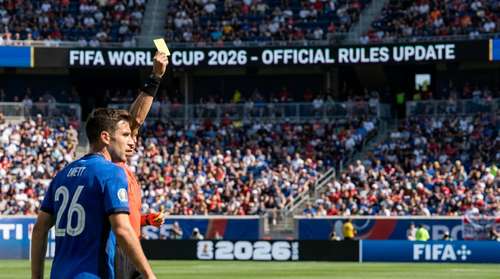
Missing a World Cup knockout match because of a minor, tactical foul is a heartbreaker for any player—and a massive disappointment for fans. With the tournament expanding to unprecedented proportions next summer, the risk of accumulated bookings sidelining top-tier talent has skyrocketed. Fortunately, the latest FIFA 2026 World Cup rules have tackled this issue directly. During a pivotal gathering in Vancouver on Tuesday, April 28, 2026, the governing body officially adopted a sweeping double amnesty protocol for player disciplinary records.
By wiping single bookings clean at two different stages of the competition, organizers are effectively insulating stars from devastating suspensions during high-stakes elimination matches. For anyone tracking the latest FIFA Council news, this decision represents a massive win for national team coaches, broadcasters, and fans who want the best athletes on the pitch.
How the Yellow Card Amnesty 2026 Actually Works
To appreciate the gravity of these FIFA rule changes 2026, you have to look at the traditional framework. In previous tournaments, a single yellow card was only wiped clean after the quarterfinal stage. That baseline system was introduced years ago to guarantee that no player would miss the final simply for picking up a single booking in the semifinals. Two yellow cards in separate matches automatically triggered a one-match suspension.
Under the updated soccer tournament regulations, player disciplinary records will now undergo two distinct resets.
- Reset One: Single yellow cards will be wiped entirely after the three-match group stage. Every player advancing to the newly minted Round of 32 will begin the knockout phase with a completely clean slate.
- Reset Two: Just like in the past, single yellows will be canceled again following the quarterfinals.
What This Means on the Pitch
If a midfielder receives a yellow card during their opening group match and avoids another over the next two games, their record resets before the knockouts begin. However, if that same player earns two bookings within the three group games, they still face an automatic one-game suspension.
The second phase forces players to stay disciplined over a crucial three-game stretch: the Round of 32, the Round of 16, and the quarterfinals. If an athlete collects two bookings across those specific three matches, they sit out the semifinals. But if they only carry one card heading into the semis, it vanishes.
Why Adjust the World Cup Suspension Rules Now?
You can trace this entire shift directly to the expanded 48-team tournament format. More teams inevitably mean an additional knockout round. Lifting the iconic trophy on July 19 at MetLife Stadium will now require teams to survive eight grueling games, up from the traditional seven.
Without altering the World Cup suspension rules, players would have been forced to walk a terrifying disciplinary tightrope. The physical toll of modern soccer tournament regulations also played a major factor. The game is faster, pressing systems are more aggressive, and tactical fouls are a standard defensive tool. Asking a defensive midfielder to navigate four sudden-death matches without making two mistimed tackles was a recipe for disaster.
Long-time supporters know exactly how devastating card accumulation can be. You only have to look back at Michael Ballack missing the 2002 final for Germany after a tactical foul in the semis. While FIFA fixed the semifinal-to-final loophole years ago, the new Round of 32 threatened to reintroduce that exact kind of heartbreak earlier in the bracket. National federations lobbied hard, arguing that the 2026 World Cup North America shouldn't be defined by who is sitting in the stands.
Beyond the Pitch: Essential FIFA Council News
While the new disciplinary framework stole the spotlight, the recent meetings in Canada delivered other crucial updates for the upcoming tournament. As organizers finalize logistics for the massive event co-hosted by the United States, Canada, and Mexico, financial backing took center stage.
Participating nations will see a 15% increase in financial resources. The total distribution pool has swelled to $871 million, which averages out to just over $18 million for each of the 48 teams. That figure includes a bump in preparation funds to $2.5 million per squad, ensuring that under-resourced federations can afford elite training camps and travel arrangements across the massive North American continent.
Ultimately, the decisions made this week reflect a governing body attempting to balance a bloated tournament structure with sporting fairness. The introduction of the yellow card amnesty 2026 guarantees that when the knockout rounds reach a fever pitch between June 11 and July 19, the outcome will be decided by the stars on the grass, not the referee's notebook.