
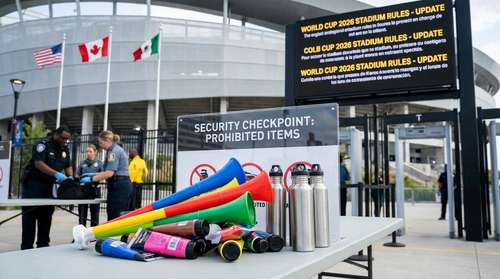
With the expanded 48-team tournament kicking off on June 11 across North America, the organizing committees have triggered widespread frustration among supporters by heavily revising their entry protocols. The newly updated list of FIFA World Cup 2026 banned items features some shocking last-minute additions that will force match-goers to drastically rethink their matchday preparations. Highlighting a sudden U-turn on hydration policies and a strict crackdown on fan attire and noisemakers, the global governing body is prioritizing physical safety and standardized crowd management across all host venues. If you are holding a ticket, understanding these new guidelines is absolutely essential to avoid gate rejections.
The Last-Minute Reusable Water Bottle Ban FIFA Issued
As recently as last month, the official World Cup stadium code of conduct explicitly stated that empty, transparent, reusable plastic bottles up to one liter in capacity would be permitted inside venues. However, in a sudden policy reversal executed this week, ticket holders received official notifications that a reusable water bottle ban FIFA just mandated is now in full effect. The updated security rule plainly states that reusable water bottles may no longer be brought into any of the tournament stadiums.
A FIFA spokesperson confirmed the reversal was made strictly on safety grounds to prevent projectile injuries, noting that outside bottles are already prohibited at several of the North American host venues under existing local laws. The timing of this U-turn has sparked intense debate, as extreme heat and high humidity remain well-documented concerns for the summer tournament. To offset the loss of personal refillable containers, officials have promised that misting stations, cooling tents, and dedicated hydration points will be available throughout the stadium footprints. Fans looking for water inside the venue will have to rely on bottled water sold at standard event prices.
Silencing the Stands: The Vuvuzela Ban 2026 World Cup Directive
South Africa's historic 2010 tournament gave the soccer world a soundtrack it could never forget: the relentless, buzzing drone of the vuvuzela. Sixteen years later, the infamous plastic horn has been decisively silenced in North America. The explicit vuvuzela ban 2026 World Cup mandate strictly prohibits these high-decibel items, classifying them alongside bullhorns, air horns, and referee whistles as non-compliant noise-making devices.
While a vocal contingent of supporters still views the horn as a vibrant symbol of international fan culture, the ban stems from years of persistent complaints by television broadcasters, coaching staff, and players. Many argue the extreme decibel levels disrupt critical on-pitch communication and ruin the traditional chanting atmosphere. Furthermore, fans hoping to bring other musical instruments to support their national squads must note that anything larger than 12 centimeters requires prior written approval from event organizers. The goal is to cultivate a more controlled auditory environment and prevent the overwhelming noise pollution that heavily divided global audiences over a decade ago.
Dress Code Reality: The Strict FIFA Body Paint Rule
Fan expression often takes incredibly creative forms, from giant non-flammable flags to elaborate costumes. However, supporters planning to brave the summer heat using minimal clothing need to review the FIFA body paint rule carefully before arriving at the gates. The revised security regulations take a remarkably firm stance against indecent exposure, permanently prohibiting streaking, flashing, or otherwise revealing intimate body parts in the stands.
Crucially, the code of conduct explicitly clarifies that "body tattoos and body paint do not constitute clothing". Fans arriving at the perimeter covered only in elaborate, team-colored paint rather than actual fabric will be turned away or formally asked to cover up before scanning their tickets. These stringent dress code standards are part of a broader organizational initiative to maintain a family-friendly, culturally respectful atmosphere during matches spanning the United States, Canada, and Mexico.
Navigating Broader Soccer Stadium Regulations 2026
Beyond the headline-grabbing restrictions on hydration and attire, the overarching World Cup 2026 stadium rules enforce one of the tightest security nets in international sports history. Organizers are deploying a rigid clear-bag policy to expedite security screening, meaning backpacks, totes, and large handbags will be universally rejected at the perimeter. Furthermore, there is no official bag-check service or temporary storage available at any stadium, meaning non-compliant luggage must be returned to hotels.
Another significant hurdle for international travelers involves vaping devices. While vapes and e-cigarettes will simply be confiscated and disposed of at stadium gates in the US and Canada, fans traveling to Mexico face severe legal jeopardy. Earlier this year, Mexico enacted a strict nationwide constitutional ban on vapes, making it a serious offense to even import or possess the devices. Supporters are strongly advised to leave e-cigarettes entirely at home if their team is scheduled to play group-stage matches in cities like Mexico City or Monterrey.
What Happens If You Break the Rules?
Security personnel across all three host nations are under strict orders to systematically seize any non-compliant signs, banners, or prohibited materials. Spectators attempting to bypass the soccer stadium regulations 2026 risk being denied entry or immediately ejected from the premises. In severe cases, ticket holders who fail to comply with event staff directions may have their stadium credentials and any future match tickets formally revoked without a refund.
As the global spotlight turns toward the opening fixtures, reviewing these detailed guidelines is just as critical as packing your national team jersey. Arrive early, pack light in a clear bag, and leave the water bottles and vuvuzelas behind.