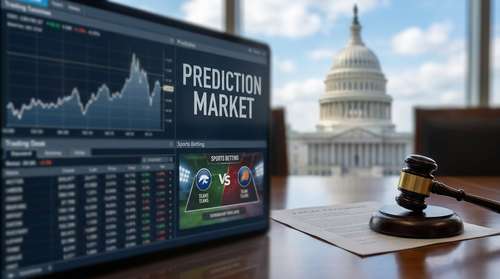
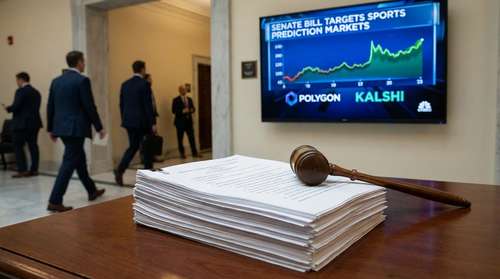
A newly introduced bipartisan piece of legislation threatens to dramatically alter the landscape of American wagering by shutting down sports betting prediction markets. Unveiled on Monday, March 23, 2026, by U.S. Senators Adam Schiff (D-Calif.) and John Curtis (R-Utah), the Prediction Markets Are Gambling Act takes direct aim at platforms like Kalshi and Polymarket. The groundbreaking bill seeks to prohibit entities regulated by the Commodity Futures Trading Commission (CFTC) from offering trading contracts on sporting events and casino-style games. For an industry that saw well over $1 billion in Super Bowl trading volume earlier this year and currently hosts more than $100 million in active March Madness wagers, the proposed legislation represents a massive existential threat to a rapidly expanding sector.
The meteoric rise of event contracts has created what lawmakers describe as a sprawling, unregulated gray market. Because these platforms operate as financial exchanges under federal commodities law, they have successfully bypassed state-level restrictions that traditional sportsbooks must navigate. This structural advantage has allowed them to operate nationwide, offering contracts that function identically to traditional parlays and moneylines.
The Core of the Kalshi Federal Bill and CFTC Loophole
At the heart of this sports betting legislative news is the ongoing jurisdictional battle between federal regulators and state governments. Over the past year, the CFTC has allowed prediction markets to proliferate with minimal friction, essentially greenlighting their operations across all 50 states. This includes areas where sports wagering is strictly prohibited, such as California and Utah. The Kalshi federal bill aims to explicitly amend the Commodity Exchange Act to strip the CFTC of its ability to authorize contracts tied to competitive sports and casino games like blackjack and roulette.
Lawmakers argue that these platforms are exploiting online betting loopholes to skirt critical consumer protections, dodge state tax liabilities, and undermine tribal gaming sovereignty. By reclassifying these event contracts as explicit gambling products rather than speculative financial derivatives, the proposed law would effectively dismantle the primary revenue engines for these emerging tech companies.
Adam Schiff Sports Betting 2026 Stance
The coalition backing the bill bridges a significant partisan divide. During the rollout of the Adam Schiff sports betting 2026 initiative, the California Democrat minced no words regarding the federal government's role in facilitating these platforms. Schiff emphasized that sports prediction contracts are simply sports bets operating under a different legal designation. He argued that instead of enforcing the law, federal regulators are actively promoting a backdoor that intrudes upon state authority and generates zero public revenue.
Senator Curtis echoed these sentiments, focusing heavily on consumer protection and youth exposure. With Utah maintaining a strict constitutional ban on gambling, Curtis highlighted the danger of speculative financial products bleeding into spaces where they do not belong, emphasizing that regulatory jurisdiction must remain firmly in the hands of the states rather than federal agencies.
Industry Pushback Against the Polymarket Sports Betting Ban
Unsurprisingly, the targeted companies are mounting a fierce defense against the looming Polymarket sports betting ban. Representatives for Kalshi argue that regulated prediction exchanges offer a fundamentally fairer ecosystem for consumers compared to traditional sportsbooks, noting that exchanges do not restrict winners or employ algorithms designed to maximize user losses. The company warns that driving these markets out of the regulated American financial system will simply push users toward shadowy, offshore crypto-betting alternatives where no oversight exists.
The timing of the legislative crackdown coincides with high-profile mainstream integrations that previously signaled the industry's arrival. Just last week, Major League Baseball announced a partnership with Polymarket, an arrangement that now faces severe uncertainty. Furthermore, despite the mounting legal pressure, the financial backing for these platforms remains robust. Reports emerged on Monday that Polymarket CEO Shayne Coplan and Kalshi CEO Tarek Mansour threw their weight behind a new $35 million venture fund specifically designed to incubate early-stage prediction market startups. The resilience of venture capital in this space suggests the industry intends to fight the proposed regulations aggressively.
Despite these defenses, the walls appear to be closing in from multiple directions. Just days before the Senate announcement, Arizona filed criminal charges against Kalshi for allegedly operating an illegal gambling syndicate, while Nevada successfully secured a temporary restraining order blocking the platform from offering sports and entertainment contracts. In a scramble to demonstrate self-regulation, both Kalshi and Polymarket rushed to implement strict new bans on insider trading this week, explicitly blocking professional athletes, college players, and political candidates from trading on events related to their respective fields.
The Future of Federal Prediction Market Regulation
The momentum behind federal prediction market regulation is already sending shockwaves through Wall Street and the broader gaming sector. Shares of traditional sportsbook operators like DraftKings and FanDuel surged on Monday, reflecting investor confidence that their unregulated competitors might soon be sidelined. Furthermore, the Indian Gaming Association has thrown its substantial political weight behind the Schiff-Curtis bill, welcoming the effort to halt federal overreach and restore tribal sovereignty over domestic gaming operations.
As the Prediction Markets Are Gambling Act heads toward the Senate Agriculture Committee, the clash between Silicon Valley financial engineering and traditional gambling regulation reaches a boiling point. Whether prediction platforms can survive a coordinated, bipartisan offensive remains highly uncertain. For now, the lucrative era of trading sports outcomes as commodity futures is facing its most formidable legislative hurdle to date.