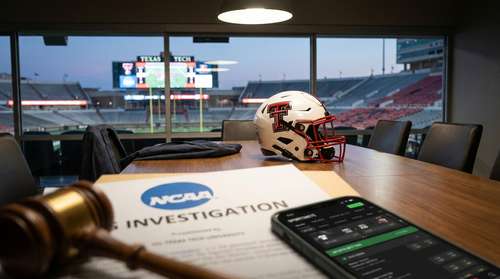
The college football world is bracing for a monumental legal collision. At the center of the unprecedented Brendan Sorsby betting scandal is a $5 million star quarterback, a high-stakes championship roster, and a rulebook that could soon be shredded in federal court. Texas Tech standout Brendan Sorsby has officially retained high-profile litigator Jeffrey Kessler to challenge a potential lifetime ban following an NCAA investigation into his wagering history. Sorsby recently took an indefinite leave of absence to enter a residential treatment program for gambling addiction. Now, with his collegiate career on the line, the stage is set for a landmark legal battle over the NCAA's strict gambling policies.
Inside the NCAA Gambling Investigation 2026
The details emerging from the NCAA gambling investigation 2026 paint a complex picture of modern athlete behavior in an era of legalized sports wagering. According to reports, Sorsby placed over 10,000 alleged wagers across multiple sports using a mobile gambling app. Crucially, investigators discovered bets placed on Indiana University football games during the 2022 season, when Sorsby was a redshirt freshman for the Hoosiers.
Although sources indicate he did not bet on the single game he appeared in, NCAA bylaws dictate that student-athletes who wager on their own school’s teams face a permanent loss of eligibility. Further reports allege a steady volume of micro-wagers, including live, pitch-by-pitch bets ranging from less than a dollar up to $2.50 during Cincinnati Reds baseball games. As state regulatory commissions in Ohio and Indiana launch parallel integrity inquiries, the controversy has sparked an urgent national dialogue regarding college football betting integrity.
Why Jeffrey Kessler Sports Lawyer Changes the Calculus
The retention of Jeffrey Kessler sports lawyer transforms this case from a straightforward eligibility violation into an existential legal threat for the NCAA. Kessler is a titan of sports antitrust litigation. He successfully represented Tom Brady during the "Deflategate" saga and recently secured the historic House v. NCAA settlement that paved the way for modern athlete revenue sharing.
By bringing Kessler into the fold, Sorsby's camp is sending a clear message: they are prepared to aggressively fight a permanent ban. Kessler's involvement forces the NCAA to operate cautiously, as the governing body is already navigating court-imposed constraints from previous antitrust losses. Sorsby is initially seeking a negotiated resolution, but Kessler is reportedly ready to take the NCAA to court if a settlement cannot be reached. A potential NIL gambling lawsuit could seek an injunction, arguing that stripping an athlete of their livelihood over legalized mobile betting—while universities sign multi-million-dollar data deals with sportsbooks—violates antitrust principles.
Major Texas Tech Football News: A $25 Million Roster on the Brink
This development is seismic Texas Tech football news. The Red Raiders entered the spring as a heavy favorite to claim the Big 12 championship, largely due to Sorsby's arrival. Sorsby transferred to Texas Tech from Cincinnati after a standout 2025 campaign where he threw for 2,800 yards and 27 touchdowns. Texas Tech’s billionaire boosters invested roughly $25 million into the roster, with Sorsby acting as the $5 million crown jewel of that operation.
If Sorsby is ruled permanently ineligible, Texas Tech will have to rely on a recovering backup, Will Hammond, or Tulsa transfer Kirk Francis to lead the offense. The fallout has drawn sharp reactions across the sport. Recently, former head coach Urban Meyer publicly condemned politicians and sportsbooks for aggressively marketing mobile wagering apps to young people, highlighting the systemic failures that leave athletes vulnerable to addiction. Meyer argued that legalized mobile betting has rewired what young athletes are tempted with daily. This incident underscores the mounting challenges of Big 12 sports betting regulations as gambling culture permeates college campuses.
The Mental Health Aspect of Athlete Gambling
While the legal and athletic ramifications dominate the headlines, Sorsby's decision to enter a residential treatment facility for gambling addiction highlights a growing mental health crisis in sports. Texas Tech head coach Joey McGuire has publicly supported his quarterback, emphasizing that the program's primary focus is on Sorsby's personal health and recovery above football.
The Path Forward: Legal Action or the NFL Supplemental Draft?
As Sorsby remains in treatment, the clock is ticking toward the 2026 season. The NCAA has yet to provide Texas Tech or Sorsby with a definitive timeline for the investigation's conclusion, leaving his college career hanging in the balance.
Should Kessler’s negotiation tactics and a prospective lawsuit fall short, Sorsby has a compelling backup plan. Evaluators considered him a potential first-round talent for the NFL Draft before the scandal broke. A ban from college football could prompt him to enter the NFL Supplemental Draft this summer, making him the most prominent player to take that route since Josh Gordon in 2012. For now, the entire sports world is watching Lubbock. The Brendan Sorsby case is not merely about one quarterback's mistake; it is a profound legal stress test that will define the future of college athletics, athlete mental health, and gambling enforcement for years to come.