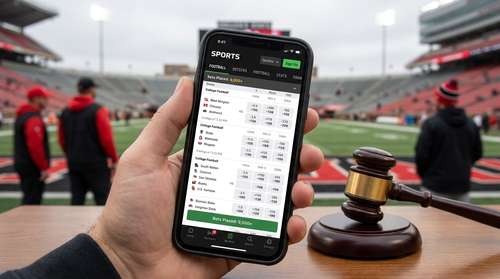
The landscape of collegiate athletics was completely rocked this week by a controversial court decision surrounding the Brendan Sorsby sports betting scandal. In an unprecedented move, a Texas judge cleared the Texas Tech signal-caller to hit the gridiron this fall, despite his admission to placing over 9,000 wagers totaling at least $90,000. For decades, wagering on your own team was the ultimate unwritten sin in sports. Now, the outcome of this case has fundamentally shifted the balance of power, sparking fury across rival programs and throwing the NCAA's authority into absolute chaos.
Breaking Down the Brendan Sorsby Injunction
Lubbock County District Court Judge Ken Curry delivered the bombshell ruling on June 8, 2026, granting a temporary injunction that prevents the NCAA from enforcing its permanent ban on the former Cincinnati and Indiana player. To understand the gravity of the Texas Tech quarterback gambling case, you have to look at the numbers. During his collegiate career, Sorsby made thousands of college football sportsbooks bets. Astonishingly, at least 40 of those wagers involved Indiana football games while he was actively on the Hoosiers' roster in 2022.
Despite crossing the ultimate red line in competitive sports, the Brendan Sorsby injunction guarantees his right to play. Sorsby's legal team, led by high-profile sports attorney Jeffrey Kessler, successfully argued that a permanent ban would cause the athlete probable, imminent, and irreparable injury. They framed his gambling as a clinical mental health disorder that requires treatment, rather than a career-ending offense. As a result, the court mandated a mere two-game suspension—a penalty proposed by Sorsby's own attorneys—along with ongoing counseling.
Enraged Rivals React to the Sports Betting Scandal NCAA
The reaction from the collegiate sports world was swift and merciless. Administrators across the country are livid that the NCAA college football gambling ban was so easily bypassed by a local county judge. The frustration stems from the existential threat to the integrity of the game. If an athlete can actively wager on their own team and avoid a lifetime ban by claiming a medical disorder and citing the loss of their lucrative NIL deals, many fear the foundational trust in the sport is shattered.
Boycott Threats and Big 12 Emergency Meetings
Rival athletic directors are reportedly contemplating a frontier justice approach. Kansas State athletic director Gene Taylor didn't mince words, describing the ruling with expletives, while Georgia athletic director Josh Brooks publicly suggested that schools should refuse to play Texas Tech. The prospect of an outright boycott is very real. Putting athletes on a field where the competitive integrity of the contest is compromised is a line many programs simply refuse to cross. In response to the escalating outrage, Big 12 Commissioner Brett Yormark quickly convened an emergency meeting to discuss the sweeping ramifications of the decision.
The NCAA Fights Back Over Brendan Sorsby Eligibility 2026
Unsurprisingly, the sport's governing body is not taking this legal defeat lying down. Following the injunction that established Brendan Sorsby eligibility 2026, the NCAA issued a scathing statement. Officials warned that the court's intervention "undermines and corrupts the integrity of sports," creating broadly destabilizing ramifications for the entire industry. The organization has already announced its intention to appeal the decision to the Court of Appeals for the Seventh District of Texas in Amarillo.
However, the damage to the NCAA's enforcement authority may already be done. The injunction explicitly prevents the NCAA from penalizing any university that competes against the Red Raiders this season. This hidden weapon within the court order quietly neutralizes the governing body's most powerful enforcement tool: the Rule of Restitution.
The Future of College Football Sportsbooks Bets
With Texas Tech fully backing their quarterback—protecting a reported $5 million NIL investment—the sports betting scandal NCAA represents a turning point. We are now witnessing a bizarre reality where the legal system prioritizes an individual athlete's financial and professional prospects over the broader competitive integrity of the league.
As the 2026 season approaches, all eyes will be on Lubbock. Will Sorsby take the field against Houston in week three? Will opposing teams actually forfeit their games in protest? One thing is certain: the conversation around college football sportsbooks bets and athlete accountability will never be the same. The collision course between billion-dollar sportsbooks, massive NIL payouts, and collegiate enforcement has finally reached its breaking point.