
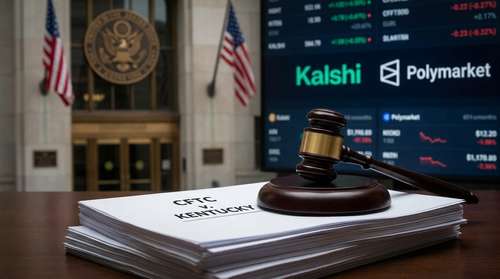
The federal government and state regulators are locked in an unprecedented clash over the future of the booming multi-billion-dollar event contract industry. On Tuesday, June 23, as the CFTC sues Kentucky prediction markets, the move officially makes the Bluegrass State the ninth battleground in a nationwide campaign by the U.S. Commodity Futures Trading Commission to assert federal dominance. The federal lawsuit is a direct countermeasure to recent enforcement actions targeting the Kalshi Polymarket sports betting ecosystem, pulling the legal status of these innovative exchanges into a high-stakes jurisdictional war. The outcome of this preemption fight will reshape the U.S. betting landscape, dictating who ultimately controls this rapidly evolving financial frontier.
The Core of the Illegal Sportsbook Lawsuit
The conflict reached a boiling point on June 17 when Kentucky Attorney General Russell Coleman filed lawsuits in state court targeting Polymarket, Kalshi, and their affiliated distribution partners—prominent brokerages including Coinbase, Robinhood, and Webull. State officials accuse these federally registered exchanges of operating a massive, unlicensed gambling enterprise masquerading as a financial market. In a public statement, Coleman did not mince words, claiming the platforms' legal defenses fail the 'sniff test' and straightforwardly labeling them illegal sportsbooks.
In this escalating sports event contracts legal battle, Kentucky argues that tradeable instruments tied to real-world outcomes fall squarely within the state's legal definition of sports wagering. Because these platforms allow users to place trades that economically resemble money lines, point spreads, and player prop bets, the state insists they must be regulated by the Kentucky Horse Racing and Gaming Corporation. The state further claims these platforms fail to offer consumer protections for problem gamblers, which are mandated for locally licensed operators. This fundamental disagreement represents the core of the ongoing debate regarding prediction markets vs sportsbooks.
Weaponizing the Kentucky Sports Betting Tax
Beyond civil enforcement, the CFTC's federal complaint highlights a severe financial and regulatory obstacle recently erected by state lawmakers. Earlier this spring, the Kentucky General Assembly passed legislation enacting a staggering 14.25% excise tax on prediction market transaction fees, an unprecedented levy scheduled to take full effect on January 1, 2027.
Federal regulators, along with the industry-backed Coalition for Fair Markets, argue this new tax is intentionally discriminatory and preempted by federal law. In its complaint, the CFTC claims that the Kentucky sports betting tax is deliberately structured to make it economically impossible for prediction platforms to sustain operations within the state's borders. By imposing a massive tax rate strictly on event contracts—sweeping in trades concerning not just sports, but political elections, economic data, and global weather patterns—Kentucky is effectively orchestrating a backdoor ban on federally regulated financial products.
Breaking the Blue-State Pattern
The lawsuit also carries significant political weight. Before this week, the CFTC had initiated legal challenges against eight other states—including New York, Illinois, Minnesota, Rhode Island, and Arizona—all of which featured Democratic attorneys general. The aggressive move against Kentucky breaks this pattern, marking the first time the agency has sued a state led by a Republican attorney general. This bipartisan sweep signals that the federal government's push to defend its exclusive authority transcends party lines, focusing strictly on protecting its regulatory turf.
Navigating Sportsbook Regulation: CFTC and the Future of Event Trading
The core of the agency's argument relies on the Commodity Exchange Act. The CFTC maintains that sports-linked event contracts are officially classified as 'swaps'. By this legal definition, Congress granted the federal government exclusive jurisdiction over the regulation of derivative markets, fully preempting local gambling statutes. CFTC Chairman Michael Selig recently defended this stance, stating that prediction markets provide valuable information and crucial risk management products to citizens, while pledging to forcefully combat any state that infringes upon federal territory.
For industry leaders like Kalshi and Polymarket—which collectively recorded an astonishing $25 billion in monthly trading volume in May alone—the stakes are nothing short of existential. If the courts ultimately decide that state lawmakers have the primary authority to oversee these trades, prediction markets could be forced to acquire highly restrictive traditional gaming licenses on a state-by-state basis, fundamentally disrupting their operations. Conversely, a decisive federal victory would cement their status as financial derivatives, shielding the platforms from local legal hurdles and paving the way for further integration with mainstream Wall Street powerhouses.