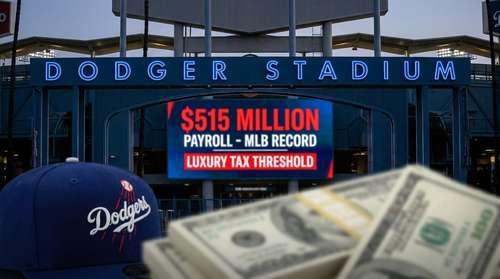
The Los Angeles Dodgers have officially pushed the boundaries of baseball economics into uncharted territory. Fresh off hoisting their second consecutive championship trophy, the front office has committed to a staggering figure that has the rest of the league taking a collective gasp. Official opening week financial data released in mid-April confirms the Los Angeles Dodgers payroll 2026, combined with their staggering luxury tax penalties, has officially surpassed $514 million. This astronomical total—hovering just around the $515 million mark—makes them the undeniable kings of the highest MLB team spending and essentially outpaces the combined financial commitments of six different big-league franchises.
As the baseball world digests this news, the disparity between the haves and have-nots has never been more glaring. Operating with a payroll that is nearly seven times higher than the league's lowest-paying clubs, like the Miami Marlins, the Dodgers have assembled a roster that resembles an All-Star squad. Building a true Dodgers World Series dynasty comes with a hefty price tag, and the team's ownership group has demonstrated they are perfectly willing to pay it.
Shattering MLB Luxury Tax Records
Reaching the $515 million threshold isn't just about base salaries; it is a combination of massive guaranteed contracts and unprecedented penalties. The Dodgers shattered previous MLB luxury tax records by triggering the highest penalty tiers outlined in the collective bargaining agreement. Their estimated active payroll accounts for roughly $345 million, while the associated competitive balance tax accounts for the remaining $169 million, creating a financial commitment that easily eclipses the previous benchmark set by the New York Mets in 2024.
Los Angeles has adopted a win-at-all-costs philosophy. Rather than cutting spending after back-to-back championships in 2024 and 2025, the organization has doubled down. The luxury tax acts as a soft cap, heavily taxing teams that exceed certain financial tiers. By blasting through the highest threshold, the Dodgers are essentially paying a dollar-for-dollar premium on top of their roster additions. Yet, the revenue generated from consecutive October parades and massive international broadcasting rights has seemingly neutralized the sting of these massive fines.
The Genius of Shohei Ohtani Salary Deferrals
The financial gymnastics required to float a half-billion-dollar roster without going bankrupt begin and end with one man. When the front office secured the two-way superstar, they structured a 10-year, $700 million contract that reshaped baseball economics. The Shohei Ohtani salary deferrals are the lifeblood of the 2026 roster design. By deferring $68 million of his $70 million annual salary until 2035, Ohtani gave the franchise the liquidity needed to sign other premium talent.
For luxury tax purposes, Ohtani still carries roughly a $46 million average annual value hit, which heavily contributes to the total spending figures. However, the actual cash savings in the present day allowed Los Angeles to secure extensions and free agents without violating their own cash-flow limitations. This masterstroke paved the way for adding pitching depth, securing elite bullpen arms, and keeping franchise cornerstones in Dodger Blue. It is a strategy that remains perfectly legal under the current collective bargaining agreement, even as rival executives quietly express their frustration over the loophole.
The High-Stakes Roki Sasaki MLB Contract
The final piece of this unstoppable juggernaut arrived from Japan, solidifying the most feared starting rotation in the modern era. After intense speculation, the Roki Sasaki MLB contract materialized, bringing the Japanese phenom to Southern California to pitch alongside Ohtani and Yoshinobu Yamamoto. Because Sasaki jumped to the major leagues before turning 25, he was classified as an international amateur, meaning he was restricted to a minor-league deal and the team's available international bonus pool money.
While his initial signing bonus was a modest $6.5 million, his presence carries high stakes. Sasaki brings a triple-digit fastball and a devastating splitter to a rotation that already features elite talent. In 2026, Sasaki is earning a major league base salary of roughly $800,000. Despite his microscopic cap hit, his acquisition required complex international pool money trades and signaled to the rest of the league that the Dodgers are the premier destination for global talent. Getting a top-of-the-rotation starter at a league-minimum salary is the ultimate bargain, offsetting the massive deals weighing down the rest of the ledger.
Reigniting the MLB Salary Cap Debate
The sheer magnitude of the Los Angeles Dodgers payroll 2026 has predictably ruffled feathers in front offices from Tampa Bay to Milwaukee. With one team outspending a quarter of the league combined, the MLB salary cap debate is reaching a boiling point among owners and fans alike.
- Competitive Imbalance: Critics argue that small-market teams physically cannot generate the $514 million required to compete with Los Angeles, creating a predictable, top-heavy league where big-market franchises lap the competition.
- The "Dodger Rule": Rumors are already swirling that the next collective bargaining agreement negotiations will feature fierce battles over limiting contract deferrals, aimed directly at the Dodgers' current blueprint.
- Revenue Sharing Questions: Owners of lower-spending clubs are facing backlash from their fan bases, who wonder why revenue-sharing dollars aren't being invested back into their own rosters instead of maintaining microscopic $68 million payrolls.
For now, the rules remain the rules. The Los Angeles front office has operated brilliantly within the confines of the system, leveraging their massive market advantage to build an indomitable force. As they chase a historic three-peat this summer, the rest of baseball is left to watch, learn, and figure out how to beat a $515 million machine.