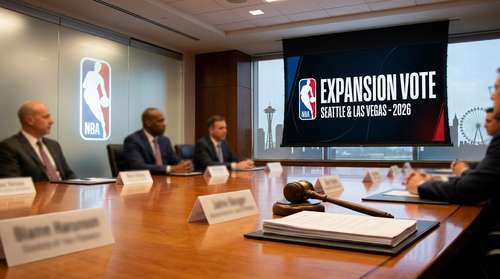
The wait is almost over for basketball fans in two of America's most sports-hungry cities. According to a groundbreaking Shams Charania expansion report released this morning, the league is taking its most definitive step toward a 32-team future. The NBA Board of Governors vote is officially scheduled for March 24-25, serving as the formal catalyst for an NBA expansion 2026 process that will likely transform the landscape of professional basketball. If approved, the league will exclusively target the highly anticipated Seattle SuperSonics return and the creation of a brand new Las Vegas NBA franchise. Both organizations are actively targeting a return to the hardwood for the 2028-29 regular season.
Record-Breaking Territory: NBA Franchise Valuation 2026
Adding two new teams to the association is no small financial undertaking. League stakeholders have watched franchise values absolutely explode over the last few seasons, setting a new baseline for the NBA franchise valuation 2026 framework. Industry executives project that ownership bids for the new franchises will fall anywhere between $7 billion and $10 billion per team. This astronomical entry fee reflects the massive long-term revenue growth owners expect to generate from these two specific markets.
To understand how we arrived at these staggering figures, you have to look at recent landmark sales. Mat Ishbia's $4 billion acquisition of the Phoenix Suns in late 2022 seems like a bargain in hindsight. Last year, Bill Chisholm purchased the Boston Celtics at a $6.1 billion valuation, and Mark Walter took majority control of the Los Angeles Lakers for an unprecedented $10 billion. By demanding expansion fees in the $10 billion tier, existing owners ensure their equity isn't diluted without a massive, immediate financial payout to soften the transition from 30 to 32 teams.
Inside the NBA Board of Governors Vote Process
Turning an expansion dream into reality requires a strict parliamentary process. The meetings next week represent the first of two crucial hurdles. During this initial session, the primary goal is to authorize the league office to formally explore purchase processes and solicit official bids exclusively for Seattle and Las Vegas.
For this motion to pass, 23 of the 30 current team governors must cast a vote in favor. Provided the preliminary vote succeeds, the league will follow a strict timeline to launch the clubs:
- March 24-25, 2026: Initial board vote to open the exclusive bidding process for both cities.
- Summer/Fall 2026: A second, final vote to officially ratify the winning ownership groups.
- 2028-29 Season: The targeted inaugural tip-off for the two newest franchises.
Sources indicate there is currently significant momentum inside the league office to get this done, propelled largely by the new parity-friendly collective bargaining agreement and skyrocketing global sports media revenues.
Healing Old Wounds: The Seattle SuperSonics Return
For fans in the Pacific Northwest, today's Seattle basketball news is the culmination of nearly two decades of heartbreak. The SuperSonics were a foundational piece of the city's sports identity from 1967 until their bitter departure to Oklahoma City following the 2007-08 season. The relocation, sparked by disputes over the outdated KeyArena, left a massive void in the community. For a city that produced basketball icons and cultivated one of the most hostile home-court advantages in the sport, watching the Thunder thrive in another state has been an enduring frustration.
Today, the infrastructure issues that cost Seattle its team have been completely resolved. The old venue underwent a massive, multi-year renovation to become Climate Pledge Arena, currently housing the NHL's Kraken and the WNBA's Storm. With the arena situation secured and local appetite at an all-time high, the NBA is perfectly positioned to revive the iconic green and gold colorway—assets the city legally retained during the 2008 settlement.
Doubling Down on the Desert: Las Vegas NBA franchise
While Seattle represents a restoration project, the push for a Las Vegas NBA franchise is about conquering the modern sports capital of the world. Just a decade ago, major professional sports leagues avoided Nevada. Today, Las Vegas boasts the NHL's Golden Knights, the NFL's Raiders, and will welcome MLB's Athletics for the 2028 season.
Basketball has already established a dominant footprint in the desert. The WNBA's Las Vegas Aces have built a modern dynasty, capturing championships in 2022, 2023, and 2025. Combine that success with the annual summer tradition of the NBA Summer League and the newly minted NBA Cup championship games held on the Strip, and a permanent franchise is the logical next step. Vegas offers an unparalleled entertainment infrastructure, premium hospitality for visiting fans, and a corporate sponsor base eager to attach itself to the NBA's global brand.
The Domino Effect: Conference Realignment
Adding two teams to the Western Conference creates an immediate geographic imbalance. If Seattle and Las Vegas join the ranks, the league will expand to 32 teams, meaning 16 teams are required for each conference to maintain competitive symmetry.
According to front-office executives, either the Minnesota Timberwolves or the Memphis Grizzlies will be forced to pack their bags for the Eastern Conference. Moving Minnesota would reunite them with natural geographic rivals like the Milwaukee Bucks and Chicago Bulls, significantly cutting down their league-leading travel fatigue. Conversely, shifting Memphis east would place them in closer proximity to traditional Southeast and Central division opponents. Either way, the ripple effects of next week's vote will reshape the league's competitive balance for decades.