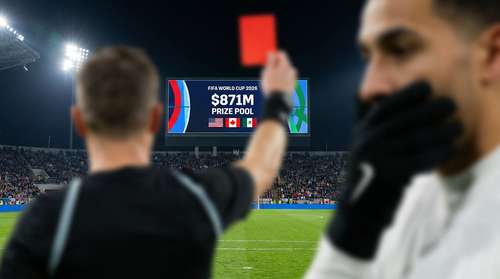
With the expanded 48-team tournament just around the corner, football’s international governing body has implemented sweeping modifications that will drastically alter how the game is officiated in North America. The latest FIFA 2026 rule changes represent one of the most aggressive crackdowns on player dissent in the sport's history. If you are expecting business as usual on the pitch this summer, prepare for a shock.
Following high-stakes meetings with the International Football Association Board (IFAB) in Vancouver this week, officials have ratified strict new protocols. The updates mandate immediate expulsions for specific confrontational behaviors, introduce a highly anticipated World Cup yellow card wipe rule, and confirm a massive financial windfall for participating nations. Here is a breakdown of the monumental shifts headed to the pitch.
The Controversial World Cup Red Card Mouth Covering Ban
For years, a familiar sight in modern football has been players shielding their mouths with their hands while arguing with referees or opponents. This tactic prevents lip-readers and broadcasters from decoding their conversations. Starting this summer, engaging in this behavior during an on-pitch dispute will result in an immediate sending-off.
The World Cup red card mouth covering directive is specifically designed to eliminate hidden abuse, racist remarks, and excessive dissent. FIFA President Gianni Infantino and other executives have taken a hardline stance: if you have to hide what you are saying during a confrontation, officials will operate under a presumption of guilt. The straight red card acts as a severe deterrent to force transparency and protect players from undetectable discriminatory language.
In addition to the mouth-covering ban, the updated FIFA disciplinary rules 2026 stipulate that any player or team official who deliberately leaves the pitch to protest a refereeing decision will also face an instant dismissal. The overarching message to squads arriving in the US, Canada, and Mexico is clear—respect the officials, or your tournament will be cut short.
Revamping the World Cup Yellow Card Wipe Rule
Expanding the tournament to 48 teams brought massive logistical challenges, not least of which was managing player suspensions. Historically, a player receiving two yellow cards across different matches would face a one-game suspension, with bookings only wiping clean after the quarter-finals. However, the introduction of a new Round of 32 means teams must survive up to five matches before reaching that traditional reset point.
To protect the sport's biggest stars from missing crucial knockout fixtures, officials have introduced an updated World Cup yellow card wipe rule. The newly amended framework features a double-reset system. Yellow cards will now be wiped completely clean immediately following the group stage, and then once again after the quarter-finals.
Protecting the Spectacle
Nobody wants to see a repeat of the infamous 2002 semi-final where Michael Ballack was forced to miss the final due to a tactical foul. By introducing a third lifeline, this rule tweak ensures that nations won't lose their best talent to accumulated soft bookings during the extended early knockout rounds. Players can now commit to high-intensity football in the Round of 32 and Round of 16 without the crippling anxiety of a looming suspension.
Record-Shattering 2026 World Cup Prize Money
While the focus on FIFA 2026 player conduct dominates the headlines, the federation also finalized an unprecedented financial package. Capitalizing on the sheer commercial power of hosting the event across North America, the 2026 World Cup prize money pool has ballooned to a staggering $871 million.
This figure represents a 15% increase from previously projected totals and absolutely dwarfs the $440 million awarded in Qatar in 2022. The massive fund is structured to help associations handle the complex logistics of a multi-country tournament spanning across different time zones and climates. Preparation money alone has surged, with each of the 48 participating teams guaranteed $2.5 million just to cover training camps, travel expenses, and friendlies leading up to the main event.
Furthermore, qualification bonuses have increased to $10 million per team, rewarding the grueling multi-year effort required to secure a ticket to the expanded showcase. For smaller federations making their debut on the world stage, this financial injection will completely revolutionize their domestic football programs.
What to Expect Moving Forward
Understanding the impact of these FIFA 2026 rule changes will be vital as fans and teams adjust to the new reality. Managers will need to rigorously drill their squads on the updated communication protocols. A careless hand over the mouth during a heated penalty dispute could leave a team down to ten men in an instant. Simultaneously, coaches can breathe a sigh of relief knowing the forgiving card-wiping schedule offers a buffer for their key playmakers.
Tracking World Cup 2026 news reveals a definitive shift in how international football will operate. As the global spotlight turns to the United States, Canada, and Mexico, anticipate a tournament defined by zero-tolerance officiating, unparalleled financial stakes, and ultimately, a fairer environment for the beautiful game to flourish.