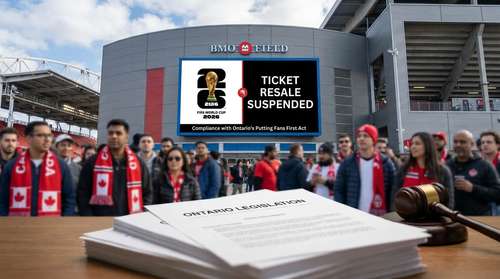
If you logged into the official ticketing portal this weekend hoping to score a seat for the upcoming matches in Canada, you likely noticed a glaring omission. In an unprecedented move, FIFA has officially suspended all resale transactions for the six games scheduled in Toronto. The sudden blackout of FIFA World Cup 2026 tickets for this specific venue isn't a technical glitch—it's the direct result of groundbreaking provincial legislation. Late last month, Ontario passed the Putting Fans First Act Ontario, a strict new law prohibiting the resale of event tickets above their original face value. For a global ticketing machine accustomed to massive secondary market markups, the legislative strike forced an immediate shutdown of the Toronto exchange while executives scramble to reconfigure the system.
Breaking the Scalping Market in Ontario
The newly minted legislation, which formally took effect in late April 2026, aims to eliminate the rampant price gouging that has long plagued major sporting events and concerts. The mandate is incredibly straightforward: no person or platform can sell or facilitate the sale of a ticket on the secondary market for more than its original face value, including any applicable fees or service charges. This effectively stops scalpers from turning a profit.
As a result, FIFA was legally compelled to wipe Toronto World Cup resale listings entirely clean from its official platform. It isn't just FIFA feeling the pressure, either. Third-party secondary platforms like StubHub, which previously hosted listings for Toronto matches exceeding $72,000, have also been ordered to update their systems to comply or face massive penalties. FIFA confirmed the organization's backend is currently undergoing mandatory reconfigurations to align with the provincial cap. Until those updates are finished, the secondary market for Toronto remains frozen in limbo.
A Direct Hit to World Cup 2026 Dynamic Pricing
This localized legislative victory highlights a much larger FIFA ticket controversy. Across the other 15 host venues in the United States, Mexico, and even Vancouver, the secondary market remains largely unregulated by such strict caps. Because those jurisdictions lack this specific localized resale cap, World Cup 2026 dynamic pricing and unchecked secondary inflation continue to run rampant. In fact, some Category 3 tickets for the tournament final were recently listed on the exchange by sellers demanding an eye-watering $11.5 million.
FIFA has publicly defended its secondary market model, stating that it operates as a not-for-profit organization and that any revenue generated from the platform is reinvested into the global development of football. However, Ontario's intervention provides a stark contrast to that system. By capping the secondary market, the province has effectively killed the predatory resale culture for its localized matches. Professional resellers who utilized bulk-buying tactics to secure initial drops can no longer flip their digital assets for astronomical profit margins. As an example, if an initial buyer paid $600 for a seat, they are legally bound to resell it for exactly $600.
The Impact on BMO Field World Cup Matches
Toronto is slated to host six critical games this summer, making the ticketing freeze a high-stakes waiting game. The crown jewel of the city's schedule is the host nation's opening fixture, where Canada will take on Bosnia on June 12. With over five million tickets already sold globally out of the expected six million for the tournament, securing a spot for these BMO Field World Cup matches has been a fiercely competitive endeavor.
While the resale portal for Toronto is temporarily dark, standard face-value tickets do remain accessible through FIFA's primary last-minute sales phases, subject to availability. The organization traditionally collects a 15 percent surcharge from both buyers and sellers on its secondary platform. While FIFA adjusts to the new legal reality, the suspension leaves Toronto as the only city among the 16 host venues without active resale ticket listings.
Stabilizing World Cup 2026 Ticket Prices
Industry watchdogs are monitoring whether Ontario's aggressive stance will inspire similar consumer protection laws in other host cities before the tournament kicks off on June 11. For now, Toronto stands completely alone as a designated no-profit zone for scalpers.
FIFA is expected to relist the pulled tickets soon, once the platform accurately restricts input fields to mirror original purchase costs. When the portal inevitably comes back online, fans looking for World Cup 2026 ticket prices in Toronto will experience something entirely unique to the massive tournament: a fair, predictable, and legally mandated secondary market.