With just 40 days remaining until the highly anticipated June 11 kickoff at Estadio Azteca, securing FIFA World Cup 2026 tickets has become a fiercely competitive sport of its own. FIFA's newly expanded 48-team format means a record number of matches are being staged across North America this summer. However, as the last-minute sales phase enters its final month this May, supporters are slamming the controversial introduction of "dynamic pricing" for the remaining seats. While thousands of tickets are still available for less prominent group stage fixtures, marquee matchups have seen their prices surge into the thousands. This unprecedented cost structure has sparked intense global debate about the tournament's accessibility for average fans right before the action begins.
The Reality of World Cup 2026 Ticket Prices
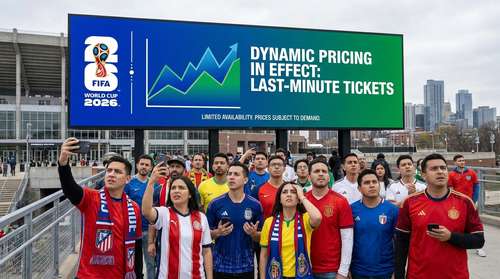
For the very first time in the tournament's history, FIFA has abandoned its traditional flat-rate system in favor of a dynamic pricing model. Similar to strategies utilized by airlines and major concert promoters, this algorithm means World Cup 2026 ticket prices fluctuate in real-time based on supply, demand, and team popularity. Many loyal supporters have been highly vocal, with prominent fan groups labeling the pricing strategy a "monumental betrayal" of the working-class football community.
While officially recognized national team supporters had access to a $60 Supporter Entry Tier earlier in the cycle, the current general sale paints a much starker financial picture. Today, fans can still secure Category 3 seats for roughly $380 for select, lower-demand group stage games. However, for top-tier nations like Argentina, Brazil, and England, premium Category 1 and Category 2 tickets have surged well past the $2,000 mark. The tournament final, scheduled for July 19 at MetLife Stadium in New Jersey, boasts standard Category 1 face values approaching an eye-watering $7,875 before service fees are even applied.
USMNT World Cup Schedule 2026 Drives Unprecedented Demand
Nowhere is the pricing surge more evident than with the primary host nation. The USMNT World Cup schedule 2026 features three pivotal group-stage clashes entirely on the West Coast, and the get-in price has skyrocketed accordingly. The United States Men's National Team opens their campaign against Paraguay on June 12 at SoFi Stadium in Los Angeles, where the most expensive group-stage tickets recently peaked at an astonishing $4,105 on the primary market.
Following the opener, the USMNT travels north to Lumen Field for a June 19 matchup against Australia, before returning to Los Angeles on June 25 to face Turkiye. Because these matches feature the home team in premium, state-of-the-art venues, the dynamic pricing engine has treated them as ultra-elite events. For the everyday American soccer fan hoping to catch a glimpse of their national heroes making a deep run into the newly introduced Round of 32, the financial barrier to entry has quite literally never been higher.
Navigating the FIFA Ticket Resale Marketplace
As the purchase window rapidly closes, desperate fans are aggressively hunting for last-minute World Cup 2026 tickets. FIFA's official last-minute sales phase opened in late April and operates strictly on a first-come, first-served basis. For those who continually miss out on these primary digital drops, the official FIFA ticket resale marketplace stands as the only legally sanctioned alternative to secure stadium access.
FIFA maintains that it does not manually dictate the resale prices on its platform, allowing market demand to set the terms. However, the governing body collects a substantial 30% commission on transactions conducted within this official marketplace. This hefty fee structure, combined with already inflated dynamic face-value prices, has created a secondary market where fans are paying massive premiums. Despite the widespread public outcry, Major League Soccer Commissioner Don Garber recently defended the strategy, publicly calling FIFA "smart" to leverage variable pricing for a sporting event of this historic magnitude.
104 Matches FIFA 2026: A Sprawling North American Spectacle
Even with the ongoing pricing controversy dominating headlines, the sheer scale of this summer's tournament cannot be overstated. Featuring exactly 104 matches FIFA 2026 is officially the largest iteration in the century-long history of the sport. The massive 48-team expansion guarantees more football than ever before, but it also creates logistical and financial hurdles for traveling fans.
Alternative Options in the 2026 World Cup Host Cities
The 16 sprawling 2026 World Cup host cities across the United States, Mexico, and Canada are heavily preparing for an influx of millions of international visitors who may not even hold match tickets. For those officially priced out of the biggest stadium games, host cities are heavily investing in official FIFA Fan Festivals. Locations like the Los Angeles Memorial Coliseum will transform into massive viewing parties, ensuring the cultural impact of the tournament reaches beyond those who can afford the dynamic premium.
FIFA President Gianni Infantino recently noted that the staggering ticket demand is the equivalent of "1,000 years of World Cups at once". Ultimately, while 17 high-profile matches—including Mexico's June 11 opener against South Africa—are completely sold out, the massive match inventory ensures that seats do exist for those willing to pay the price. Whether this dynamic pricing model becomes the accepted new standard for global soccer or goes down as a deeply unpopular one-time experiment will likely depend on the atmosphere in the stands this June.