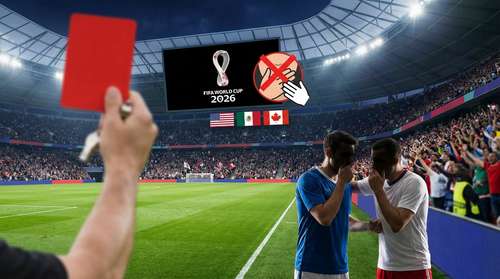
The landscape of global football is about to undergo one of the most drastic behavioral shifts in its history. In a landmark decision that will forever alter how players interact on the pitch, the International Football Association Board (IFAB) has officially approved strict FIFA 2026 new rules aimed at completely eradicating hidden verbal abuse. Most notably, the World Cup red card mouth covering mandate—unofficially dubbed the Vinicius Law FIFA—will grant referees absolute discretion to dismiss any player caught using their hand or jersey to conceal their speech during an altercation.
The "Vinicius Law" and the Eradication of On-Field Abuse
For decades, footballers have reflexively raised their hands or pulled their collars over their mouths to hide conversations from broadcast cameras, amateur lip-readers, and observant referees. Historically, this physical barrier created significant hurdles for disciplinary committees attempting to investigate allegations of on-pitch abuse. Moving forward into the next global tournament, that deeply ingrained habit will carry the ultimate disciplinary consequence.
The sweeping updates to soccer on-field abuse rules follow a highly publicized incident in February 2026 involving Real Madrid’s Vinícius Jr and Benfica’s Gianluca Prestianni. Following a heated exchange, Vinícius accused Prestianni of racial abuse. Prestianni, who had visibly shielded his mouth with his shirt, denied the racist allegations but was later banned by UEFA for six matches after admitting to using a homophobic slur. By turning mouth-covering into a straight red-card offense, governing bodies are eliminating the ability to mask discriminatory language.
The new mandate entirely flips the script, removing the burden of perfect lip-reading from the equation. If an athlete feels the need to hide their words during a heated exchange, the act of hiding itself becomes an instantly punishable offense.
Sweeping World Cup 2026 Disciplinary Changes
The new regulations were formalized during a special meeting of the sport's lawmakers. These FIFA Council Vancouver updates demonstrate a zero-tolerance approach to poor discipline ahead of the North American tournament. Beyond the headline-grabbing mouth-covering ban, IFAB confirmed several other massive World Cup 2026 disciplinary changes to protect officials and maintain the flow of the game.
Walk-Off Protests Lead to Immediate Forfeits
Another major rule amendment targets collective protests against match officials. Players who walk off the field in disagreement with a refereeing decision can now be shown an instant red card. Furthermore, any team official or coach who incites a walkout will face the same severe punishment, and the offending team will forfeit the match.
This specific provision serves as a direct response to the chaos at the January 2026 Africa Cup of Nations final in Rabat. During that match, Senegal head coach Pape Thiaw ordered his squad off the pitch to protest a stoppage-time penalty awarded to Morocco by referee Jean-Jacques Ndala. The game was stalled for nearly 18 minutes, resulting in CAF stripping Senegal of the title and awarding Morocco a 3-0 walkover victory. FIFA is ensuring a similar spectacle does not embarrass the sport on its grandest stage.
Double Amnesty Yellow Card System
To balance the strict new red card policies, lawmakers also introduced a progressive "Double Amnesty" system for yellow cards. Cautions will now be wiped clean after the group stage and once again after the quarterfinals. This adjustment is designed to prevent superstar athletes from missing the World Cup final due to accumulated minor infractions, ensuring the best players remain available for the biggest matches.
A New Era of 2026 World Cup Refereeing
FIFA President Gianni Infantino has firmly backed the drastic shift in protocol, supporting a new "presumption of guilt" for athletes who intentionally obscure their speech during aggressive encounters. The logic is straightforward: if you have nothing to hide, you do not need to hide your mouth.
However, this no-nonsense approach completely alters the dynamic of 2026 World Cup refereeing. Match officials are now burdened with judging the intent behind a player's physical movements in real-time. In a tournament where margins are incredibly thin, a referee’s subjective decision to send off a star player for raising a hand to their face could quickly become the most fiercely debated VAR intervention in football history.
As national teams begin their final preparations for the upcoming World Cup, coaches will have to aggressively reprogram their players' on-field behavior. Muscle memory dictates that players cover their mouths, but the threat of leaving their team down a man will force a rapid behavioral adjustment. The message from IFAB and FIFA is uncompromising. On the pitch, total transparency is no longer an optional courtesy—it is a strictly enforced law.