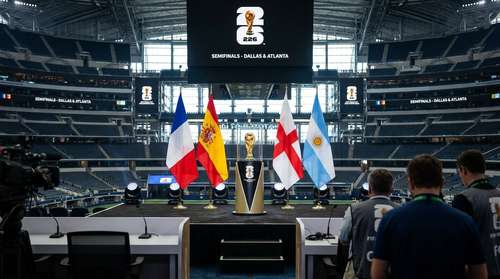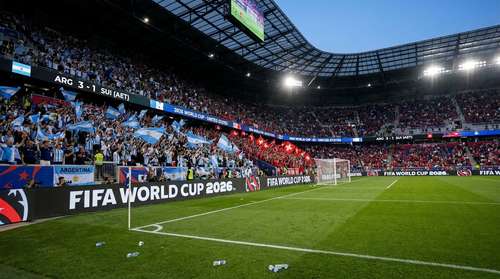
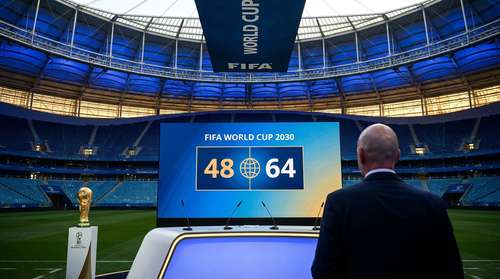
The dust hasn't even settled on the historic tournament in North America, yet world football's governing body is already plotting its next massive overhaul. In a recent interview with Swiss media outlet Bluewin, FIFA President Gianni Infantino confirmed that a staggering FIFA World Cup expansion to 64 teams is officially on the table for future editions. While fans are still digesting the latest FIFA World Cup 2026 news and analyzing the tactical shifts seen across the United States, Mexico, and Canada, executives are looking ahead to the 2030 centennial edition. Driven by what leadership views as a 48-team World Cup success, the proposed changes have ignited immediate debates surrounding global representation, massive logistical hurdles, and the ever-growing concerns over the player fatigue World Cup schedule. It represents a paradigm shift that could alter international football permanently.
Why FIFA Believes the 48-Team Format Was a "Huge Success"
Before the action kicked off in the United States, Canada, and Mexico, critics were incredibly vocal about diluting the quality of the tournament and cheapening the group stages. However, speaking directly to the press this weekend, Infantino painted a completely different picture of the month-long spectacle. He hailed the current iteration as an undisputed triumph, pointing specifically to the rise of underdog nations on the global stage.
"It's been a huge success with 48 teams," Infantino told Bluewin. "Every team played at a high level. Teams from every continent scored goals and earned at least one point. Nine out of 10 African teams reached the knockout stage. At the last World Cup, there were only five teams from Africa".
For the FIFA brass, this increased participation is the ultimate justification for exploring a Gianni Infantino 64-team World Cup. The core philosophy pushed by the administration is that smaller nations will lack the incentive to invest in grassroots development if they cannot realistically dream of qualifying for football's biggest spectacle. By throwing the doors open to 64 teams, FIFA argues they are democratizing the sport, giving developing programs vital television revenue, global exposure, and high-stakes match experience.
Decoding the Potential World Cup 2030 Format
If these football tournament format changes are approved, how would a 64-team tournament actually function? While the 2026 edition utilized a somewhat convoluted group stage that required three matchdays to eliminate only a third of the field, a 64-nation setup could ironically streamline the opening phase.
Under a 64-team structure, the World Cup 2030 format would likely return to a clean symmetry: 16 groups of four teams. The top two nations from each group would automatically advance to a knockout stage starting with a Round of 32. This eliminates the complex mathematics of third-place qualifiers and ensures every final group stage match carries immense weight.
The primary trade-off, however, is a massive ballooning in the total number of fixtures. Expanding the field would increase the tournament from 104 matches to an incredible 128 games. Hosting 128 matches presents extraordinary challenges for municipal infrastructure, security forces, and transit systems. The 2030 tournament is already a sprawling multi-continent endeavor, primarily hosted by Morocco, Portugal, and Spain, with commemorative opening matches slated for South American countries. Accommodating 16 extra squads means preparing more base camps, securing more training facilities, and executing immense logistical gymnastics. This increased volume of matches could severely limit the number of countries capable of hosting independently, making massive cross-border co-hosting bids essentially mandatory for all future tournaments.
The Backlash: Evaluating the Player Fatigue World Cup Schedule
Unsurprisingly, the tease of yet another FIFA World Cup expansion has drawn sharp criticism from player unions, domestic league managers, and sports scientists. The global football calendar is already bursting at the seams, and introducing a 64-team tournament only exacerbates the physically punishing player fatigue World Cup schedule.
Top-tier athletes are currently being asked to navigate extended domestic club seasons, a newly expanded 32-team FIFA Club World Cup, and rigorous continental qualifiers. Adding more teams to the flagship summer event could push physical and mental limits to a breaking point, risking an epidemic of soft-tissue injuries. Furthermore, critics argue that giving nearly a third of FIFA's member associations a guaranteed ticket to the main event severely diminishes the prestige of the qualification process. Regional matches that once served as do-or-die gladiatorial battles could become largely ceremonial, potentially eroding television viewership for qualifiers.
Opposition From Within the Football Ecosystem
Even inside the sport's administrative bubbles, a 64-team concept hasn't been universally embraced. Concacaf President Victor Montagliani previously voiced firm concerns that pushing the tournament to 64 teams might not be the right move for the broader football ecosystem, warning that the ripple effects on national team setups and domestic club competitions could be severe. A tournament of this magnitude risks monopolizing the global sporting calendar, overshadowing other competitions, and demanding an unprecedented commitment from host nations.
Is a 64-Nation Tournament Inevitable?
Despite the widespread pushback regarding player welfare and logistical constraints, the financial incentives might be too massive for the governing body to ignore. The organization projected a staggering, record-breaking $9 billion in revenue from the 2026 cycle alone, driven heavily by expanded television rights and corporate sponsorships. Adding 24 more games to the global broadcast packages and selling hundreds of thousands of additional stadium tickets for 2030 represents a lucrative financial windfall that member nations will likely vote to approve.
The relevant FIFA committees will officially review the expansion proposal in the coming months once comprehensive debriefs of the 2026 event are concluded. While football traditionalists might scoff at the idea of a 64-team field, arguing it sacrifices quality for quantity, the reality is that international football is expanding rapidly into new markets. If the North American experiment taught fans anything, it is that world football's governing body is never afraid to rewrite the rulebook in pursuit of global growth, political capital, and record-breaking revenue. Whether the players' bodies can withstand the demand, however, remains the biggest unanswered question.