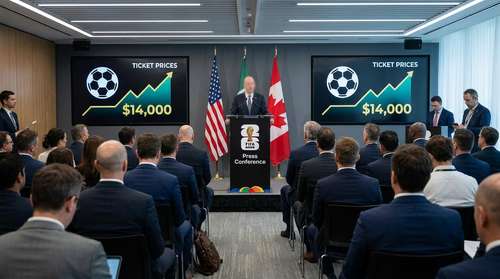
As the final countdown to North America's historic soccer spectacle begins, FIFA World Cup 2026 ticket prices have ignited a firestorm of global backlash. Soccer's governing body is facing unprecedented scrutiny after semi-final seats surged past $14,000. Instead of walking back the astronomical figures, FIFA President Gianni Infantino doubled down this week, justifying the exorbitant fees as standard for the American entertainment landscape. The defiant stance comes right as the tournament launches into its chaotic final purchasing phase, prompting enraged supporters to take unprecedented legal action against what they are calling a monumental betrayal of the sport's working-class roots.
Market Rates in a Developed Entertainment Landscape
Speaking at the Milken Institute Global Conference in Beverly Hills, the architect of the expanded 48-team tournament showed no remorse for the sticker shock fans are currently experiencing. When pressed on the reality that everyday supporters are being priced out of the stadiums, the Gianni Infantino 2026 World Cup strategy was laid bare: charge what the host nations' economies can bear.
We have to look at the market, Infantino told attendees. We are in the market in which entertainment is the most developed in the world. So we have to apply market rates.
He argued that if soccer's governing body priced tickets lower, secondary scalpers would simply absorb the profit margins anyway, citing U.S. laws that freely permit ticket resale. Infantino frequently reminds critics that FIFA operates as a non-profit, utilizing the revenue generated in this single month to fund global football development across 211 member nations for the next four years. While FIFA maintains that a portion of early group-stage tickets were available for under $300, the reality of the current marketplace paints a far grimmer picture for fans hoping to witness the knockout stages.
The World Cup Dynamic Pricing Controversy
At the heart of this financial barrier is a massive shift in how entry is sold. For the first time in the tournament's nearly century-long history, organizers have fully embraced algorithmic ticket valuations, leading directly to the current World Cup dynamic pricing controversy. By allowing prices to fluctuate in real-time based on surging demand and limited supply, the cost of attendance has skyrocketed far beyond initial projections.
The system's implementation has been brutal for consumers. Demand for 2026 World Cup semi-final tickets—matches guaranteed to feature heavy-hitting global powerhouses—has triggered the algorithm to push face-value seats to extreme highs. Meanwhile, the absolute peak of the tournament, the final in New York/New Jersey, has seen secondary listings eclipse the million-dollar mark, though Infantino was quick to point out that listing a ticket for $2 million does not mean someone will actually pay it.
Desperation is only accelerating. With the tournament kicking off in just over a month, the launch of the FIFA last-minute ticket sales phase has forced fans into a frantic, high-stakes bidding war. FIFA has repeatedly defended its structure by pointing to a limited inventory of $60 group-stage tickets. However, consumer watchdog groups note these cheaper categories represented a fraction of the stadium capacity and vanished before general sales even opened. What remains for the average buyer caught in the rush are premium categories heavily subjected to algorithmic inflation.
Monumental Betrayal: The FIFA Fan Organization Lawsuit
Supporters are no longer just complaining online; they are mobilizing in the courtroom. Football Supporters Europe (FSE), operating in tandem with consumer rights group Euroconsumers, has officially taken the battle to the European Commission. The resulting FIFA fan organization lawsuit accuses the Zurich-based entity of illegally abusing its monopoly position to exploit international audiences.
Representatives from the FSE did not mince words, officially labeling the pricing structure extortionate and a monumental betrayal of the global fanbase. The legal complaint highlights that the cheapest openly available tickets for the 2026 final cost $4,185—more than seven times the lowest-priced equivalent at the 2022 Qatar tournament.
The lawsuit argues that by operating as the sole vendor for the globe's premier sporting event, FIFA has imposed purchasing conditions that would never survive in a truly competitive marketplace. By artificially restricting affordable categories and leaning heavily into dynamic gouging, organizers have essentially locked out the demographic that built the sport's popularity.
Compounding the Crisis: World Cup 2026 Host City Costs
The financial barrier to entry does not stop at the turnstiles. Astronomical matchday fees are colliding with soaring World Cup 2026 host city costs, creating an impossibly expensive travel matrix for international and domestic fans alike. Infrastructure and accommodation prices across the 16 host cities in the U.S., Canada, and Mexico have swelled to meet the anticipated influx of millions of tourists.
Local transit authorities have also capitalized on the captive audience. New Jersey recently faced immense backlash for hiking public transit fares for matchdays, requiring fans to pay up to $150 just to take the train to MetLife Stadium. When combining inflated hotel rates, domestic flights, basic food expenses, and five-figure seat purchases, the total expenditure for a family to attend a single knockout match easily eclipses the median annual income of many visiting nations.
As the summer kickoff rapidly approaches, the beautiful game finds itself at a financial crossroads. While executives celebrate unprecedented revenue projections, the lifeblood of the sport—the painted, chanting, generational supporters—are left watching from the outside, priced out of the very spectacle they helped create.