
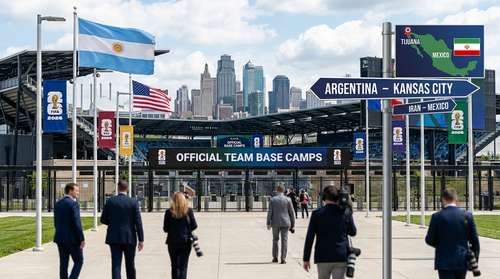
The operational map for the most expansive sporting event in history is now firmly set. On Monday, May 25, 2026, FIFA officially finalized the FIFA World Cup 2026 base camps for all 48 participating nations, wrapping up a grueling, multi-year logistical puzzle. While an overwhelming 39 squads have chosen the United States as their tournament home, the announcement was defined by two sharply contrasting narratives: the meteoric rise of the American Midwest as an elite football sanctuary, and a high-profile geopolitical standoff that forced a sudden, unprecedented border pivot.
World Cup 2026 Kansas City Training Sites Attract Global Heavyweights
The American Heartland has officially become the epicenter of international football preparation. The newly revealed FIFA 2026 team base camp locations highlight Kansas City as a massive winner in the facility sweepstakes. Thanks to its centralized geography, elite recovery infrastructure, and proximity to Arrowhead Stadium, the city successfully lured some of the sport's most storied federations away from traditional coastal hubs.
For the defending champions, the Argentina World Cup 2026 training base will be anchored in Kansas City at Sporting KC's state-of-the-art training center. Lionel Scaloni’s squad will use the Midwest facility to launch their title defense, playing two of their Group J matches locally at Arrowhead Stadium and nearby Arlington. The regional atmosphere is expected to be electric, with Arrowhead renowned for delivering one of the loudest matchday experiences in North America.
The Midwestern Football Boom
Joining the South American giants are the Three Lions. The England World Cup 2026 camp will also operate out of the Kansas City metropolitan region, ensuring the city will host an unprecedented influx of international media and supporters throughout the group stages. Beyond Argentina and England, the Netherlands has also secured local real estate, utilizing the KC Current Training Facility for their operational headquarters. What makes this Missouri hub so universally attractive? It boils down to a thriving local football culture nurtured over the last decade, high-end privacy, and the logistical ease of reaching either coast for the later knockout rounds.
The Iran World Cup 2026 Controversy: A Border Shift
While the Midwest celebrated a triumph of sports infrastructure, a starkly different narrative unfolded down south. The finalization of the base camps was completely overshadowed by the Iran World Cup 2026 controversy, which culminated in the Iranian national team abruptly relocating their headquarters from Tucson, Arizona, to Tijuana, Mexico.
Originally slated to utilize a sports complex in the Arizona desert, Team Melli faced mounting pressure and logistical roadblocks stemming from recent military escalations in the Middle East involving the U.S., Israel, and Iran. The tense situation hit a breaking point over the weekend when reports surfaced that the United States declined to host the team overnight, citing acute security concerns and unresolved visa complications for Iranian players and coaching staff.
Mexico Steps In as Last-Minute Host
In a press conference on Monday morning, Mexican President Claudia Sheinbaum confirmed that her government stepped in to accommodate the stranded squad. "The United States doesn't want the Iranian team to spend the night," Sheinbaum told reporters. "So they asked us... We said sure, no problem". FIFA swiftly approved the relocation, and Iran will now set up their daily operations at the Centro Xoloitzcuintle in Tijuana.
This forced World Cup 2026 logistics update means the Iranian squad will base themselves just across the border from San Diego. They will commute via strict security corridors to their Group G fixtures on the West Coast, which include matchups against New Zealand and Belgium at the Los Angeles stadium, and Egypt up in Seattle. Iranian Football Federation President Mehdi Taj noted that the Tijuana facility provides exclusive training pitches and private amenities, while the proximity to Southern California eases the matchday travel burden without triggering the complex U.S. visa restrictions that threatened to derail their participation entirely.
A Historic Logistics Undertaking
The sheer scale of the expanded 48-team tournament requires a level of coordination never before seen in global athletics. According to Heimo Schirgi, Chief Operating Officer for the 2026 tournament, these training facilities serve as a critical "home away from home" where players establish their daily rhythms, recover from grueling physical demands, and execute tactical preparation away from the public eye. The finalized geographical footprint ensures that the tournament's massive socioeconomic benefits stretch far beyond the 16 primary host cities.
The selection process for these elite hubs began back in 2024 with a foundational catalog of venues presented to prospective qualifiers. After the final draw in December 2025, federations rushed to secure the most advantageous time zones. The final tally reveals a sprawling continental network: 39 teams will reside in the United States, seven in Mexico—including regional heavyweights like Colombia, Uruguay, and South Korea—and two in Canada. With the base camps officially locked in, local organizing committees and federal security agencies now face the monumental task of securing these sites ahead of the opening kickoff on June 11, 2026.