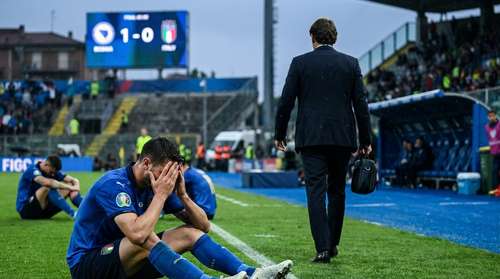
The unthinkable has become a grim reality for one of football's most storied nations. Following their shocking elimination from the 2026 World Cup qualifiers, the fallout in Rome has been swift and severe. In a historic blow to the nation's sporting pride, legendary goalkeeper Gianluigi Buffon and Italian Football Federation (FIGC) President Gabriele Gravina have both stepped down. The drastic leadership shakeup arrives just days after the disastrous Italy vs Bosnia 2026 playoff match, cementing a deepening crisis for the four-time world champions.
The Breaking Point: Italy vs Bosnia 2026 Disaster
The latest chapter in the ongoing Italy soccer crisis 2026 unfolded on March 31 at the Stadion Bilino Polje in Zenica. Seeking redemption after back-to-back qualifying failures, Italy appeared to be on the right path when they took an early lead through a stunning first-time finish by Moise Kean in the 15th minute. However, the match quickly spiraled out of control for the visitors. Alessandro Bastoni was shown a straight red card for a professional foul just four minutes before halftime, reducing the Italians to ten men and inviting immense pressure from a spirited Bosnian side.
Haris Tabakovic capitalized on the numerical advantage, poking home a deserved equalizer in the 79th minute to force extra time. When the 1-1 deadlock held, the grueling 2026 World Cup qualifiers news cycle was dominated by what happened next: a horrific 4-1 penalty shootout defeat for the Italians. Francesco Pio Esposito blasted his spot-kick over the bar, and Bryan Cristante rattled the woodwork, allowing Esmir Bajraktarevic to confidently seal Bosnia's ticket to the tournament. Bosnia now advances to Group B to face Canada, Switzerland, and Qatar, while the result etched an unwanted record into the history books. The defeat officially marks the Azzurri missing World Cup action for an unprecedented third consecutive time, making them the first former champion to endure such a horrific drought.
The Heartbreak Behind the Gianluigi Buffon Resignation
In the direct aftermath of the playoff nightmare, the Gianluigi Buffon resignation struck a poignant chord with fans worldwide. Serving as the national team's head of delegation since 2023, the 2006 World Cup-winning goalkeeper confirmed his departure on April 2. The legendary shot-stopper initially wanted to quit in the dressing room immediately after the final whistle but was persuaded to delay his announcement to allow the team and staff time to process the devastating blow.
Taking to social media, Buffon shared a deeply emotional farewell to the supporters. "Resigning one minute after the end of the match against Bosnia was an urgent act, one that came from deep within me," he wrote, citing the profound heartache he shared with millions of Italians. Buffon emphasized that stepping down was a necessary act of responsibility now that the federation's leadership was changing, ensuring that whoever takes the reins next will have the freedom to select their own staff and rebuild the squad entirely. His departure removes one of the most respected figures in global football from the Italian setup, leaving a massive leadership void.
FIGC President Resigns: A Desperate Need for Change
Buffon's decision was preceded hours earlier by another monumental shift at the top of the hierarchy: the FIGC president resigns. Gabriele Gravina, who initially took charge of the federation in 2018 following the catastrophic failure to qualify for the tournament in Russia, officially tendered his resignation during an emergency meeting in Rome on Thursday. While Gravina oversaw the glorious Euro 2020 triumph at Wembley Stadium, that victory now feels like a distant anomaly sandwiched between two World Cup qualifying disasters.
Facing immense political and public pressure—including direct calls for an immediate overhaul from Italy's Sports Minister Andrea Abodi—Gravina acknowledged that the federation desperately needs a fresh start. Abodi did not mince words, stating clearly that Italian soccer needs to be completely overhauled from the top down. The FIGC has already announced that elections to appoint Gravina's successor will take place on June 22. Giovanni Malago, the former head of the Italian Olympic Committee, has emerged as an early frontrunner for the crucial post.
Gattuso's Future Hangs in the Balance
With Gravina and Buffon exiting the stage, the focus has immediately shifted to the dugout and head coach Gennaro Gattuso. Installed under Gravina's leadership, Gattuso's position is now widely considered untenable. The entire technical staff, reportedly including assistant Leonardo Bonucci, is on the verge of being dismantled as the federation prepares for sweeping institutional reforms.
Rebuilding from the Italy Soccer Crisis 2026
The current Italy soccer crisis 2026 extends far beyond the pitch and the starting eleven. While the immediate pain of the Italy World Cup 2026 absence dominates headlines, systemic issues plague the domestic game. UEFA President Aleksander Ceferin recently warned that Italy risks losing its status as co-host for the 2032 European Championship if the nation fails to urgently upgrade its crumbling stadium infrastructure, further highlighting the deep-rooted administrative decay.
The road ahead for the four-time world champions will be arduous. By the time the 2030 tournament rolls around, Italy will have endured a staggering 16-year absence from football's grandest stage, having not played a knockout match at the World Cup since they lifted the trophy in 2006. As a new era of leadership prepares to take the helm this summer, they will inherit a shattered footballing landscape. For a nation where soccer is practically a religion, the immediate priority will be restoring faith, completely overhauling youth development, and ensuring that this historic sporting tragedy is never allowed to happen again.