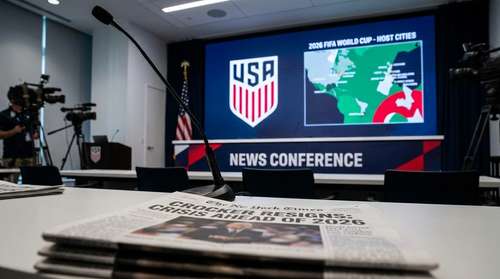
The American sports landscape has been rocked by the sudden Matt Crocker resignation, throwing the nation's soccer federation into a tailspin. With merely 50 days remaining before the massive tournament kicks off across North America on June 11, the departure of the U.S. Soccer Sporting Director has sparked a severe US Soccer leadership crisis. Fans seeking the biggest U.S. Soccer news today are left wondering how this executive void will impact the men's national team right when stability is needed most.
The Details Behind the Executive Departure
Matt Crocker, the 51-year-old Welsh executive who took the reins of U.S. Soccer in April 2023, officially stepped down on April 14 to pursue an international soccer opportunity in Saudi Arabia. During his transformative tenure, Crocker fundamentally reshaped the federation's sporting vision. He was the chief architect behind securing high-profile managers, successfully recruiting Emma Hayes for the women's squad—leading directly to their incredible 2024 Olympic gold medal run in Paris—and pulling off a massive coup for the men's side.
The timing of the Matt Crocker resignation has drawn heavy criticism from pundits and former national team players alike. Former U.S. goalkeeper Kasey Keller publicly questioned the move, noting that it "makes zero sense" to leave mere weeks before the tournament. Similarly, analyst Alexi Lalas dubbed the departure an "own goal" for the federation, highlighting the negative message it sends to the global soccer community. As the latest American soccer federation updates confirm, interim leadership falls to Chief Operating Officer Dan Helfrich, alongside Assistant Sporting Director Oguchi Onyewu and Head of Women's Youth Development Tracey Kevins, to steady the ship.
How This Impacts World Cup Preparations
This executive disruption arrives at the absolute worst possible time for USMNT World Cup 2026 preparations. The United States is slated to open its highly anticipated group stage campaign on June 12 against Paraguay at SoFi Stadium in Los Angeles. Subsequent massive fixtures against Australia on June 19 at Lumen Field in Seattle and Turkey back in Los Angeles on June 25 mean the pressure cooker is already at maximum capacity for the squad. Fans eagerly tracking the U.S. Soccer news today are expressing deep concern over the timing.
Without a sporting director to run interference, handle complex logistical hurdles, or buffer the intense media glare, the entire technical staff faces an unprecedented challenge. A sporting director traditionally acts as the general manager of the national team, insulating the playing squad from administrative distractions. The Matt Crocker resignation removes that vital safety net, leaving federation executives scrambling to project stability. While Helfrich has publicly maintained that there will be "zero impact" on the team's readiness, a sudden organizational shakeup undeniably alters the atmosphere in the training camps just as final preparations are underway.
Will the Head Coach Dynamic Shift?
When analyzing the on-field product, the spotlight intensely focuses on the Mauricio Pochettino coach dynamic. Crocker personally spearheaded the recruitment of the former Chelsea, Tottenham, and Paris Saint-Germain boss in September 2024. Over the past year and a half, Pochettino has worked tirelessly to build a high-pressing, attacking identity with core European-based stars like Christian Pulisic and Weston McKennie.
Now, Pochettino must navigate the most high-stakes tournament of his prestigious international managerial career without his primary advocate in the front office. While the Argentine manager and his dedicated coaching staff maintain full control over tactical decisions and roster selections—having recently called up a strong 27-player squad for the crucial March friendlies against Belgium and Portugal—the sudden absence of a sporting director removes a key collaborative partner. If the US Soccer leadership crisis bleeds onto the pitch and the team stumbles under the immense pressure of playing on home soil, the structural weakness above the head coach will undoubtedly become a primary point of contention.
Looking Ahead: Host Cities Await
Despite the boardroom turmoil dominating the headlines, the massive tournament machine marches on without delay. The 2026 FIFA World Cup host cities are finalizing their preparations for what is guaranteed to be the largest sporting event in history. Featuring an expanded format of 48 teams and 104 matches across the United States, Canada, and Mexico, the logistical scale of this summer is staggering. From the world-class facilities in Atlanta to the championship final slated for July 19, the venues are primed to showcase the global game to an unprecedented audience.
The United States possesses a generational opportunity to cement soccer's place in the American cultural fabric permanently. While the front office drama and the fallout from the Matt Crocker resignation are currently capturing the news cycle, the ultimate success of this entire four-year cycle will be judged exclusively by what happens on the pitch starting this June. The federation has already launched a comprehensive domestic and global search for a permanent successor. Their immediate priority is ensuring that this executive disruption remains a mere footnote, rather than the defining story of their biggest summer.