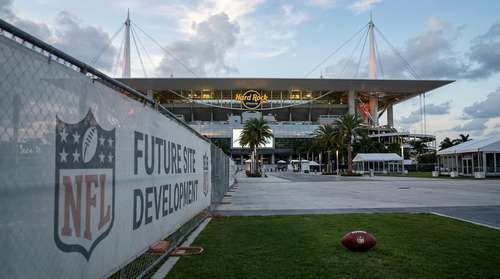
For decades, South Florida has been a cornerstone of professional football's biggest game, operating on a reliable cycle that brought the championship down south every handful of years. But a bombshell announcement this week has abruptly halted that legacy. The city has officially been pulled from the NFL Super Bowl rotation 2026 and beyond. Miami Dolphins owner Stephen Ross confirmed the surprising development, revealing that the very upgrades that turned the area into a year-round global sports hub have inadvertently disqualified it from hosting the Lombardi Trophy.
The issue doesn't lie with the seating capacity, the recently renovated canopy roof, or the field itself. Instead, it comes down to modern logistics. As the league's spatial demands continue to balloon, the Hard Rock Stadium NFL requirements are no longer being met due to a severe lack of surrounding real estate needed for the league's massive sponsor and fan villages.
Why Miami Lost the Super Bowl: Space and Infrastructure
If you're wondering exactly why Miami lost the Super Bowl, the answer is parked right outside the stadium's front doors. Over the past few years, the sprawling parking lots and open grounds surrounding the venue in Miami Gardens have been heavily developed to accommodate two highly lucrative, recurring international events: the Miami Open tennis tournament and the Formula 1 Miami Grand Prix.
Permanent infrastructure was installed to ensure these global spectacles run smoothly. The F1 track weaves directly around the stadium, featuring permanent paddock buildings, hospitality suites, and trackside grandstands. Similarly, the Miami Open utilizes dozens of outer courts built directly onto the stadium's campus. However, those structural additions consumed the vast, empty acreage that the NFL absolutely requires for its sprawling, multi-day pregame events.
Current NFL stadium hospitality standards dictate that a host city must provide enormous operational footprints. The modern Super Bowl is no longer just a Sunday football game; it is a week-long corporate retreat. The league demands an expansive blank canvas to construct VIP hospitality tents, massive sponsor activations, broadcast media compounds, and sprawling security perimeters. By transforming the grounds into a bustling multi-sport campus, Hard Rock Stadium simply ran out of room.
Stephen Ross Dolphins News: Ownership Searches for a Fix
Addressing the situation at a business conference at the Four Seasons in Brickell on Thursday, the Dolphins owner laid bare the current reality. In the latest Stephen Ross Dolphins news, he told the South Florida Business Journal that the franchise normally expects to host a championship every five years, but they are currently on the outside looking in.
"The one thing that suffered is Miami hasn't gotten a Super Bowl here, and we normally have one every five years," Ross admitted to the attendees. "Miami is not really in line for one. It's always exciting to have the Super Bowl but that was before we had all the other events... at this point they don't believe we meet all the requirements and the demands."
Exploring New Renovations for Hospitality Needs
Despite the setback, the front office isn't entirely giving up on bringing the big game back to South Florida. Ross and Relevent Sports Group CEO Daniel Sillman are already evaluating potential remedies. The stadium previously underwent a massive, $500 million renovation to add an open-air canopy roof after notorious rain-soaked games in the late 2000s. Ownership is once again exploring a "next phase" of property improvements to figure out how to satisfy the stringent hospitality requirements without sacrificing their incredibly lucrative F1 or tennis contracts.
Future Super Bowl Locations: The Shift to Mega-Venues
Miami's exclusion highlights a broader shift in the league's hosting model. As multi-billion dollar, purpose-built stadiums rise across the country, the competition for the game has intensified. The league's confirmed slate of future Super Bowl locations reflects an undeniable preference for massive, modern entertainment districts that essentially function as self-contained cities.
The upcoming championship schedule is already locked in through the end of the decade, and South Florida is noticeably absent from the list:
- 2027 (Super Bowl LXI): SoFi Stadium in Inglewood, California
- 2028 (Super Bowl LXII): Mercedes-Benz Stadium in Atlanta, Georgia
- 2029 (Super Bowl LXIII): Allegiant Stadium in Las Vegas, Nevada
There is also mounting speculation that Nashville will host the 2030 game to coincide with the opening of the Tennessee Titans' new enclosed stadium. The trend is clear: cities investing heavily in brand-new, publicly subsidized stadium complexes—like Los Angeles and Las Vegas—are monopolizing the calendar, putting extreme pressure on legacy markets to keep pace.
The Legacy of Miami Super Bowl Hosting
Losing out on the title game represents a massive economic shift for South Florida. Historically, Miami Super Bowl hosting has been a reliable engine for the local tourism and hospitality sectors. The city has hosted the game a record-tying 11 times, sharing the top spot only with New Orleans. The area's deep ties to the event date all the way back to the Orange Bowl in 1968, 1969, and the 1970s.
The most recent championship played at Hard Rock Stadium was Super Bowl LIV in February 2020, where Patrick Mahomes and the Kansas City Chiefs defeated the San Francisco 49ers. With the schedule booked through at least 2029, the gap between Miami's hosting duties will easily exceed a decade, eclipsing the previous 10-year drought they faced prior to their canopy roof installation.
Ross correctly noted this week that Miami still boasts "by far the best weather" of any potential host city. But in the modern landscape of professional football, idyllic sunshine is no longer enough to secure a bid. Until the Dolphins organization can engineer a spatial compromise between their permanent racing paddocks, tennis courts, and the NFL's hospitality behemoth, the league's biggest spectacle will stay away from South Florida.