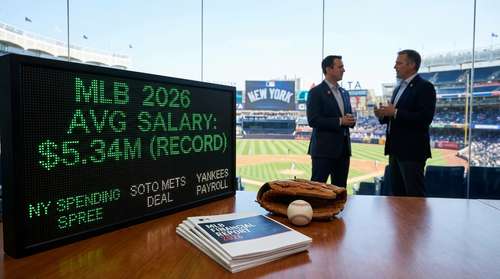
In the latest MLB financial news 2026 released just yesterday, the economics of America's pastime have officially entered uncharted territory. According to the annual Opening Day payroll analysis published on April 10, the MLB average salary 2026 has surged to a record-breaking $5.34 million. This landmark figure represents a dramatic leap from previous seasons, largely fueled by mega-deals in major markets, including a blockbuster Juan Soto Mets contract and massive commitments from the Bronx Bombers.
As the 2026 season gets underway, the financial gap between baseball's juggernauts and its small-market franchises has never been more pronounced. Here is a closer look at the historic spending spree that pushed the league's average compensation to unprecedented heights over the last 48 hours of reporting.
The Benchmark: Juan Soto's Record-Shattering $61.9M
When evaluating the highest paid MLB players 2026, one name stands alone at the top of the mountain. New York Mets superstar Juan Soto commands a staggering $61.9 million annually, cementing his status as the sport's ultimate financial outlier.
The Juan Soto Mets contract completely redefined the market for elite talent. Under billionaire owner Steve Cohen, New York Mets spending has consistently defied traditional budgeting constraints, but Soto's compensation package represents a new era of payroll flexibility. By paying a single player nearly $62 million for the 2026 campaign, the Mets have effectively inflated the league's overall average, setting a daunting precedent for future free agents. Soto's unique blend of elite plate discipline and generational power makes him worth every penny to a franchise desperate to secure a World Series title.
Cody Bellinger and the Yankees' Counter-Strike
Not to be outdone by their cross-town rivals, the New York Yankees have contributed heavily to the rising MLB average salary 2026. The most notable recent commitment was securing star outfielder and designated hitter Cody Bellinger.
The Cody Bellinger Yankees partnership was solidified earlier this year when the front office signed the veteran to a five-year, $162.5 million contract, complete with a $20 million signing bonus and player opt-outs. Bellinger, who put up a stellar 5-WAR season in pinstripes with 29 home runs in 2025, provides vital left-handed power to complement reigning AL MVP Aaron Judge.
This aggressive investment pushed the Yankees' projected Competitive Balance Tax (CBT) payroll to approximately $317.8 million. Keeping Bellinger in the Bronx wasn't just a roster move; it was a definitive financial statement that the Yankees will not quietly concede the spending crown to Queens.
How Super-Teams Dominate the MLB Payroll Rankings
The latest revelations in MLB financial news 2026 highlight a fascinating dynamic within current MLB payroll rankings. While the $5.34 million average salary sounds uniformly luxurious, it is heavily skewed by the top-heavy spending of a few select franchises.
The New York-Los Angeles Axis
At the summit of the MLB payroll rankings, the Los Angeles Dodgers, New York Mets, and New York Yankees are operating in a completely different financial stratosphere. The Dodgers continue to carry a CBT payroll exceeding $402 million, while the Mets sit comfortably around $375 million. When you combine extreme New York Mets spending with the massive guaranteed deals handed out by Los Angeles and the Yankees, the mathematical average is pulled sharply upward, even if median salaries across the league haven't experienced the same aggressive growth.
The Ripple Effect on Mid-Market Clubs
For mid-market and small-market teams, navigating this economic landscape requires immense creativity. While superstars enjoy $61.9 million annual paychecks, the league minimum remains set at $780,000 for the 2026 season. Front offices for teams like the Tampa Bay Rays or Baltimore Orioles are forced to rely heavily on pre-arbitration talent and analytical advantages rather than engaging in nine-figure bidding wars for the highest paid MLB players 2026.
What This Means for Baseball's Future
As we digest the reality of an MLB average salary 2026 sitting at $5.34 million, the sport's financial trajectory shows absolutely no signs of cooling. The massive investments in players like Juan Soto and Cody Bellinger demonstrate that large-market ownership groups believe the return on investment—through regional sports networks, global merchandising, and ticket sales—justifies these astronomical roster costs.
For fans, this historic spending spree means that the concentration of superstar talent in major markets will likely persist. The Juan Soto Mets contract and the massive Cody Bellinger Yankees deal are just the latest chapters in baseball's ongoing financial arms race. As long as league revenues continue to climb in 2026, we can expect today's benchmarks to serve as mere stepping stones for the mega-deals of tomorrow.