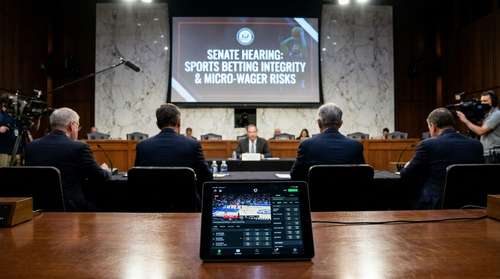
WASHINGTON — The future of online wagering faced intense scrutiny on Thursday as a high-stakes Senate sports betting hearing zeroed in on what lawmakers describe as a rapidly deteriorating environment for consumer protection. The May 21, 2026, subcommittee session featured blistering questions directed at industry executives regarding the aggressive proliferation of predatory micro-wagers and a wave of sports betting cheating scandals that have rocked the digital ecosystem.
At the center of the legislative crosshairs are both traditional sportsbook operators and the rapidly expanding decentralized prediction markets. The hearing laid bare a growing bipartisan appetite for strict federal oversight, largely driven by concerns that current regulatory frameworks are fundamentally unequipped to police split-second wagers and sophisticated insider trading rings.
The 'Prediction Markets Are Gambling Act' Takes Center Stage
Much of Thursday's session revolved around the Prediction Markets Are Gambling Act, a bipartisan bill introduced earlier this year by Senators Adam Schiff and John Curtis. The proposed legislation seeks to amend the Commodity Exchange Act to explicitly prohibit CFTC-registered entities from listing any event contracts that resemble sports bets or casino-style games.
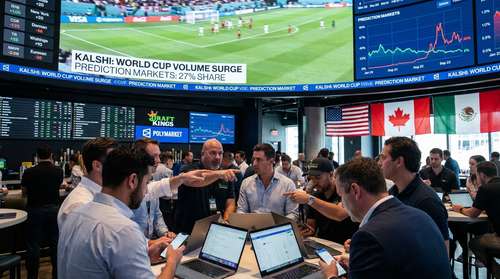
If passed, the law would severely restrict platforms like Kalshi and Polymarket from offering wagers on live sports outcomes, forcing a massive shift in US sports betting regulation 2026. Traditional industry heavyweights used the hearing to hammer their decentralized competitors. The American Gaming Association (AGA) submitted compelling testimony branding prediction platforms as "backdoor betting operations" that deliberately bypass the consumer protections maintained by state and tribal regulators.
Bill Miller, CEO of the AGA, stressed that thousands of industry regulators work daily to ensure match integrity and shield bettors from fraud—a system he claims is entirely undermined by pseudo-financial exchanges masquerading as commodity derivatives.
Clashing Over Federal vs. State Authority
The hearing arrives during a massive flashpoint for decentralized betting. Just one day prior, Minnesota Governor Tim Walz signed the nation's first state law criminalizing prediction markets, a move that prompted an immediate federal lawsuit from the Commodity Futures Trading Commission (CFTC). This jurisdictional tug-of-war has left the Polymarket legal status, and that of its domestic rival Kalshi, hanging in the balance while they fight a two-front war against state criminal bans and federal legislative threats.
Unpacking the Sports Betting Cheating Scandals
Beyond regulatory turf wars, lawmakers interrogated industry leaders over a stark drop in sports gambling integrity. Recent global investigations have cast a long, damaging shadow over the sector. Most notably, a sprawling probe recently identified more than 11,000 accounts on Polymarket exhibiting highly suspicious betting patterns.
Lawmakers cited instances of impeccably timed long-shot wagers and sudden capital influxes from newly created accounts right before major sporting and geopolitical outcomes. These anomalies bear all the hallmarks of organized insider trading rings exploiting the liquidity of decentralized platforms. Witnesses at the hearing admitted that detecting bad actors on blockchain-based betting platforms remains incredibly challenging due to pseudo-anonymity and cross-border enforcement hurdles.
The global heat is also rising. India's technology ministry recently warned that prediction platforms fall under prohibited online money games, yet offshore sites continue to facilitate tens of millions of dollars in trading volume on Indian Premier League cricket matches. The Senate committee pointed to these international violations as evidence that the platforms operate with impunity.
The Micro-Betting Controversy and Youth Marketing
Perhaps the most contentious exchanges of the afternoon focused on the micro-betting controversy. Micro-betting—allowing users to wager on granular, split-second in-game events like the outcome of the next pitch in baseball or the result of a single basketball free throw—has exploded in popularity. Addiction specialists at the hearing testified that the dopamine loops created by these high-frequency wagers closely mirror those of electronic slot machines.
Compounding the legislative outrage is how these products are marketed to young audiences. Senators tore into platforms for employing viral advertising tactics aimed at younger demographics. Unlike heavily regulated traditional sportsbooks which largely restrict usage to adults over 21, some prediction markets allow users as young as 18 to trade contracts.
Lawmakers presented evidence of aggressive social media campaigns, including a highly criticized advertisement where a young user claimed she paid two years of rent simply by trading on Kalshi. Critics and former industry insiders warned executives that the sector is careening toward a "Juul-style reckoning" if it continues to employ youth-focused marketing tactics wrapped in the guise of financial empowerment.
What Lies Ahead for the Wagering Ecosystem
Thursday's hearing made one thing abundantly clear: the regulatory grace period for experimental wagering platforms has officially expired. With state attorneys general actively investigating operators and federal lawmakers finding rare bipartisan consensus, the Wild West era of the industry is rapidly closing.
Whether the crackdown materializes through the swift passage of the Schiff-Curtis bill, a sustained barrage of state-level criminalization, or tightened CFTC enforcement, betting giants are facing an existential threat to their current operational models. As Washington tightens its grip, these platforms will have to prove they can guarantee market integrity and protect vulnerable consumers—or risk being regulated out of existence entirely.