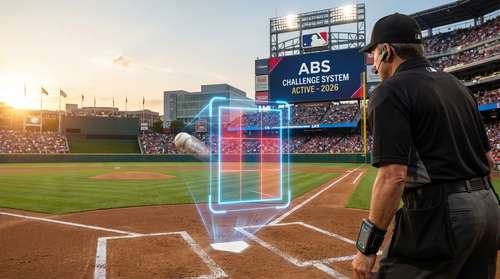
Baseball purists and technology advocates are finally finding common ground. On Wednesday, March 25, when the New York Yankees travel to Oracle Park to face the San Francisco Giants, professional baseball will officially usher in its most monumental officiating overhaul in history. The highly anticipated arrival of MLB robot umpires 2026 is here. Following years of minor league testing, the league is formally introducing the Automated Ball-Strike System (ABS) for the entire regular season.
The Dawn of the Automated Ball-Strike Era
For over a century, the human element behind home plate has been fiercely defended and widely debated. Blown calls and heated manager ejections have become woven into the fabric of the sport. However, any comprehensive MLB 2026 season preview reveals a major shift: the league's 11-man competition committee overwhelmingly approved the implementation of ABS last September, paving the way for this week's historic rollout.
Rather than completely replacing human umpires, the league struck a vital compromise. Human plate umpires will still call every pitch. The crucial difference is that players now hold the power to appeal questionable calls directly to an advanced camera network. This hybrid approach preserves the subtle art of catcher pitch-framing while ensuring high-leverage moments aren't derailed by blatant human error.
Mastering the MLB ABS Rules and Challenge System
If you are tuning in for the first time this season, understanding the new MLB ABS rules is essential. The setup functions purely as a baseball umpire challenge system. Here is exactly how the protocol will unfold during live play:
- The Allocation: Each team is granted two challenges per game. Teams that retain their challenge upon a successful overturn keep it. Those who burn their challenges will receive one additional appeal during each extra inning.
- The Initiator: Only the batter, pitcher, or catcher involved in the play can challenge a call. They do so by simply tapping their helmet or cap.
- The Time Limit: The player has a strict two-second window to signal the umpire. Assistance from the dugout iPad or video room is strictly prohibited, meaning the decision rests entirely on the players' instincts on the field.
- The Resolution: Once initiated, a digital graphic of the pitch's trajectory plays on the stadium scoreboard and television broadcast. The entire process takes roughly 17 seconds.
A 2D Strike Zone and Hawk-Eye Technology
Behind the scenes, the Automated Ball-Strike System is an engineering marvel. The operation relies on Hawk-Eye Innovations' sophisticated optical tracking cameras and a dedicated, private 5G network to transmit data almost instantaneously.
Interestingly, the computer's strike zone is not the three-dimensional volume described in traditional rulebooks. Instead, the ABS registers a flat, two-dimensional plane located exactly at the midpoint of home plate (8.5 inches from the front). To ensure complete fairness, every player in the league was measured without shoes during spring training. The system dynamically adjusts to each batter, setting the top of the strike zone at 53.5% of their height and the bottom at 27%. If any part of the baseball grazes this virtual rectangle, it's a confirmed strike.
Opening Day 2026: Yankees vs. Giants Makes History
The global spotlight will be locked on San Francisco for Opening Day 2026. This standalone Wednesday night matchup between the Yankees and Giants is not just a battle of historic franchises; it is the ultimate proving ground for these MLB technology changes.
Millions of fans streaming the game globally on Netflix will witness the first official regular-season ABS challenge. When an elite pitcher like San Francisco's Logan Webb paints the corner against a prolific slugger like Aaron Judge, the margin for error will be nonexistent. On the other side, Yankees' Opening Day starter Max Fried will have his elite breaking pitches subjected to the robotic zone. The sheer theater of a late-inning strikeout being overturned by a digital overlay is expected to add a thrilling new layer of fan engagement to the sport.
The Future of Officiating and MLB Technology Changes
This evolution is not an isolated experiment. It represents the culmination of a broader initiative to modernize baseball, following the successful implementation of the pitch clock and defensive shift restrictions.
Minor league data from the past three years indicates that this hybrid challenge format significantly reduces ejections related to ball-and-strike arguments. With the power in the players' hands, the vitriol directed at umpires should naturally dissipate, keeping the focus squarely on athletic performance.
As the umpire yells "Play Ball" on March 25, the game will change forever. The integration of advanced tracking technology proves that baseball can respect its storied past while aggressively embracing the future. Whether you are a traditionalist or a tech enthusiast, the robot umpire era promises a fairer, faster, and infinitely more fascinating season.